
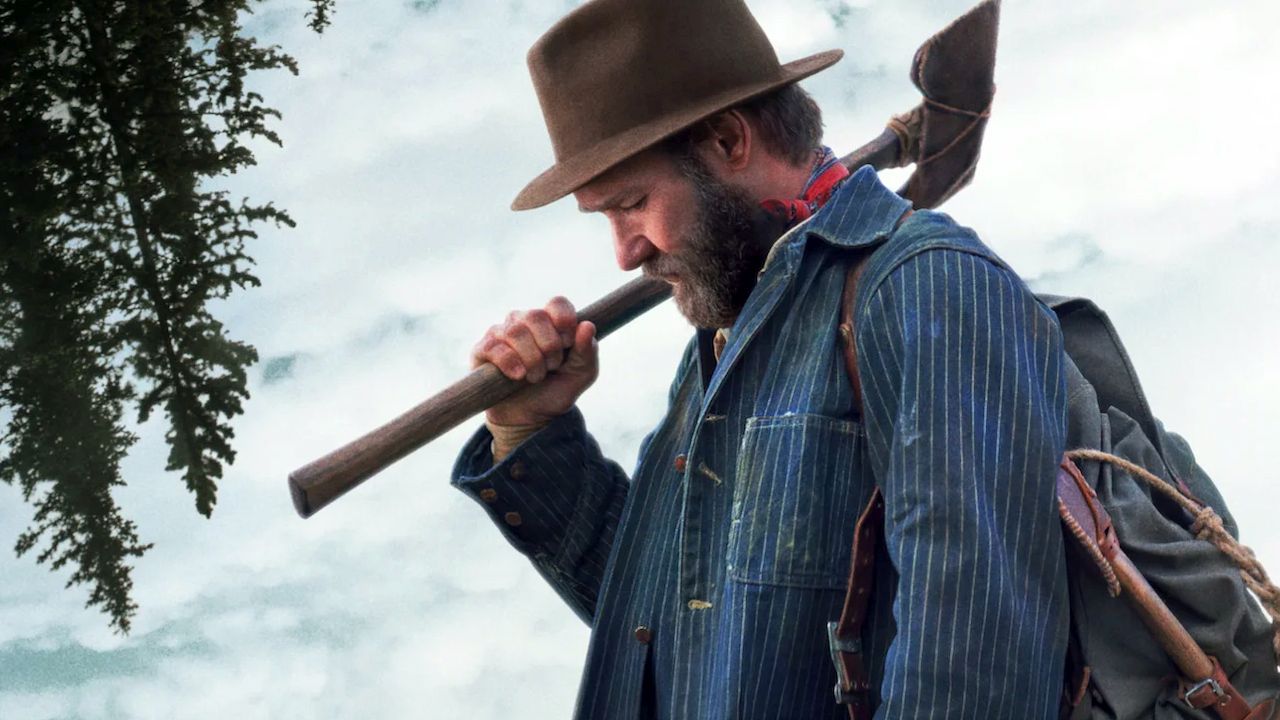
FILM REVIEW – Clint Bentley’s latest film approaches its subject with rare patience, assembling the life of a logger from fragments, impressions, and half-remembered moments. Love, loss, and guilt become inseparable from the land itself, etched into forests and mountains just as deeply as into the people who inhabit them. Adapted from Denis Johnson’s novella and now available on Netflix, the film rejects conventional plot-driven storytelling in favor of a slow, immersive experience that quietly leads the viewer toward a deeper understanding of how all things are bound together.
First unveiled at the Sundance Film Festival, the film was later picked up by Netflix. The deal guarantees visibility, but it also comes with a sense of compromise, because this is a film that clearly longs for the scale and presence of a cinema screen. Its running time is tight, yet it carries a sense of breadth and gravity that feels almost epic, shaped by sound, light, and the sheer physical weight of the forests it inhabits. The casting choices are restrained and exact. Joel Edgerton constructs his performance through subtle shifts and silences, while Felicity Jones appears in a fragile, almost luminous register that turns her presence into something remembered rather than simply observed.

When the Past Still Felt Within Reach
Train Dreams opens by evoking a world that no longer exists. A narrator recalls a time when the past felt closer, when a single turn could confront someone with something unknowable. The images that follow show tunnels, dense woodland, a pair of boots lodged inside a tree trunk, and a towering spruce falling slowly toward the ground. These shots do not explain themselves. Instead, they establish the film’s rhythm and intent. What unfolds is not a sequence of events, but a flow of memories and sensations that gradually begin to cohere.
At its core, the film traces an unremarkable life. Robert Grainier is an orphan who ends up in a small Idaho town around the turn of the twentieth century and spends his years performing grueling physical labor. He works as a logger and sawyer, cutting timber for World War I and for the rapidly expanding network of American railways and bridges. Grainier is not educated and not inclined toward introspection, yet he occasionally voices simple thoughts that carry surprising weight. Lying beside Gladys on the banks of the Moyie River, he remarks that, in that moment, he feels as if he could almost understand everything about the world.

The Epic Lives in the Details
Visually and sonically, the film is deeply affecting. It is not a long feature, but it possesses a sense of scale that feels far larger than its duration. Ancient forests stretch to the edges of the frame, while the landscape shifts between dusty mountains, mist-filled horizons, and stretches of scorched, lifeless ground. In close-up, the weathered faces of the men resemble uncharted terrain. In many films, physical labor is little more than costume and posture. Here, lit by campfires and filtered through heavy canopies, the workers feel both grounded in reality and faintly mysterious.
This harsh, smoke-saturated environment stands in contrast to Grainier’s idea of home, or rather to the version of home that lives in his memory. His work continually pulls him away from his family, and he drifts through visions of his wife and daughter that grow increasingly abstract as time passes. The violence of the world feeds into this longing. As a young man, Grainier witnesses the brutal removal of Chinese immigrants, and the narration notes his shock at how ordinary such cruelty appears. With time, however, he cannot claim complete innocence. When a Chinese coworker is seized during a job, Grainier desperately asks what the man has done, yet he ultimately fails to stop the others from carrying him across a bridge and throwing him to his death.
The image of the murdered man haunts Grainier for the rest of his life, but the film extends its gaze beyond personal guilt. It also questions the moral cost of the work itself. At one point, Grainier wonders whether the wrongs people commit follow them forever. The question encompasses both his private failures and the relentless cutting and shaping of the land that sustains him. He survives by destroying his surroundings, and he knows he cannot continue indefinitely. To most of the workers, the forests of the Pacific Northwest seem inexhaustible. A gaunt, eccentric explosives expert, played by a nearly unrecognizable William H. Macy, offers a different perspective, observing that the world is delicately interwoven and that pulling on one thread inevitably alters the entire pattern. Later, as Grainier grows increasingly disconnected from the mechanized and impersonal nature of his labor, he passes a dead bear lying atop a stack of logs, a blunt reminder that attempts to master the wilderness always end in damage.
When Only Longing Remains
Like its protagonist, Train Dreams moves forward by drifting, carried along by time much like a simple bowl floating downstream, an image that appears briefly and returns later in reflection. Comparisons to Terrence Malick are almost unavoidable, particularly in the film’s approach to nature, as are echoes of works such as Andrew Dominik’s The Assassination of Jesse James by the Coward Robert Ford. Viewers might also be reminded of Tarkovsky’s Andrei Rublev, Jun Ichikawa’s Tony Takitani, or Kubrick’s Barry Lyndon. The film contains no shortage of incident, including gunfire, sudden deaths, and a devastating forest fire, yet it never settles into a traditional narrative shape. Through Edgerton’s quietly tormented performance, Will Patton’s measured narration, Adolpho Veloso’s attentive cinematography, and Bryce Dessner’s restrained, trembling score, the film draws us into Grainier’s unspoken desire for peace and meaning.
Ultimately, the film gestures toward the nature of transcendence itself. It suggests that the shape of the world often becomes clear only when it is too late to change it. As a dying man looks out into the gathering night, he says simply, “It’s beautiful.” When asked what he means, he replies, “All of it. Every last bit.” That exchange captures the spirit of the entire film. This is not a work meant to be skimmed or consumed casually. It asks for time, attention, and space, and it rewards those who give it exactly that.
-Herpai Gergely “BadSector”-
Train Dreams
Direction - 8.4
Actors - 8.2
Story - 7.6
Visuals/Music/Sounds - 9.2
Ambience - 8.8
8.4
EXCELLENT
Train Dreams constructs a quietly devastating portrait of early twentieth-century America through the fragments of one ordinary life set against a vanishing natural world. Clint Bentley’s film expresses guilt, grief, and longing through rhythm and imagery rather than exposition, anchored by Joel Edgerton’s restrained performance. It is a drama that reveals its power slowly, staying with the viewer long after it ends.










Leave a Reply