
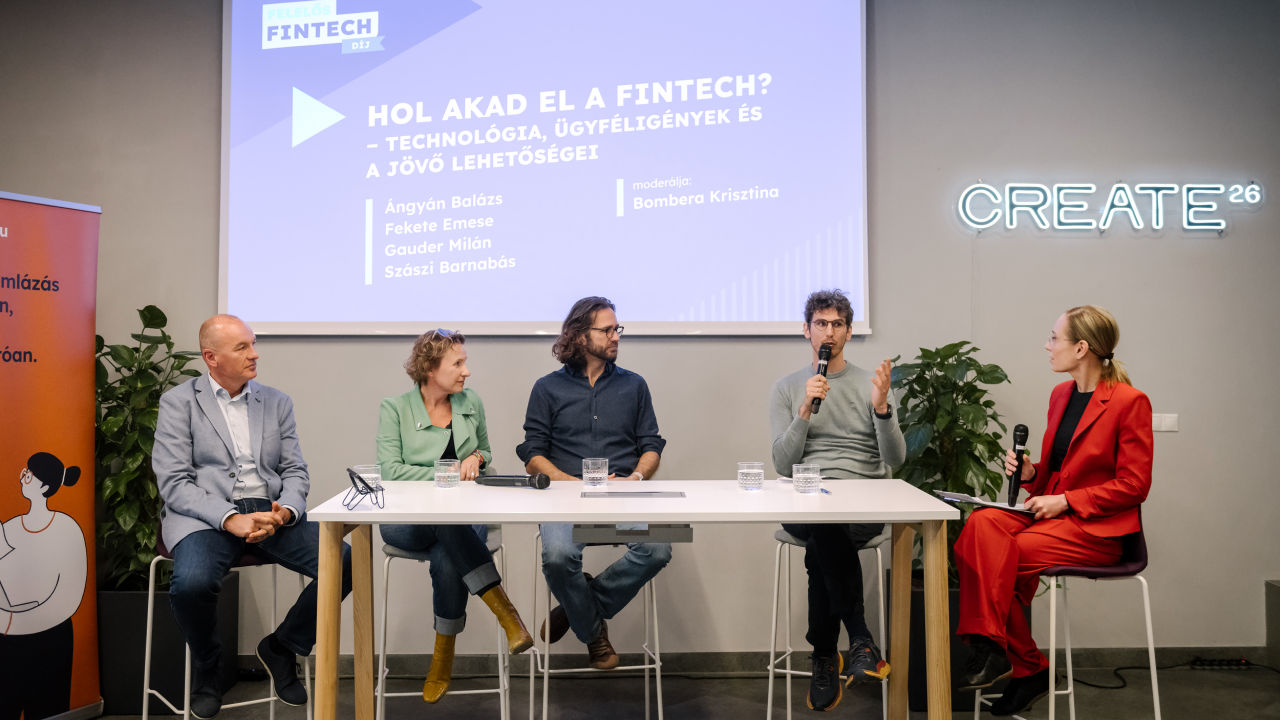
Digital invoicing, online accounting, neobanks, instant payments, and automated administration are spreading quickly across everyday life, yet fintech still has not delivered a true mass-market breakthrough. A recent roundtable hosted by Számlázz.hu in Budapest argued that technology alone is not enough – users also need to feel that these tools were actually built for them.
Fintech is no longer a niche subject. From digital invoicing and online bookkeeping to instant payments and automated back-office tasks, financial technology tools are showing up in more and more areas of daily life, often at little or no direct cost to the user. On paper, that should have been enough to trigger a much broader adoption wave by now. In reality, however, the picture remains slower and more cautious. That was the central issue at a Budapest roundtable organized by Számlázz.hu, where participants discussed how technology can be brought closer to real business needs and what role innovation and artificial intelligence now play in the sector.
The discussion made one thing clear: fintech’s future will not be determined only by how fast the technology evolves, but also by when people start to believe that these solutions are genuinely meant for them. “The future of fintech does not depend on what the technology can do, but on when people start believing it was really built for them,” said Emese Fekete, deputy editor-in-chief of Forbes Hungary. In her view, the media also carries real responsibility here. Instead of repeating specialist jargon, it should explain in clear and critical language what a given solution replaces, when it helps, and how it should be used. In other words, fintech has not only a product problem, but also a translation problem: how do you turn technical innovation into something people can recognize as relevant to their own lives?
Tech investor and philanthropist Milán Gauder argued that the most exciting fintech fields usually emerge where the old systems are visibly flawed or incomplete. International payments are an obvious example, he said, because they remain slow, expensive, and unpredictable. Fraud prevention is another. “The fintechs that can be successful are the ones that connect to a larger infrastructure and solve a customer problem or create a convenience service,” Gauder said. In other words, fintech does not break through simply because it sounds innovative. It breaks through when it removes friction, saves time, or makes an old problem less painful.
But rational value is not always enough. According to Barnabás Szászi, head of the ELTE Behavioral Science Lab, one of the biggest obstacles to fintech adoption is human nature itself. “People are naturally attached to what they already know,” he said. What feels familiar also feels less risky. It does not have to be learned from scratch, and in some cases users may even have an emotional attachment to it. In business, efficiency is usually treated as the main selling point, and fintech often tries to sell exactly that. But that does not automatically mean efficiency is a decisive argument for every user. If someone does not feel that a new system brings a real qualitative improvement, they may still stay with the older and less efficient one. This is especially visible in the business segment: participants agreed that while fintech adoption is more visible on the consumer side, companies tend to switch more slowly, and often only move decisively when an outside force – such as regulatory change – pushes them to act.
Balázs Ángyán, managing director of Számlázz.hu, argued that the sector also makes things harder for itself. “Fintech is a fast-changing industry in which it is often difficult not only to understand the underlying technology, but even to understand what exactly is being offered to the customer,” he said. The arrival of AI is accelerating this process in front of our eyes while also making the industry even more complex. In such an environment, it is easy for insiders to turn into a closed circle that talks comfortably among itself about complicated issues while ordinary users have already lost the thread. That may be the most important takeaway from the discussion. The next big leap for fintech may not depend on another technical breakthrough. It may depend much more on whether the sector can remain human, communicate clearly, and convince users that it is not just throwing yet another system at them, but actually taking something off their shoulders. So yes, fintech can make life easier – but only if it is not just efficient, but also understandable, usable, and trustworthy. Until then, the promise of convenience and the feeling of anxiety may continue to grow side by side.















Leave a Reply