
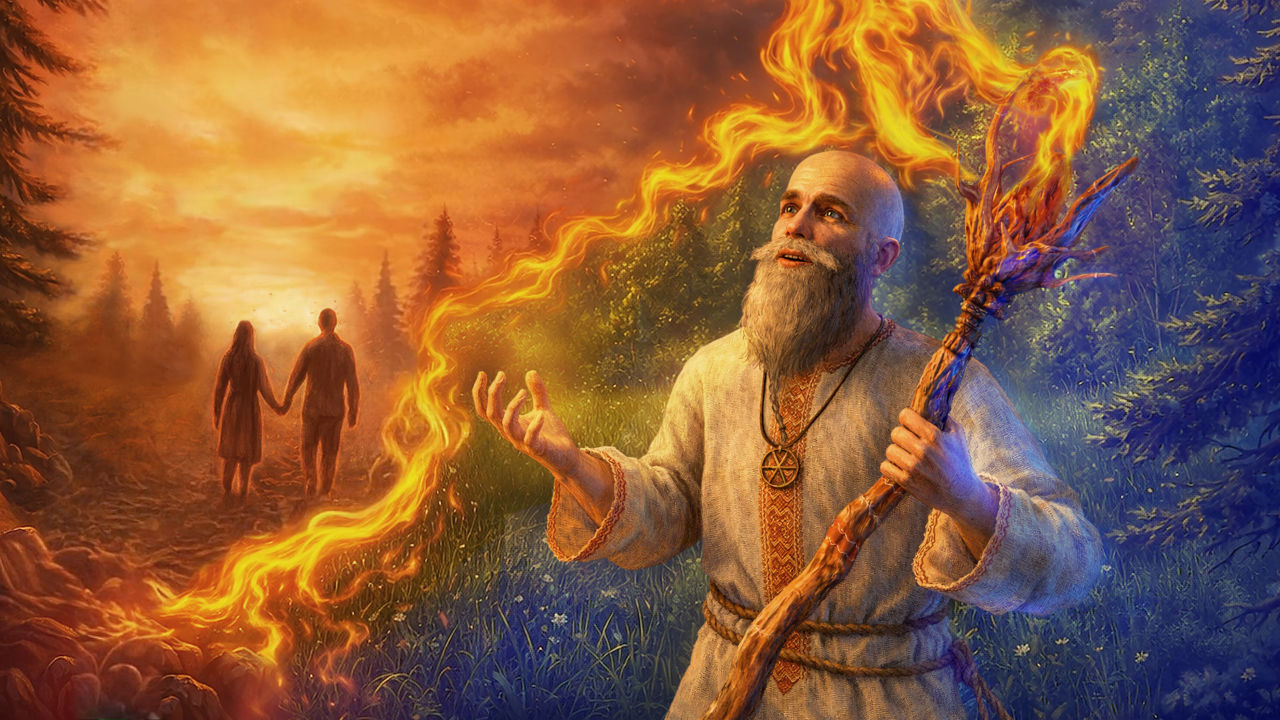
REVIEW – When just two developers create a game, that’s no small feat. It was eventually released on the PlayStation 5, though we had to wait a little over a year for that. This doesn’t detract from its value, though. While it isn’t perfect, it stands out from the flood of titles that appear weekly on the PlayStation Store (excluding asset flips and shovelware).
That said, at first glance, players are likely to wonder what the developers were smoking and how much. It turned out to be quite unique – and that’s putting it mildly.

The Result of In-Depth Research
There’s serious work behind TEOTS. Photogrammetry was used in ethnographic museums beyond the research itself. As a result, we have one of the most authentic depictions of Slavic folklore. Judging solely on this basis, it would obviously be a success. However, we should add that it is a slow-paced and limited game in which we control Ashter, a Slavic fire mage. He can perceive time through flames. Ashter goes to a village where the people have disappeared and only their echoes remain. Reality lies between timelines and seasons, so the narrative is presented in an unusual way.
Through environmental clues and reconstructed events, we experience what happens during the investigation. We have to investigate to uncover the events, so the full picture only slowly comes together. We must be patient and observant. This will either keep the player engaged or cause them to lose interest. These are two extremes, but they are undeniable. Through the campfires, we uncover hidden threads of events because reality becomes “readable” through the fire. We discover elements of past lives, such as echoes of dialogue, environmental changes, and spatial reinterpretations.
Once a fire is fully lit, we can explore that location in a different year or season. The relationship between places, timelines, and events is revealed through discovery in this game. Thus, when we build a fire, another piece of a memory fragment fits into the puzzle. Rather than time travel, the entire experience is built from subtle layers, which is why you need to pay close attention to the details and be curious enough to distinguish between events. We discover mythical creatures mostly through deduction and observation, and the puzzles are woven into the world. Players are not satisfied by solving something, but rather by realizing what is actually happening. Environmental elements frozen in time, such as an abandoned village or a misty forest, can create atmosphere. However, the side effect is that players are in for a somewhat minimalist and slower-paced gameplay experience. It’s a slower-paced experience where thoughts, not battles, await.

It’s a Mythology That Feels Unfamiliar to Us
As we’ve mentioned, the buildings have been faithfully recreated from cultural heritage, so the village is not fictional, but rather, something real from the past. The changing seasons reinforce this idea, and a sense of transience emerges as well (which, incidentally, is a central theme of the game). The sound effects blend well into the background, and the music rarely plays, so it doesn’t feel forced. When it does play, it creates a melancholic atmosphere. The overall atmosphere is soothing but perhaps a bit too slow-paced. At first, it’s not clear what to do.
The puzzles are inconsistent. In some places, it’s almost like pixel hunting, while in others, it feels rewarding. In other instances, it’s satisfying when a little exploration yields results. There are no dynamic gameplay systems. Instead, you must rely on the environment and your curiosity. We need to address the PlayStation 5’s performance. It is strongly recommended that you enable the frame rate cap (30, 45, or 60 FPS) because screen tearing can be very noticeable. The PlayStation 5 Pro has a Performance/Quality mode (the latter at 4K). V-Sync can be enabled, though not alongside an FPS cap. The level of anti-aliasing is also adjustable. You can turn off motion blur. The graphics on the PlayStation 5 Pro are spectacular, though this can’t be said for the characters. Their facial movements and faces look roughly on par with the PS3.
A Standout in the Sea of Games
So, what makes The End of the Sun unique? Unlike other games, it’s not based on fiction, but on history. We don’t wander through made-up worlds, but through thoroughly researched ones. It doesn’t try to compete with trendy adventure games. However, you have to be patient and persistent. In return, players get a taste of Slavic mythology that they won’t find anywhere else. That’s exactly why we can say the game is good. It’s quietly powerful and doesn’t try too hard. However, we must emphasize the slower pace and atmosphere, which take center stage compared to almost every other element. The only question is whether players have the patience for it.
-V-
Pro:
+ Authentic portrayal of Slavic mythology
+ The story comes together uniquely
+ Transience as a theme? Not a bad idea
Contra:
– Feels overly drawn out in places
– Not easy to get into
– Character models and screen tearing without an FPS cap
Developer: The End of the Sun Team
Publisher: The End of the Sun Forge (PC)/IMGN.PRO (console)
Genre: first-person adventure
Release date: January 29, 2025 (PC)/April 21, 2026 (console)
The End Of The Sun
Gameplay - 6.7
Graphics - 6.3
Story - 7.3
Music/audio - 6.7
Ambience - 8
7
GOOD
The End of the Sun does not try to win through speed, but through its world and its authentic handling of Slavic mythology. Its slow investigative structure and campfire-based layers of time demand a patient player, but anyone who tunes into it will find a strange, melancholic, and unusually atmospheric adventure. It is not flawless, sometimes feels drawn out, and is not entirely spotless on the technical side, yet as a cultural curiosity, it still manages to stand apart.












Leave a Reply