
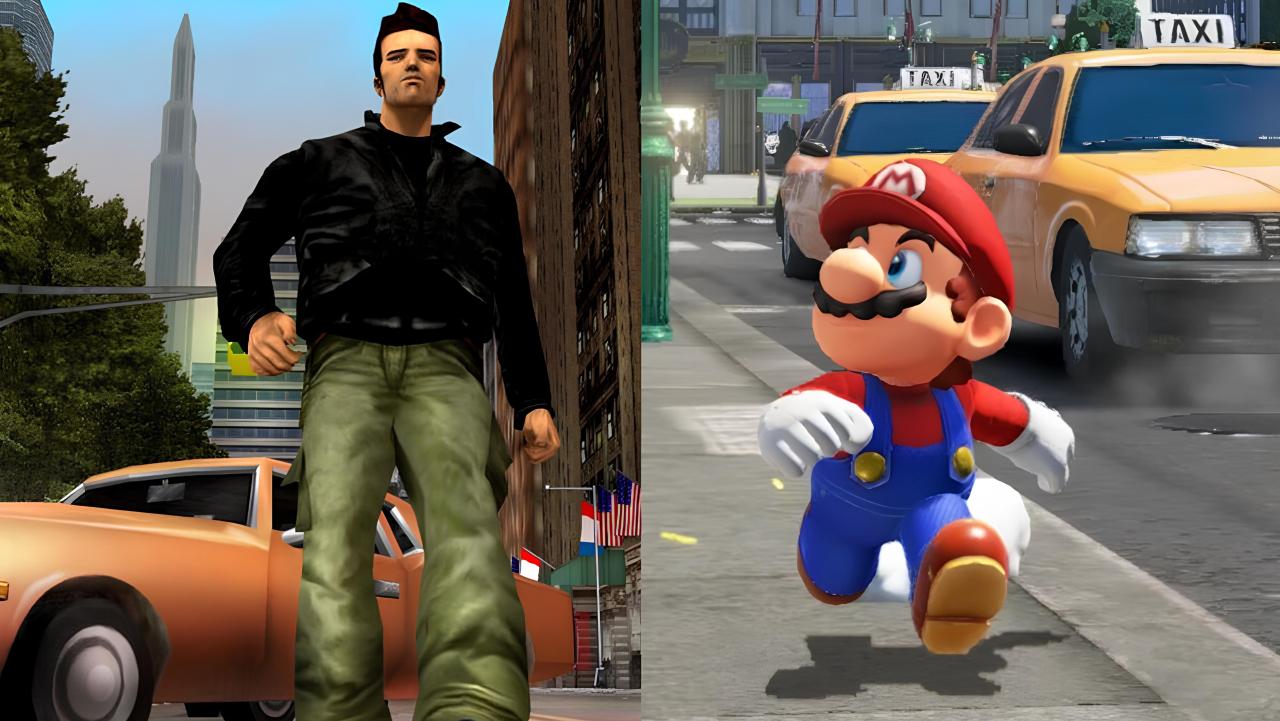
Grand Theft Auto III hit the industry in 2001 with such force that half of gaming suddenly wanted dirtier, more adult, more cynical worlds full of crime and moral rot. Nintendo, guided by Shigeru Miyamoto’s thinking, refused to follow that route: instead of making a GTA clone, it chose to become the alternative. That decision still defines the Kyoto company today.
Nintendo can be described in countless ways, but one point is hard to dispute: it remains one of the strangest giants in the video game business. As a company, it is brutally powerful; as a creator and platform holder, it often seems to be playing a different game from everyone else. While the market rushes after one new wave after another, Nintendo frequently steps sideways and builds something according to its own rules. One of the clearest moments came in the early 2000s, when the massive success of Grand Theft Auto III convinced much of the industry that there was serious money in adult themes, urban violence, crime, and morally grim stories.
Rockstar’s 2001 game was not the first mature video game, but it became a turning point. Grand Theft Auto III showed that an open urban world, a criminal perspective, a satirical tone, and restricted-age content could become a mainstream phenomenon rather than a niche curiosity. After that, many publishers decided that the future might belong to darker, more cynical, more controversial games, or at least that it was worth trying to build their own answer to GTA. Nintendo, however, took another road, and Shigeru Miyamoto made it clear as early as 2003 that imitation would not be the company’s path.
The interview from that period is especially interesting because it came during the debate surrounding The Legend of Zelda: The Wind Waker. Part of the fan base had expected the series to move toward a more realistic, mature visual style, but Nintendo instead chose a cartoon-like cel-shaded look. Today, The Wind Waker is widely treated as a classic, but at the time many dismissed it as childish. It was in that atmosphere that Miyamoto was asked what Nintendo intended to do about the GTA phenomenon pulling the industry in the opposite direction.
Nintendo Wanted an Answer to GTA, Not a Clone
Miyamoto’s response now reads almost like a mission statement. He said the video game industry was broader than ever and that there were many different ways to make games. He also acknowledged that many older players liked Grand Theft Auto, but insisted that this did not mean Nintendo would develop similar titles. His point was direct: “Our task is to find new ways and create substitutes. It is our duty to produce alternatives to GTA.”
This was not simple caution, but a deliberate act of self-definition. In the same interview, Miyamoto also said that he had never intended to make games for one specific age group, but wanted to create games for both children and adults. That line matters because it does not mean Nintendo only makes children’s games. It means the company ideally looks for experiences that do not become powerful through age ratings, swearing, shock value, or provocation, but through clarity, accessibility, playfulness, and long-term memory.
Miyamoto also drew a moral line. He argued that producers should remain within certain moral and ethical boundaries, because video games are interactive entertainment and can affect young people. He did not deny the importance of freedom of expression, but added that game designers carry responsibility for what they create. That way of thinking has not disappeared from Nintendo: the company still rarely relies on shock, scandal, or deliberately adult controversy as the central fuel for its own games.
The Wind Waker, Breath of the Wild, and Nintendo’s Own League
The long-term effects of that decision are easy to see. Nintendo later experimented with darker tones, of course, with The Legend of Zelda: Twilight Princess often looking like a partial answer to criticism of The Wind Waker’s visual style. But the company’s core strategy did not change: instead of copying Rockstar, PlayStation, or Xbox templates, it kept building worlds from its own mechanical clarity, characters, and design ideas. Super Mario, The Legend of Zelda, Mario Kart, Pikmin, and later Splatoon all show that Nintendo is not trying to look adult; it is trying to remain unmistakably itself.
That does not mean Nintendo ignores trends. The industry’s obsession with open worlds clearly influenced the company, but when The Legend of Zelda: Breath of the Wild arrived, it did not become a soulless map full of icons. Nintendo translated the open-world formula into its own language: physics systems, discovery, experimentation, quiet curiosity, and freedom built around rules the player could bend. The same line continued with The Legend of Zelda: Tears of the Kingdom, where the important question was not simply how large the map was, but what the system allowed the player to do.
The same philosophy is visible in hardware. The Nintendo Switch did not compete with PlayStation and Xbox through raw technical power, yet it became one of the most successful consoles in video game history, with more than 155 million units sold according to Nintendo’s official financial data. That result proves exactly what Miyamoto’s 2003 answer suggested: Nintendo is strongest when it does not try to enter someone else’s league, but builds its own. It is not a perfect company, it has made decisions that deserve consumer criticism, and it remains a hard business machine like any other giant. But one thing is clear: when the world wanted GTA clones, Nintendo understood that it did not need to recreate Liberty City. It needed to keep building Hyrule, the Mushroom Kingdom, and its own strange, stubbornly functional universe.
Source: 3DJuegos, GamesRadar+, SpriteCell, Nintendo IR, The New Yorker











Leave a Reply