
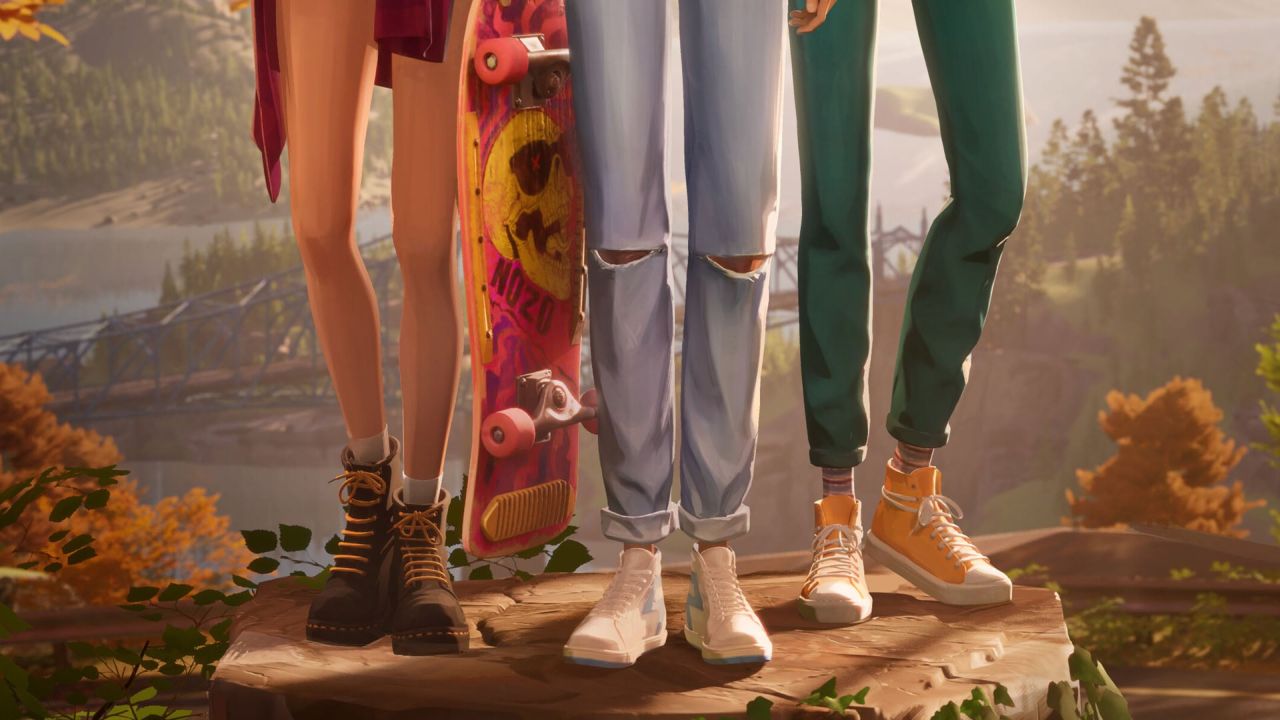
REVIEW – Mixtape is exactly the kind of game that either makes you lean back and surrender to its wave of American ’90s teen nostalgia, or makes you look up from the screen every five minutes and ask: what is this now? Beethoven & Dinosaur’s second game is not a simple adventure game, but a mood tape, a teenage fantasy, an interactive memory album, and a slightly unhinged coming-of-age trip all at once. It is sometimes heartwarming, sometimes mannered, sometimes genuinely brilliant, and sometimes it feels like someone tried to force a three-hour indie film to become a video game every few minutes.
We have Cassandra, Van Slater, and Stacey Rockford, three teenagers in the small Californian town of Blue Moon Lagoon, preparing for their final night together before Stacey heads to New York. On the surface, it is simple: friends, farewell, music, alcohol, a party, teenage drama, and that strange moment when someone is still a child, but already desperately wants to convince themselves that they are an adult. Mixtape, however, refuses to leave it there: every memory becomes a minigame, every emotion turns into a music video, and every teenage exaggeration becomes a playable scene.
That is also why it is divisive. If it catches your wavelength, it becomes a three-hour, scattered but lovable teenage ballad. If it does not, it feels like tuning into an old MTV late-night block where someone accidentally attached game controls between the videos. While playing it, the question often really is: is this interactive poetry, deliberate teenage nonsense, or a minigame that should have been left in the rehearsal room?

Nostalgia Arrives on Tape, and Sometimes It Whines
The most important fuel in Mixtape is nostalgia. Not vague nostalgia, but very specific American, suburban, ’90s teenage nostalgia: messy bedrooms, video stores, vinyl records, cassettes, stolen alcohol, running from the police, youthful world-saving ambition, and the kind of confidence that only makes complete sense when you are still a teenager. Beethoven & Dinosaur understands this era, or at least knows how to invoke its cinematic memory. The game is more of a spiritual relative to Ferris Bueller’s Day Off, Dazed and Confused, Empire Records, and High Fidelity than a traditional adventure game.
Stacey’s mixtape gives the whole thing its structure: the music is not background, but spine. Songs by DEVO, Roxy Music, The Smashing Pumpkins, Iggy Pop, Siouxsie and the Banshees, Joy Division, The Cure, Portishead, and others drive the scenes forward, and that sometimes really does make the game feel like watching MTV at dawn from an era when the channel still played music instead of watching wealthy, empty people move into even emptier living rooms. The soundtrack is unquestionably the game’s strongest weapon.
The trouble begins when Stacey too often wants to explain why a given song matters so much. For a while, that works as characterization: she is the music-obsessed girl who assigns a track to every feeling, wraps every moment in mood, and treats even her own uncertainty like the perfect B-side. Then it sometimes drifts into affectation. At those moments, Mixtape no longer shows what a song means, but comments on it until the magic starts hissing like a badly rewound cassette.
And when it works, it really works. Rewinding a cassette with a pencil, the small objects in a childhood bedroom, old posters, half-forgotten travel plans, friendly stupidity, and the thick, slightly melancholic air of a summer evening all show that the developers did not simply hang costumes on the era. Mixtape feels authentic when it is not selling nostalgia, but capturing a feeling many of us only understand later: that the greatest adventures sometimes happen when nothing special happens at all, except being with the people we are about to lose.

Three Teenagers, One Farewell Night, and a Lot of Excess
The story centers on Stacey, who is preparing to leave for New York because she wants to escape into the music industry, or attack it head-on, as only a teenager could imagine doing. Cassandra and Slater are not just companions, but two other emotional states: Cass is trying to break out of pressure and expectations, while Slater appears more relaxed and peaceful, yet understands perfectly that this night marks the end of something. Mixtape is not strong because of a grand plot, but because of moods, flashbacks, and the way three friends try to pretend they are not afraid while standing next to each other.
The game is structured as a sequence of memories and minigames. Sometimes we skateboard, sometimes we control two tongues during a kiss, sometimes we fly, sometimes we stagger around drunk, and sometimes childhood fantasies turn into completely exaggerated scenes. The idea is good, because adolescence really is like that: there is no clean border between reality and personal mythology. A failed evening can instantly become legend, an awkward kiss can turn into biological horror, and an angry gesture can feel like a world-destroying superpower.
Not every minigame lands, though. The kissing scene, for example, is disgusting, funny, and painfully accurate at the same time: teenage romance really can be that clumsy, wet, too close, and far too biologically real. Other scenes, however, simply feel bizarre. Blowing things up with Stacey’s middle finger, pulling off gravity-defying teenage flights, or stumbling through various absurd interactive inserts is fun the first time, a little tiring the second time, and by the third, it becomes clear that the game sometimes trips over its own cleverness.
Mixtape‘s biggest design problem is that it often cannot decide how much of a game it wants to be. In the better scenes, interactivity adds to the feeling: we are not just watching adolescence, we are fumbling through it. In weaker moments, the minigames interrupt the film rather than deepen the experience. Then it feels as if someone keeps pausing a beautiful, personal animated film so we can move a couch or perform some tiny mechanical trick with little weight or rhythm.

An MTV Teen Dream Married to Awkward Dialogue
The quality of the dialogue is uneven. Sometimes the dynamic between the three main characters feels natural, witty, and likeable: the inside jokes, oversized teenage plans, half-spoken resentments, and friendly teasing all work well. At other times, the game tries too hard to convince us how free, wild, loose, and generational these characters are. That is when the writing starts straining, and looseness becomes pose.
It mostly captures the ’90s mood well, but sometimes it feels as if it is sticking coolness onto the era from a modern angle. The obligatory rebellious remarks about cops, the overwritten teenage quips, and some forced cultural gestures do not always feel like they come from the period, but from the way we now like to imagine that everyone back then was constantly a supporting character in an alternative rock video. This does not ruin the game, but it leaves stains on that pretty, slightly overexposed nostalgia photo.
At the same time, Mixtape sincerely understands what an extreme emotional state adolescence is. One minute, everything is the end of the world; the next, everything will last forever. In one scene, the three friends soar, and in another, they sink into complete lethargy, and that is not inconsistency, but a symptom of the age. The game is at its best when it does not laugh at this, but takes it seriously. Yes, flipping the middle finger sounds ridiculous when written down, but as a teenager, that can genuinely feel like your complete political, philosophical, and aesthetic program.
That is why it is hard to judge Mixtape objectively. Anyone who lived through the cassette, video store, band-shirt, teen-magazine era will connect to different points than someone for whom the ’90s are only an aesthetic filter. The game is not for everyone, and it does not pretend otherwise. That is admirable, but it also means that anyone who remains outside this emotional frequency may find Mixtape less heartwarming than simply strange.

Beautiful, but the Visual Style Is Not Always Strong Enough
The visuals are not impressive in a technical sense, but try to sell everything through style. The colors, character animations, music-video-like compositions, and magical realist exaggerations often suit the game well. Beethoven & Dinosaur already proved with The Artful Escape that it is not afraid of overflowing visual ideas, and Mixtape is at its best when ordinary teenage life suddenly becomes an internal music video, a dream sequence, or a spectacular emotional overstatement.
At the same time, it is not always strong graphically. The characters work very well in some scenes and feel stiff in others; the environments are sometimes atmospheric and sometimes empty; and the overall image does not always support the musical and emotional intensity the game places on top of it. It is not ugly, but it is not always as strong as the soundtrack and direction want us to believe. Sometimes a very good music video gets only a merely adequate set.
The audio, however, is in another league. The licensed songs carry a large part of the production on their own, and the game knows exactly when a track should enter. The sound mix, atmosphere, small-town noises, party murmur, skateboard hum, and the too-loud world of teenagers all add to the experience. If Mixtape becomes harder to obtain one day because of music licensing, no one should be surprised, because this game is genuinely built around its soundtrack.
And that is the big contradiction: the music gives AAA-level luxury to a game with a very indie structure. This makes Mixtape feel large and small at the same time. Large, because the cultural weight of the songs instantly elevates scenes. Small, because the mechanics, pacing, and rhythm between scenes often cannot grow to match that musical selection. It is like a perfectly assembled tape occasionally chewed up by a cheap player.
I Love You, I Don’t – You Know, Teen Stuff
Mixtape is a heartwarming game, but not because it flawlessly recreates the ’90s. It works because it understands the bored, hypersensitive, loud-mouthed, escape-hungry teenage state of mind. The feeling of wanting to destroy everything and preserve everything forever at the same time. The feeling that our friends are the whole world, even though we already know the world is about to pull that little alliance apart.
The problem is that the game does not always know how to express this through game design. Some minigames are inventive, others are too long or too bizarre, the dialogue is sometimes honest and sometimes affected, and the pacing often works more like a film than an adventure game. With its three-to-four-hour length, it at least does not overstay too badly, but there are still scenes where the player no longer wants to live through the memory, but skip ahead like a weak track on a tape.
Still, there is something here. Mixtape dares to be different, dares to be sentimental, dares to be awkward, and that alone is worth more than a game trying to show sterile professionalism at all costs. It will not speak to everyone, and many will stare at it in genuine confusion. But for those it does hit, it will not just be a game, but an old, slightly dusty, slightly overplayed, still-working cassette from the back of a drawer.
-V-
Pro
+ Excellent soundtrack with many strong licensed tracks
+ Captures the atmosphere of American ’90s teenage life very well
+ Heartwarming, personal, and genuinely memorable in several scenes
Against
– Some minigames are too bizarre or too weak
– The dialogue can be forced and mannered in places
– At several points, it works better as a film than as a video game
Developer: Beethoven & Dinosaur
Publisher: Annapurna Interactive
Genre: narrative adventure
Platforms: PC, PlayStation 5, Xbox Series X|S, Nintendo Switch 2
Release Date: May 7, 2026
Mixtape
Gameplay - 6.8
Graphics - 6.4
Story - 7.4
Music/audio - 8.6
Ambience - 8.2
7.5
GOOD
Mixtape is a strange, music-driven teen adventure that evokes American '90s nostalgia with plenty of affection, though not always with discipline. The soundtrack and atmosphere are outstanding, but the minigames and dialogue are highly uneven. It is a three-to-four-hour, odd, heartwarming experience that players will either love or spend most of the time trying to understand.


![An ex-Bethesda Dev Says Including More than 1,000 Planets in Starfield Was a Bad Decision! [VIDEO]](https://thegeek.games/wp-content/uploads/2025/09/thegeek-starfield-nagy-1-302x180.png)










Leave a Reply