
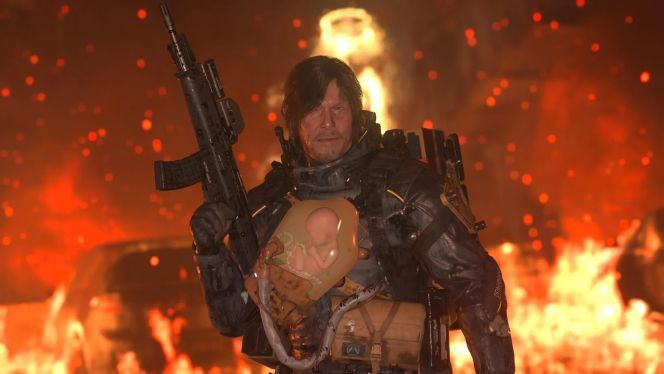
MOVIE NEWS – Michael Sarnoski does not want to simply retell the story of the Death Stranding games, but to create his own original narrative inside Hideo Kojima’s world. The director says his goal is to bring to the screen the feeling and message the game left with him, while Kojima and A24 have already approved the direction of the current script.
Video game adaptations have gained serious ground on television in recent years, but cinema is still trying to reproduce that success under much tighter conditions. A series has several hours to build a world, develop characters, and draw viewers in gradually, while a film has to work within a far shorter runtime, usually with greater visual pressure, higher technical expectations, and a much denser dramatic structure. That is the space the Death Stranding movie is now trying to enter, with Michael Sarnoski, director of Pig, A Quiet Place: Day One, and the upcoming The Death of Robin Hood, leading the project for A24 and Kojima Productions.
One of the project’s most important traits is that Sarnoski is not working on a direct copy of the games. Hideo Kojima is involved as creative supervisor for the script and the film as a whole, but the director has already made it clear that this will not be a traditional retelling of Sam Porter Bridges’ journey, nor will it rebuild the same route around Norman Reedus’ character. Filming is currently expected to begin next year in Ireland and Iceland, while Sarnoski is still working on the final version of the screenplay.
Sarnoski Wants His Own Story Inside Kojima’s World
Speaking to Variety, the director said that both A24 and Kojima are happy with the current direction, and that development “has gone very well” so far. Sarnoski also explained that Kojima has given him a lot of freedom to explore the world however he wants, meaning he does not have to stay tightly bound to the exact plot of the games. That is why he has chosen to look for an original story set inside the Death Stranding universe, one that does not undo what the game built, but opens up another corner of it.
“I was given the go-ahead to use my own characters or tell a completely new story that’s set within this world and adjacent to the games. And it’s been a great experience. I love those games, and it’s been great to take the message they left me with and how I felt playing them, and find a different story that engages with that, but still feels like my own,” Sarnoski said. That approach makes it clear that the film is not being treated as an illustrated playthrough, but as a standalone work for the cinema.
The decision is not really surprising, because Kojima had already said back in 2023 that he did not want the film version to imitate the games. His intention was instead to let the license, which had previously been closely associated with PlayStation, expand into cinema as an independent work. That matters especially with source material that is already highly cinematic, yet still depends on player participation, the monotony of the journey, vulnerability, and the slow rebuilding of human connection.
Expanding the World May Matter More Than Copying It
Several successful video game adaptations from recent years have shown that strict fidelity is not always the strongest path. Amazon’s Fallout did not copy the plot of one specific game, but told a new story inside the same universe while preserving the franchise’s grotesque humor, social satire, and post-apocalyptic atmosphere. Netflix’s Arcane is another strong example of how a known game world can be expanded in a way that lets the new story stand on its own. Even The Last of Us, which followed the events of its source game much more faithfully, added original material to avoid simply becoming the same thing without interaction.
In the case of Death Stranding, that issue is even sharper. Kojima’s game is not only strange as a story, but also as an experience: loneliness, distance, the physical presence of burdens, the reconnection of isolated people, and the act of crossing hostile landscapes all affect the player differently than they would affect a passive viewer. Sarnoski’s task is therefore not to copy the missions onto the screen, but to find a cinematic form capable of carrying the game’s strange, unsettling mix of solitude, connection, survival, and human contact.
The movie is therefore already taking a different route from what many might expect from a classic adaptation. Kojima’s approval, however, suggests that the project is not rejecting the original creative intention, but extending it into another medium. The big question will be whether Sarnoski’s own story can enter the world of Death Stranding without losing the peculiar, unmistakably Kojima-like atmosphere that made the game so divisive and so memorable.
Source: 3DJuegos









Leave a Reply