
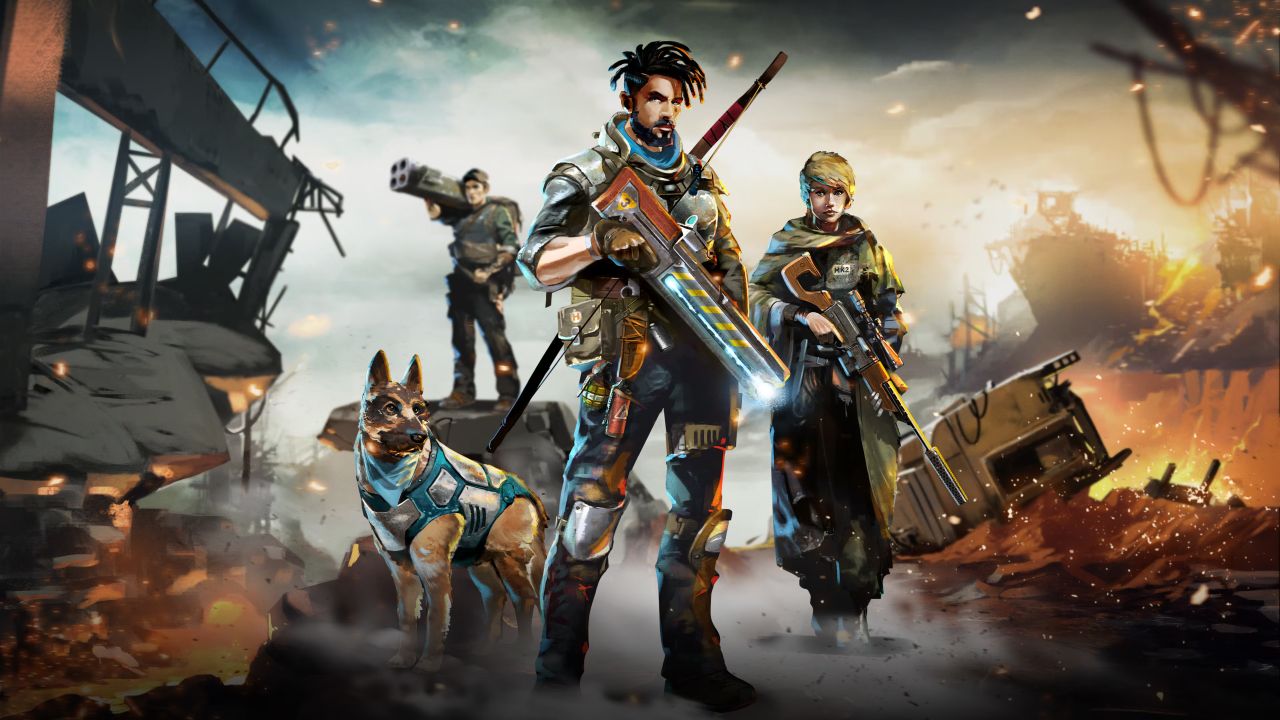
REVIEW – At first glance, Dustwind: Resistance offers exactly what one might expect from a post-apocalyptic isometric tactical action game: dust, rust, raiders, revenge, survival, and a strong echo of Fallout. The issue is not that Z-Software and Dustwind Studios build on familiar foundations, but that alongside its better ideas, almost every part of the game feels old-fashioned, stiff, and often tiring in execution.
There is no shortage of post-apocalyptic games, and if Dustwind: Resistance had to be judged on that alone, it would not get very far. The typical revenge story does not help it much either, because this genre territory has been covered many times since Mad Max: someone loses everything, picks up a weapon, and sets out to take back whatever can still be reclaimed. The first two Fallout games also come to mind very quickly, and that is not necessarily a problem in itself. The real question is whether players today still have patience for such an old-school, compromised, isometric post-apocalyptic tactical action game.
One thing can be said for certain: we will not be playing it for the story. Beneath the isometric view, Dustwind: Resistance hides a somewhat dated, but not entirely uninteresting style: real-time tactical combat with pause, squad-based control, custom equipment setups, tough enemies, and a world that keeps reminding us that survival is work. This mix could function well if the game did not so often stumble over its own pacing, camera, combat system, and general rustiness.

Jake’s Revenge Cannot Carry the Game
Jake begins the story as a farmer with a wife and a German shepherd named Diesel. Then the raider gang led by the Warlord arrives, and everything turns into a familiar revenge campaign. At first glance, Fallout 4 may come to mind, but that alone is not enough reason to judge the game, because Dustwind: Resistance can be entertaining. The problem is that it can just as often be frustrating.
The game expects tactical thinking from the start, even though most fights take place in real time. That creates one of its biggest problems: too often, there is simply not enough time to make the right decision, especially when the camera is also fighting against us. If the combat had been turn-based, it might have been easier to sink into the world, but the current setup pushes us toward constant scrambling instead. The game does allow pausing, and during that pause we can issue orders to squadmates, but aiming is still our responsibility, and it takes real time to get used to it.
The Fallout comparison returns in the combat system as well, since we have a percentage chance to hit the target. This depends partly on whether we are firing while kneeling, and partly on how far away the enemy is. That makes sense on its own, but the enemies are also fairly durable, and when a whole group of mostly identical-looking attackers comes rushing in, the system quickly becomes tiring. Squad equipment can soften this to a degree: if speed is needed, lighter armor and melee weapons can work; if we want something closer to a tank, a machine gun and heavier armor become the obvious choice. In theory – or rather at the concept level – this sounds exciting, but in practice the gameplay is far less lively than the system promises.
The visuals also strongly recall the classic Fallout school. The level design is built around larger explorable areas where we can speak to many characters, or sometimes choose not to, because even reaching them becomes a test of patience thanks to the slow movement speed. It is understandable that the developers try to break up the fighting with conversations, but large empty-feeling areas and sluggish traversal can make wandering around dull rather quickly. The absence of a minimap does not help either, so players should expect to stare at the full map often, which is especially awkward in a game with this kind of pace.

Covered in Twenty-Five Years of Dust
The cutscenes are made up of drawn still images, and they do have some atmosphere, but there is much less to praise in the character design. There is hardly any real detail to speak of, and the portraits do not communicate enough to build a stronger impression of the characters. The visual world is not unacceptable, but it feels more like an idea that has been sitting in a drawer for years than a freshly assembled piece of post-apocalyptic tactical design.
The voice work does not fare much better. Beyond the scenes between missions, there is not much serious voice acting, and the dialogue is not strong enough to keep interest alive on its own. It often feels dry, sometimes openly awkward, and the overall soundscape does not elevate the experience either. This raises the question of whether one should play the previous entry in the franchise, 2021’s Dustwind: The Last Resort, first. Not really. Dustwind: Resistance is understandable on its own, and a lack of background knowledge will not be our main problem.
On PlayStation 5, performance is not a major issue, but the control layout can feel somewhat unusual. L1 and R1 switch between characters, while pressing both together selects the entire squad. X is used for interaction and dialogue responses, pressing the left analog stick activates stealth, which will sometimes be necessary, although its meter drains if we are within an enemy’s sight or hearing range. If automatic reloading is not desired, L2 handles that, while the right analog stick is used for aiming and R2 for shooting.
The controls are generally acceptable, but they are not what ultimately determines the quality of the experience. They do have an impact, of course, especially in a system where aiming and quick reactions matter this much, but the real problem lies deeper: the gameplay too often feels like a collection of ideas that could work separately, yet turn awkwardly when placed together. Dustwind: Resistance is not unplayable, but it often behaves exactly like a game that would have felt old-fashioned even twenty years ago.
Not Bad, Just Hard to Get Excited About
Dustwind: Resistance can keep players occupied for around fifteen hours, but it is easy to imagine reaching the point much earlier where one simply does not want to see more of it. That is understandable, because the overall impression is more average than memorable. It does not fall apart completely, and it does not feel entirely hopeless, but it rarely delivers moments that make us want to stick with it. If someone grew up on this kind of post-apocalyptic, isometric, tactical game and still has strong nostalgia for Fallout or Wasteland, they may find something here. Others may find it too dry, too slow, and too outdated.
The Canyon Cross DLC adds more content and focuses on our base, but even that cannot save the game by itself. Dustwind: Resistance has also been available on consoles for more than a year, and after all that time, it still feels like a title that did not stay quiet by accident. There is challenge here, there are a few usable tactical ideas, and squad composition can be interesting, but the final result too often remains stuck at the level of “fine, but why?”
-V-
Pros:
+ Squad members can be built in fairly varied ways
+ The drawn cutscenes have some atmosphere
+ Players looking for a challenge will find plenty of it
Cons:
– Feels outdated in almost every respect
– Never really escapes the shadow of the classic Fallout games
– Real-time combat often punishes more than it creates exciting tactical situations
Publisher: Z-Software GmbH
Developer: Dustwind Studios, Z-Software
Release Date: June 18, 2025
Genre: isometric tactical action game, post-apocalyptic shooter strategy
Dustwind: Resistance
Gameplay - 6.7
Graphics - 4.3
Story - 4.7
Music/audio - 6.7
Ambience - 8
6.1
FAIR
Dustwind: Resistance does not stand far above other post-apocalyptic tactical games, and it is no accident that we have not heard much about it. It has a few good ideas, but its clumsy combat, dated systems, weak story, and the heavy shadow of Fallout make it easy to recommend only to those specifically craving this kind of old-school survival tactics.





![The System Requirements for Fable Are In! [VIDEO]](https://thegeek.games/wp-content/uploads/2026/08/vnews-05-fable-1280x720-1-302x180.png)





Leave a Reply