
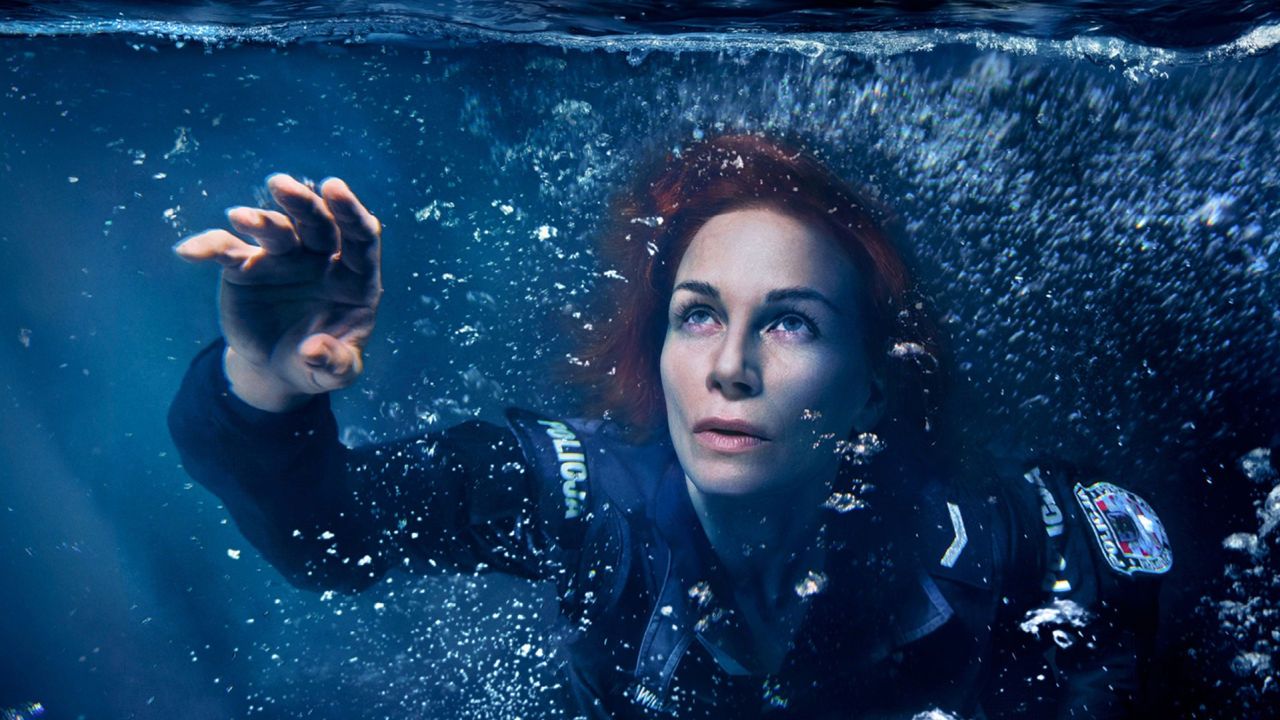
SERIES REVIEW – The first two seasons of The Thaw were slow-burning, bleak Polish crime dramas whose main strength was never the number of bodies or twists they could stack into six episodes. The series worked because it gave room to silence, grief, exhaustion, and a city in which official institutions and criminal interests had long stopped pretending to be separate. Season three keeps that world intact, but moves through it faster: there is more immediate danger, more pursuit, more police action, more criminal violence, and a clearer thriller engine driving the plot. That is often an improvement, although it also exposes a few convenient shortcuts and logic gaps that were easier to overlook when the series was moving at its earlier, more deliberate pace. Katarzyna Wajda remains the reason it all holds together, giving Katarzyna Zawieja enough force and damage to keep the show from becoming just another dark streaming crime series.
From the beginning, The Thaw was not simply trying to remake Nordic noir in Poland. The ingredients were familiar enough: grey skies, water, missing people, compromised officials, tired detectives, and a city where nobody seems surprised by corruption anymore. But the series had a harsher, more local character than that. Szczecin was not a postcard backdrop or a generic crime-drama location. It was a place where the system appeared to have spent years protecting itself rather than the people living inside it.
Season three begins a year later, with Katarzyna Zawieja demoted and working as a street officer while attempting to keep some kind of order in a life that has not become any easier. Her past cases, her own decisions, and the unresolved damage in her private life are still there. When fentanyl begins circulating through Szczecin, reaching younger people and opening up new lines between dealers, victims, officials, and those who profit by looking away, Zawieja is pulled back toward an investigation she should probably have left to someone else.
The new case makes the season more immediate. Earlier episodes of The Thaw often allowed characters to remain silent, make bad choices, misunderstand one another, or simply wear themselves down under the weight of what had already happened. Season three moves earlier and with more purpose. The investigation is pushed forward by drug trafficking, internal police interests, violent confrontations, robberies, and the sense that everyone around Zawieja knows more than they are willing to say.

The Third Season Is Faster, but It Is Not a Different Series
The best thing about the shift in pace is that The Thaw does not abandon its atmosphere. Szczecin is still a heavy, unpleasant city where consequences accumulate over years rather than arrive with one shocking revelation. The industrial spaces, empty roads, tired apartments, grey public buildings, and tense police interiors still matter because they make every case feel embedded in the place itself. Crime is not presented as an exciting intrusion into normal life. It is already part of normal life.
What changes is that the season does more than observe the decay. It starts pressing on it. The fentanyl case is not treated as a detached procedural plot but as a thread running through schools, families, the local criminal world, and police structures. The series becomes more efficient at connecting those layers, and the six episodes develop a stronger sense of direction than the earlier seasons sometimes had.
The chases, raids, street confrontations, and more direct action scenes generally suit the show. The Thaw does not become an American action series, and it wisely avoids turning every problem into a gunfight. But it is clearly more willing to pull Zawieja into situations where she has to act rather than simply investigate, wait, and absorb information. That gives the season energy, and several episodes end with enough momentum to make the next one feel necessary rather than merely available.
The trade-off is that the story occasionally shows its machinery too clearly. Some people arrive at exactly the right moment, some clues fall into place too conveniently, and a few turns are pushed forward because the script needs to reach the next major sequence. The first season could be frustratingly slow, but it also had a stubborn sense of internal reality. Here, there are moments when the plot does not unfold so much as get nudged into position.

Katarzyna Wajda Carries the Hardest Scenes
Katarzyna Wajda remains The Thaw’s strongest asset. Zawieja is not the familiar television version of a tough female detective, the kind of character defined by permanently raised eyebrows, sarcastic one-liners, and a need to prove she can outdo every man in the room. Wajda plays her as someone who is tired, impulsive, difficult to live with, and constantly one mistake away from making everything worse. That makes her much more interesting than a polished hero.
That quality has been visible across Wajda’s earlier work as well. After graduating from the National Film School in Łódź, she gained wider attention in the 2012 film You Are God, and later became especially memorable as Anka Kruk in Raven. Both roles helped establish the kind of screen presence she now brings to Zawieja: strength that is never clean, vulnerability that is never sentimental, and a sense that the character is carrying more than she can reasonably manage.
Season three gives Wajda plenty to work with, even when the script occasionally loads too much onto Zawieja at once. She keeps the character grounded through small choices rather than big declarations. A look that lasts too long, an answer she refuses to give, a burst of anger she immediately regrets, or a moment where she clearly wants to leave but cannot. Wajda makes it easy to understand why Zawieja keeps crossing lines, even when she should know better.
Bartłomiej Kotschedoff’s Trepa remains a strong counterweight. Their relationship does not work because it is romantic or because the series keeps teasing an easy emotional resolution. It works because there is professional friction, mutual suspicion, old resentment, and the uncomfortable fact that they understand each other better than either would prefer. The show is smart enough not to turn that into a rushed relationship subplot.

The Crime Plot Is Tighter, but the Logic Sometimes Breaks Down
The central case is stronger than the opening episodes initially suggest. Drug trafficking, the exploitation of young people, local criminal networks, and internal police interests are not treated as disconnected story pieces. They belong to the same structure, and that gives the season real weight. The series understands that catching one culprit will not solve much if the city itself keeps producing the conditions that created the problem.
When The Thaw stays with that idea, it is very good. It does not need grand speeches to explain the damage. A police decision, a family that chooses silence over another conflict, an official looking away, or a teenager treating drugs as an ordinary part of daily life can tell the story more effectively than any exposition-heavy scene. Those are the moments when the show reconnects with the uncomfortable credibility that made season one stand out.
The weaker moments come from police procedure and action logic. Zawieja sometimes gets access to information too easily, reaches the centre of an operation too quickly, or escapes situations that should leave more serious consequences behind them. None of that is unforgivable in a crime thriller, but The Thaw built its reputation on feeling more grounded than this. When it starts relying on familiar television shortcuts, the series loses some of the grim authority it has earned elsewhere.
There are stretches where the Polish urban noir gives way to a more standard crime-show rhythm. Characters use each other’s surnames like they are trapped in an imported cop drama, superiors seem to control every department at once, and certain developments are simply too convenient. These are not fatal flaws, but they prevent the season from being as persuasive as its strongest scenes suggest it could have been.
The Dark Mood Remains, but the Story Moves More
Season three of The Thaw does not reinvent the crime genre, and it does not need to. Its task is more difficult than that: it has to preserve the series’ identity without repeating the first season in a slightly different arrangement. For the most part, it succeeds. The show remains bleak, serious, and rooted in a city where people have learned to survive alongside damage rather than repair it.
The change is obvious. There is more action, more forward motion, and occasionally too much reliance on the familiar mechanics of international streaming thrillers. But the series does not become empty because of it. Zawieja’s exhaustion, the pressure inside the police force, the criminal networks, and the old wounds carried by the characters still give The Thaw a recognisable identity.
Katarzyna Wajda is the reason the season remains worth watching even when it cuts corners. The third season is sometimes too eager to accelerate, and that means it loses a little of the carefully measured force that made the first season memorable. In return, it becomes more gripping, more direct, and more consistently watchable. It does not leave Zawieja’s world behind. It simply forces her to move through it faster.
-Gergely Herpai “BadSector”-
The Thaw Season 3
Direction - 8
Actors - 8.9
Story - 7.7
Visuals/Music/Sounds/ - 8.1
Ambience - 7.8
8.1
EXCELLENT
The Thaw season three keeps the series’ bleak Polish noir identity while turning the fentanyl-trafficking case into a more direct and energetic crime thriller. Katarzyna Wajda is outstanding again, and the faster pace, chases, robberies, and action scenes give the six episodes more momentum than the earlier seasons often had. A few convenient plot turns and television-style shortcuts hold it back, but this remains a strong continuation that moves Zawieja’s story forward instead of simply repeating it.

![Harry Potter Fame Did Not Pay the Bills – OnlyFans Saved Jessie Cave [VIDEO]](https://thegeek.games/wp-content/uploads/2026/08/theGeek-Jessie-Cave-OnlyFans-302x180.jpg)









![Harry Potter Fame Did Not Pay the Bills – OnlyFans Saved Jessie Cave [VIDEO]](https://thegeek.games/wp-content/uploads/2026/08/theGeek-Jessie-Cave-OnlyFans-300x365.jpg)
Leave a Reply