
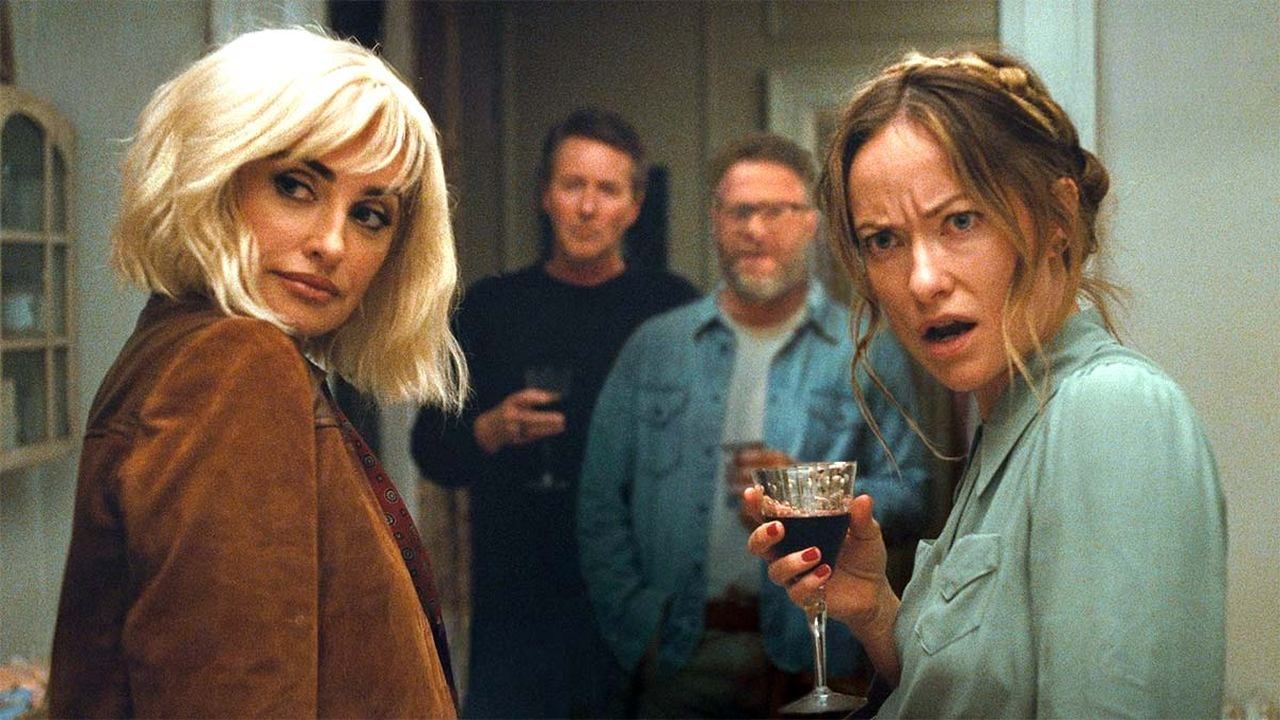
MOVIE REVIEW – Olivia Wilde turns the simplest possible premise into a razor-sharp, adult and uncomfortably familiar relationship film. The Invite locks a struggling marriage, two seemingly more liberated neighbors and one evening inside a San Francisco apartment, where wine disappears faster than politeness. The result is both a very funny chamber comedy and a painfully accurate story about how far two people can drift apart while still sleeping in the same bed.
There is no single spectacular explosion inside Joe and Angela’s marriage that can be conveniently pointed to. No old lover appears, there is no huge betrayal and no secret that suddenly explains the entire relationship in hindsight. Their situation is far worse than that: they have slowly grown tired of each other, and have become so accustomed to this state that neither of them could say exactly when it began.
Joe teaches at a music school, although he clearly once expected much more from himself. He did not fail in some grand fashion, but quietly and almost imperceptibly gave up on the life he had imagined, and bitterness now works its way through every sentence he says. Angela, meanwhile, stays home with their child, renovates their inherited apartment, organizes, tidies and tries to keep daily life under control, because something around her has to function.
Olivia Wilde understands with great precision that a relationship does not necessarily get into trouble only when love disappears from it. Interest can vanish much earlier, the kind of attention where people do not automatically assume they know exactly what the other person thinks. Joe and Angela live together, raise their child together and argue about the apartment, money and minor things together, but they stopped truly asking about each other a long time ago.
That is why Angela invites their upstairs neighbors, Hawk and Piña, over for dinner. Joe becomes miserable at the very idea because the two neighbors look exactly like the kind of couple that is easiest to hate when driven by one’s own insecurities. They are too relaxed, too attractive, too confident, and speak about desire, sex and the rules of their relationship with conspicuous ease, while Joe and Angela can no longer offer one another a normal compliment without it turning into a small argument.

Politeness resigns after the first glass of wine
One of The Invite‘s great strengths is that it refuses to turn Joe and Angela into simple scapegoats. Joe is irritating, defensive and often genuinely unbearable, but Seth Rogen never lets him remain merely the resentful, mocking husband at dinner. Behind every cynical remark lies shame about his own missed opportunities, as well as the fear that he may have arrived permanently too late for the life he once wanted to live.
Rogen gives one of the best performances of his career here. The actor still has an excellent feel for awkward jokes and one-liners tossed out in self-defense, but something much sadder vibrates beneath them throughout. Joe does not attack everything because he hates everyone, but because he cannot stand being reminded by anyone around him of the person he once imagined himself becoming.
Angela is not an innocent, patient martyr either. Wilde plays a woman so accustomed to trying to solve everything that she no longer notices how care has slowly turned into desperate control. The preparation of dinner, the rearranging of the apartment and the desire to impress the guests all lead back to the same question: does Joe even notice her anymore, or does he only see the person who deals with their child, the bills and the renovation?
The rhythm of the film immediately accelerates once Edward Norton and Penélope Cruz enter. At first, Hawk and Piña seem like the sort of couple you either come to love within ten minutes or would most like to send somewhere with less faith in themselves. Norton is unusually light, playfully intelligent and just confident enough for Joe to hear a personal attack in every sentence he says. Cruz, meanwhile, is not merely sensual and free, but watches with such precision that every kind question Piña asks eventually resembles a small psychological mine.
The dynamic between the four actors carries the film. Will McCormack and Rashida Jones’s screenplay is sharp, funny and capable of real cruelty, yet it does not build itself from major revelations. A badly emphasized sentence, a silence lasting too long or a joke left unfinished reveals more about these people than an entire therapy session.

Freedom is not the same thing as honesty
Fortunately, The Invite does not try to create comedy simply from one couple handling sexuality more openly than the other. Hawk and Piña are not dangerous to Joe and Angela because they are freer or bolder. They are dangerous because they ask questions, pay attention and refuse to accept the first polite lie as an answer.
Joe sees the two neighbors as a smug performance that will surely collapse once somebody finally scratches the surface. Angela, however, hopes Hawk and Piña’s existence proves that desire, curiosity and playfulness do not necessarily disappear from a long relationship. Both see part of the truth, but both misunderstand the other as well. The guests do not bring a solution to their marriage, but a mirror in which Joe and Angela are finally forced to see everything they have carefully kept blurred until now.
Wilde’s direction makes excellent use of the setting locked inside one apartment. Adam Newport-Berra’s camera moves between mirrors, doorframes, narrow hallways and furniture that separates the characters, so the married couple appears distant even when they are standing only a few steps apart. At first, the apartment is an orderly home, then a stage, and finally a battlefield where even a glass placed in the wrong spot carries weight.
Devonté Hynes’s music subtly supports the constantly growing tension without forcing the audience to feel when it should laugh or squirm in discomfort. The humor works especially well because the characters always try to remain funny precisely when it is obvious the situation can no longer be joked away. Fear can be heard behind every cutting remark from Joe, while more and more anger leaks through Angela’s excessive kindness.
In the third act, Wilde occasionally lets characters state things more clearly than necessary, even though the actors had already played them perfectly through their looks and silences. This is only a minor wobble. The Invite understands the defense mechanisms of long relationships too well for a few overly direct lines to spoil what it has built so precisely up to that point.
Love is not the first thing to run out
Olivia Wilde’s strongest directorial work functions so well because it does not want to offer an easy answer to how a marriage drifting in the wrong direction can be repaired. The Invite does not promise that every old desire and every piece of trust will return after a single honest evening. It only suggests that before anything can be saved, two people first need to learn how to pay attention to each other again.
-Gergely Herpai „BadSector”-
The Invite
Direction - 8
Actors - 8.5
Story - 7.9
Visuals/Music/Sounds/ - 8
Ambience - 8.1
8.1
EXCELLENT
The Invite is both a biting relationship comedy and a painfully accurate film about how easily two people can become strangers beside one another. Olivia Wilde's assured direction, Seth Rogen's unusually strong performance, and Edward Norton and Penélope Cruz's excellent counterplay sustain the tension throughout. It is not the story of easily saving a marriage, but of realizing that curiosity must be recovered first.













Leave a Reply