
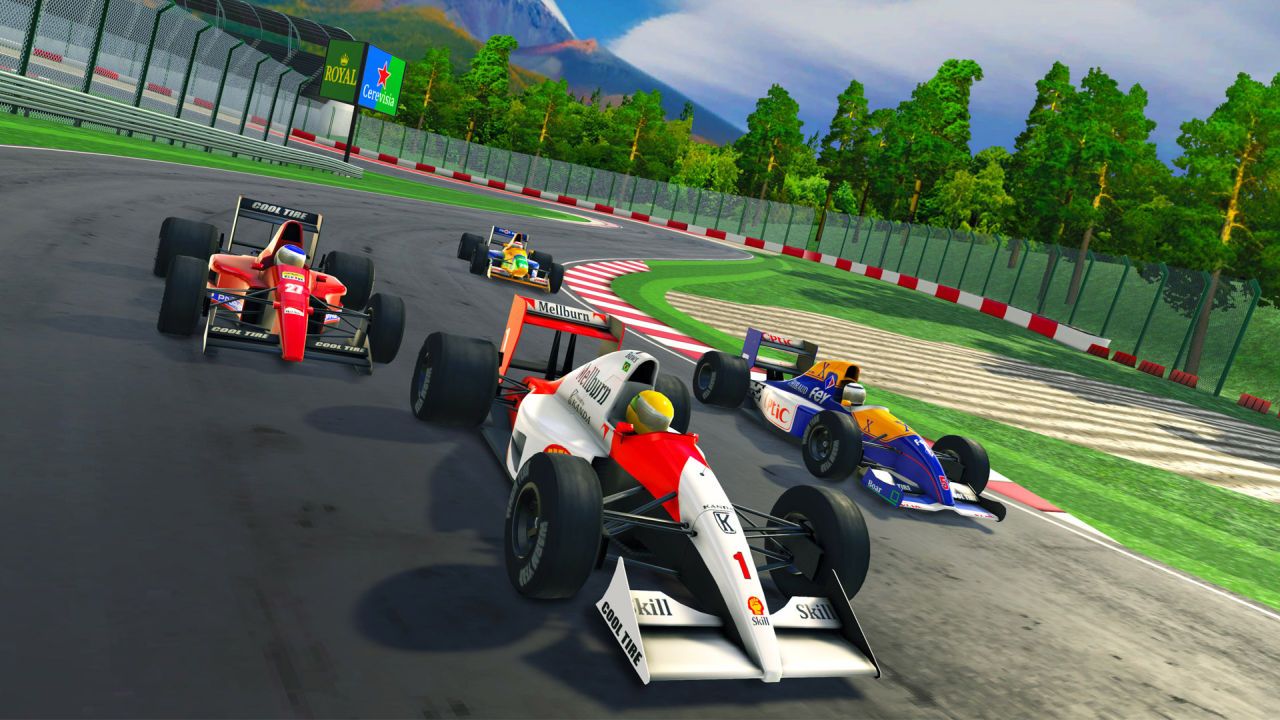
TEST – 4PGP is built around what the best arcade racers of the 1990s did so well: it puts you on the grid within seconds, gives you tracks that are quick to learn, and never turns every race into a motorsport engineering exam. This Nintendo Switch 2 formula racer brings fast circuits, a strong sense of speed, retro charm, and four-player multiplayer while deliberately avoiding any attempt to become a full simulation. Playing alone, though, the overly aggressive CPU and limited solo content often slow down the momentum that works almost perfectly with friends.
4PGP makes its intentions clear from the opening minutes. There is no lengthy career mode, no engineering setup screen, and no need to study tyre pressure or differential settings before a race can finally begin. You choose a formula car, wait for the lights to go out, and immediately head toward the first corner, where a poor line or late braking quickly proves that this may be an arcade game, but it is not one that can be driven entirely without thought.
That directness is one of the game’s greatest strengths. 4PGP clearly draws on the era of Pole Position, Virtua Racing, and classic Sega racing games, but it does not work as a simple imitation. It instead recreates the feeling of standing in front of an old arcade cabinet, understanding the basics within seconds, and then trying again and again until another few tenths can be removed from the next lap.
The modes follow the same old-school philosophy. Championship offers a short three-race competition where points decide who takes home the trophy, Quick Race exists for immediate action, and Time Attack gives solo players something to do when they want to chase personal records. Time Attack is naturally a single-player mode, but the others can support up to four racers at once, which reveals very quickly where the game’s real focus lies.
Nineteen fictional yet clearly Formula 1-inspired cars and fourteen circuits based on real-world motorsport locations make up the core selection. Melbourne’s Albert Park, Monaco, Monza, and several other famous venues are easy to recognise in spirit, even if the game does not use official licences or exact recreations. The tracks are short, tight, and quick to learn, but strong lines and truly competitive lap times still require practice.

The CPU Takes Arcade Racing Far Too Seriously
Driving in 4PGP is fundamentally enjoyable. The cars feel quick, the circuits have a clear rhythm, and a strong lap does not come from holding the accelerator down from start to finish. You need to brake carefully, lift at the right moment, use slipstreaming effectively, and avoid wheel-to-wheel contact whenever possible, because even a minor touch between open-wheel cars can have serious consequences.
On Rookie difficulty, that formula becomes almost too comfortable. After only a few laps, a safe lead can usually be built, the CPU is not much of a threat, and races feel more like practice sessions than genuine competition. That would not be a major problem on its own, except the setting does not reward players with unlocks, leaving anyone who wants a more relaxed experience with little long-term motivation.
At higher difficulty levels, several elements become more interesting. The cars are faster, drafting matters more, races last longer, and there is more room to recover from a small mistake. The rhythm of each event also improves, because it becomes less about who can complete a flawless lap and more about who can use the aerodynamic wake of the cars ahead and find the right moment to overtake.
Computer-controlled opponents become genuinely irritating at this point. They defend the ideal line too aggressively, make mistakes only rarely, and often act as though they are not trying to win the race but personally trying to prevent the player from setting a good lap. A small sideways touch can quickly become a spin, a major time loss, or a recovery that feels practically impossible, which might be understandable in a serious motorsport simulation but feels too harsh in a colourful arcade racer.
The most frustrating part is that 4PGP’s ideal race comes very close to being fantastic. When you keep a clean line, brake well, use slipstreaming, and link several corners into one flowing movement, the game delivers exactly the instinctive arcade flow that made the classics so compelling. But you are not alone on the circuit, and when the CPU defends too rigidly or a small contact leads to disproportionate consequences, that momentum falls apart very quickly.

The Pit Lane Is More Recharge Station Than Real Strategy
The pit stop system does not push the game toward traditional Formula 1 strategy either. It feels much closer to refilling a boost reserve in F-Zero, where stopping restores some of the car’s power and a short timing challenge can improve the result. That suits the arcade approach because it never interrupts a race for too long, but it also never becomes a deep mechanic that opens meaningful tactical possibilities.
On lower settings, it is not always obvious that pitting is worth the effort. The time lost in the pit lane can feel greater than the benefit of the refill, so it is often easier to keep pushing forward and hope the car survives until the finish line. It becomes slightly more relevant at higher levels, but clean driving, minimising mistakes, and recognising the right overtaking opportunities remain the true centre of every race.
That simplicity would not be a problem by itself, because 4PGP never wanted to be a deep simulation. The issue is that the harsh contact penalties and the CPU’s aggression can sometimes make the game feel much stricter than the loud, colourful, and playful arcade atmosphere suggests. When you end up in a poor position early on, fighting back often feels less like an exciting challenge and more like an exhausting restart.

Everything Falls Into Place With Four Players
Once real people join the virtual grid, most of 4PGP’s flaws become far less irritating. Friends can still hit your car, ruin a perfect lap, and brake far too late before a tight hairpin, but at least those are human mistakes. When someone pushes you off the circuit, you can laugh, get angry, and answer in the following lap with something emotionally justified but perhaps questionable from a sporting perspective.
Split-screen is quick to set up, and performance remains convincingly stable during multiplayer races. GameShare fits the game extremely well, because it allows local sharing with another console and enables shared racing online with Nintendo Switch 2 players. One copy can be enough to create multiplayer events where the real story is written by friends who brake too late, make impossible overtakes, and blame each other after the finish line rather than by unpredictable artificial intelligence.
The three-race Championship structure is at its best in a group. It is short enough not to take over an entire evening, but long enough to allow a comeback after a bad opening race. With four players, the smaller amount of content also feels much less restrictive, because every event creates new mistakes, new overtakes, new rivalries, and new arguments.
That is when the meaning of the title becomes fully clear. 4PGP is not a racer built around a long and lonely career mode, but a fast, loud, and easy-to-start social game where winning can matter just as much as watching somebody lose their patience in the final corner of the final lap. With human opposition, it becomes not only less frustrating but simply far more alive.
Great Sense of Speed, but Music That Keeps Falling Silent
Technically, 4PGP delivers a very smooth Nintendo Switch 2 experience. In TV mode, it supports 4K resolution at 60 frames per second, while Full HD reaches up to 120fps with one or two players and 90fps with three or four racers. That fluidity adds a great deal to the driving experience, because circuits remain readable at high speed, the cars move lightly, and split-screen does not visibly weaken the overall presentation.
Assist Mode and gyro controls are also smart additions, because 4PGP is not made exclusively for veteran arcade racers. A younger or less experienced player can join quickly, while the higher levels still provide something for people who want to drive more precisely. The fictional Formula 1 brands and liveries also warmly evoke an era when the lack of official licences often made racing games feel more playful and inventive.
The music is less of an unambiguous success. What is present is excellent: energetic, pulsing electronic tracks that would sound perfect blasting from the speakers of an old Sega Rally cabinet. The strange decision is that these songs generally appear only at the start and end of races, as well as when crossing the lap line, while large portions of the actual competition take place without them.
That does not make 4PGP worse, but it is clearly a missed opportunity. The engine sounds work, the speed sensation is convincing, and the retro-modern visual style has plenty of character, yet continuous music could have tied the entire experience together even more effectively. The game creates an excellent arcade atmosphere, then repeatedly lets it fade away in the middle of the race.
Nintendo systems now have far more racing games to choose from than they did in the days when a new driving title felt like an event on its own. 4PGP does not try to appeal to everyone, and it does not offer a deep solo structure capable of keeping one player occupied for weeks. What it understands extremely well is quick restarts, immediate driving pleasure, and the raw energy of multiplayer rivalry.
-Gergely Herpai „BadSector”-
Pros:
+ Immediate, fast, and enjoyable arcade handling.
+ Excellent local multiplayer and genuinely useful GameShare support.
+ Smooth performance, likeable retro visuals, and playful fictional Formula 1 flavour.
Cons:
– The CPU becomes far too aggressive and rigid at higher settings.
– No unlocks on Rookie difficulty, while the solo offering runs out of fuel quickly.
– The excellent music disappears too often during the races themselves.
Developer: Vision Réelle
Publisher: 3goo
Genre: arcade racing game
Release date: February 5, 2026 (Nintendo Switch, Nintendo Switch 2), June 11, 2026 (PlayStation 5, PC)
4PGP
Gameplay - 6.5
Graphics - 8
Driving Experience - 7
Music/audio - 6.5
Ambience - 7
7
JÓ
4PGP is a likeable, technically smooth arcade racer that perfectly captures the immediate joy of 1990s formula racing games in its best moments. Its aggressive CPU, lack of unlocks on beginner difficulty, and thinner solo offering make it less lasting alone than it could have been. With friends, four controllers, and a few tense Championship races, however, it can easily become one of the most entertaining short-session racing games on Nintendo Switch 2.



![Monster Hunter Wilds: Ascendance’s Daily Boosted Action Overviews Have Begun [VIDEO]](https://thegeek.games/wp-content/uploads/2026/09/bca47e7d475d4cc4-302x180.jpg)
![Lost Museum: Echoes of the Chromageists: Adventures in the Lost Museum [VIDEO]](https://thegeek.games/wp-content/uploads/2026/09/1c2bd0af3f56a59c-1-302x180.jpg)





Leave a Reply