

REVIEW – Solo Leveling: Arise Overdrive is easy to confuse with Netmarble’s earlier gacha-based Solo Leveling: ARISE, but Overdrive is a far more traditional, story-focused action RPG. You do not need to know Sung Jinwoo’s entire history in advance, and the game remains understandable without watching the anime or reading the webtoon, though fans naturally get more familiar moments. Jinwoo’s power, fast combat, and flashy boss battles work well, but the game reveals too quickly that there is not always enough depth behind all that levelling up.
Even the name Solo Leveling is a small minefield in game form. The word Overdrive may look like a minor subtitle, but it represents a much larger shift in design. Instead of another mobile-oriented, collection-heavy experience built around gacha mechanics, this is a linear action RPG where the player does not have to equip their wallet in a separate gear slot before starting a mission.
The game also does not lock out people who only know that the franchise stars a black-haired guy who keeps getting stronger while an alarming number of monsters take that personally. Jinwoo’s story remains easy enough to follow, missions launch from a central hub, and the game walks through the major events while adding a handful of new scenes written specifically for this version. Those additions give more context to the world and its characters, although the presentation does not always help newcomers get equally invested.
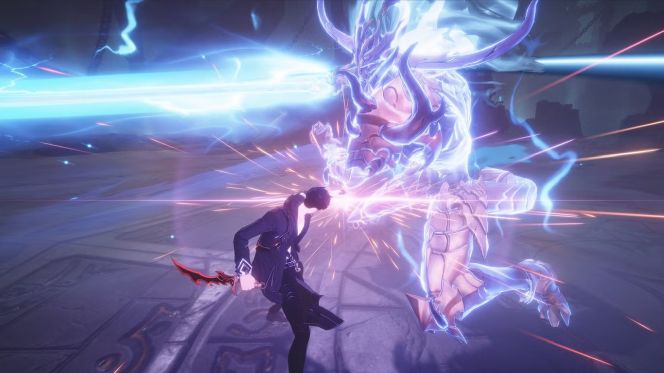
Jinwoo Starts as a God, Then Learns to Walk Again
The opening uses the familiar but still effective formula of showing the hero at full power before taking everything away again. Jinwoo begins with access to his abilities, then the first major mission sends the player back to the period when he was only beginning to understand his powers. It is not a revolutionary idea, but it supports the fantasy well: players do not simply tick new skills off a list, they gradually experience how the hero becomes an unstoppable one-man solution to increasingly unreasonable problems.
The narrative presentation is more uneven. Important scenes receive proper voice work, characters speak, and larger dramatic moments have some weight, but the game often switches to webtoon-like still images, speech bubbles, and comic-book panels. Fans of the source material may enjoy seeing familiar scenes translated into the game, yet newcomers may struggle to connect more deeply when so much of the storytelling leans on visual recaps rather than fully staged sequences.
Jinwoo’s attempt to save his mother and eventually the wider world is at least more than a hurried greatest-hits collection. New scenes written for the game explain more about the setting and its characters, which is particularly helpful for people who have not watched the anime or read the webtoon. The problem is that those additions do not always receive enough variety to create genuinely fresh momentum between the major story beats.
On Normal difficulty, the campaign takes roughly fourteen to fifteen hours to complete. A harder difficulty option exists, but the game does not build enough around it to make replaying the whole adventure feel necessary. This is a very traditional one-and-done game, the kind you may pull from the shelf again in a few years when you suddenly want to see a weak Hunter become the sort of person bosses worry about before they have even heard his name.
Jinwoo’s growth still feels satisfying. His movement is quick, his attacks are dynamic, knocking down powerful enemies feels great, and the game knows how to make the player feel like the hero no longer asks permission from the level before running through it. That power fantasy comes at a cost, though: the systems are too shallow. Active skills are limited, and even skill trees and unlockable weapons do not provide enough freedom for character building to become real experimentation rather than guided progression.

Fast Combat Carries What the Systems Cannot
Solo Leveling: Arise Overdrive is repetitive, but not truly boring. Combat moves quickly, bosses bring the frantic high-energy pace associated with the anime, and encounters offer enough variation to avoid becoming a simple loop of repeating the same buttons against health bars of increasing size. Larger fights work especially well when Jinwoo’s mobility, spectacular attacks, and aggressive enemies all collide at once.
Weapon crafting and upgrades create a simple but effective loop. You defeat monsters, collect the items they drop, then use those materials to create a new weapon or improve an existing one. It will not rewrite the history of role-playing games, but it works well enough to give players a reason to launch one more mission after believing their current arsenal should finally be sufficient for everything.
Visually, Netmarble has adapted the webtoon’s style effectively. Enemy designs are solid, dungeons do not feel like cheap backdrops, and the entire game is immediately recognisable as part of the Solo Leveling universe, only presented with a cleaner and slightly more detailed finish. It is not a technical marvel, but the style works, and the game understands exactly when a major attack or boss entrance needs to arrive with more volume and spectacle.
There is also a four-player co-op raid mode, where tougher challenges require players to coordinate their roles. On paper, this could become the part that keeps the game alive in the long term, but it is still far too early to know whether that will happen. Without new content, new challenges, and better reasons to return, the raids may end up exactly where many similar endgame modes do: everyone knows what needs to be done, but no one wants to do it anymore.
Fans Get a Useful Gate, Everyone Else Should Think First
The major question is who Arise Overdrive is actually for. Fans of the franchise are the easiest group to recommend it to, because the game translates Jinwoo’s growth into interactive form effectively, revisits familiar events, and lets players experience the power fantasy that made Solo Leveling so popular. Anyone who enjoys the anime or webtoon will find enough to like despite the game’s obvious flaws.
For people who have never heard of the series, recommending it becomes harder. The story is understandable, combat is fun, and the visuals work, but shallow systems, a short campaign, and uncertain long-term raid support mean this is not the game that will sell the Solo Leveling universe to absolutely everyone. Watching a few longer gameplay videos before buying is a much safer approach.
Arise Overdrive ultimately lands as a decent action RPG, but not one whose name should automatically make players sit up. It is stylish, atmospheric, quick, and at its best it genuinely makes standing in Jinwoo’s shoes enjoyable, when almost every enemy begins to look like another source of experience points. The shallow character building, limited story depth, and uncertain raid future remain obstacles that even the strongest shadow army cannot completely hide.
-Gergely Herpai „BadSector”-
Pros:
+ The webtoon’s visual identity translates well into a game.
+ Fast, flashy, and enjoyable action RPG combat.
+ Jinwoo’s progression feels satisfying from beginning to end.
Cons:
– Gameplay and character building remain too shallow.
– The storytelling needs more variety and deeper treatment.
– The long-term future of the raid mode remains completely uncertain.
Developer: Netmarble Neo
Publisher: Netmarble
Genre: action RPG
Release date: November 24, 2025
Solo Leveling: Arise Overdrive
Gameplay - 6.8
Graphics - 7.7
Story - 5.3
Music/audio - 7.2
Ambience - 6.9
6.8
FAIR
Solo Leveling: Arise Overdrive is a stylish, enjoyable action RPG that captures the franchise’s mood effectively and makes Jinwoo’s growth genuinely satisfying. Its shallow systems, short campaign, and weak replay value prevent it from fully matching the scale of its own power fantasy. Solo Leveling fans should give it a chance, while everyone else should first decide how much repetition they are willing to accept.





![Moon Studios Has Postponed the Release of No Rest for the Wicked! [VIDEO]](https://thegeek.games/wp-content/uploads/2024/04/thegeek-no-rest-for-the-wicked-2024-302x180.jpg)

![Dragon’s Dogma II: Dark Arisen: Major Free Update Ahead of the DLC [VIDEO]](https://thegeek.games/wp-content/uploads/2026/09/dragons-dogma-dark-arisen-1280x720-2-302x180.jpg)



Leave a Reply