
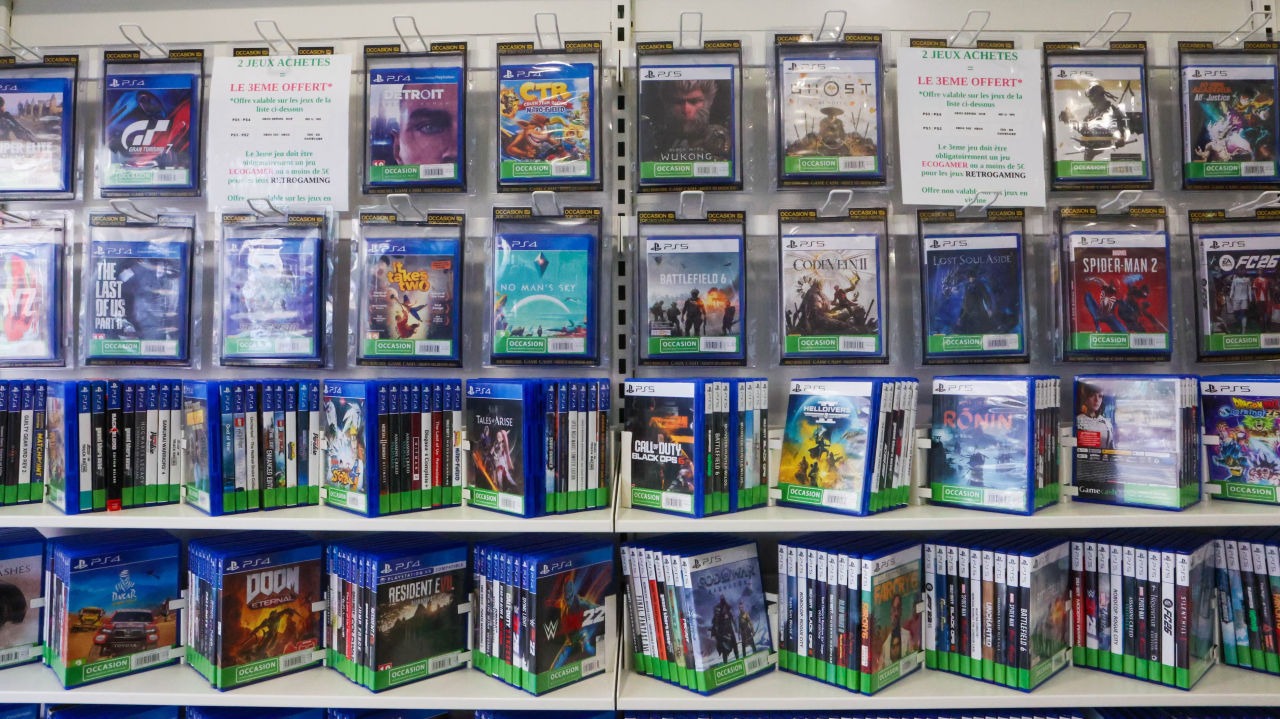
What will happen to all the games currently sitting on your shelf? Sony is moving to digital-only releases from 2028, but it still has not explained how discs already purchased might work on the next PlayStation generation.
Sony has officially announced its abandonment of physical media. Starting January 1, 2028, the company will cease distributing discs and focus exclusively on digital editions. This decision will initially affect only the PlayStation 5, but it sends a clear message for future generations. It is impossible to imagine a future PlayStation 6 including a disc drive, which raises a very reasonable question: what happens to all the games I already have on my shelf?
Two Terrible Options and One Very Bad One
Sony was well aware that, beyond the anger, the announcement would generate doubts among users, especially those who have been loyal to its products for a long time. Despite this, the company has refused to address these concerns or tell us whether there is a plan for its next console, expected in two or three years, to play games we have already purchased. In any case, it all seems to boil down to three options: discarding backward compatibility with physical games, selling a separate disc drive so the PlayStation 6 can play physical games from previous systems, or implementing some system that allows us to digitize our library.
None of these alternatives seem particularly appealing. Limiting backward compatibility to digital formats would be an insult to longtime fans of the brand, and selling a separate disc drive just so the PlayStation 6 can play physical games from older systems would reasonably be seen as the ultimate insult. If the idea of charging extra for the disc drive has not been very popular this generation, I do not even want to imagine the level of protests if this device becomes a kind of tax on backward compatibility.
This would be bad for users, but it could also have disastrous consequences for Sony itself. The PlayStation 6 launch is going to be fraught with challenges. The current RAM shortage suggests that even if the console is delayed until 2028 or 2029, the price will be far higher than reasonable. This situation is compounded by dissatisfaction with the games-as-a-service model, and now there is a breakdown that is both emotional and practical. It is not just that users will feel less connected to the brand due to its policy change, but that there is nothing left to tie them to it. If the games you own do not work on PlayStation 6, what would make you choose that console?
Physical Media Was Not So Long Ago Beyond Question
Consoles are becoming increasingly similar to computers, but they do not offer the advantages that these systems do. There is usually only one store, games tend to be more expensive, subscriptions are required, and the concept of ownership is much less clear. It is not just that, despite its flaws, Steam has built a much stronger relationship of trust with users, but also that there are alternatives like GOG where you truly own, at least de facto, your games. Furthermore, you can browse deals or take advantage of free game giveaways that are not available on other platforms.
All of this leads us to the third option, which is to initiate a digitization process. This is an option that Microsoft seems to be working on for the Xbox Helix, but it also raises many questions. Theoretically, we could convert our disc license into a digital license linked to our Microsoft account and download it to the new console. The disc could then be lent to someone else, who could perform the same process, at which point we would no longer be able to run it on our account since our license would be deactivated. The details of how this system would work, if it is ever launched, have not yet been explained.
This type of technology would be the least bad option, but not necessarily a good one. Ultimately, it is an alternative that would turn our living collection into a bunch of gadgets that, after being used once, no longer serve any clear purpose. We also must not forget that if the new consoles do not include a disc drive, this entire process would have to be carried out on a machine that you would then be forced to maintain in case you get the crazy idea of adding new physical games to your collection. It is a complication of a process that, until now, was very simple. It is also a technology that seems difficult to justify in economic terms, and let us not kid ourselves: maximizing profits is the only thing Sony has been looking for in making this decision.
Source: 3DJuegos

![[GC 2026] Ontos: A Look at Crombie's Experiment [VIDEO]](https://thegeek.games/wp-content/uploads/2026/08/theGeek-Ontos-302x180.jpg)
![[GC 2026] Zoopunk: Three Little Animals Kick and Punch—and Then Some [VIDEO]](https://thegeek.games/wp-content/uploads/2026/08/theGeek-Zoopunk-302x180.jpg)
![[GC 2026] Billy Boyd Joins the Cast of There Are No Ghosts at the Grand [VIDEO]](https://thegeek.games/wp-content/uploads/2026/08/theGeek-There-Are-No-Ghosts-at-the-Grand-302x180.jpg)
![[GC 2026] The Creature-Collecting Roco Kingdom Is Coming to Us from China [VIDEO]](https://thegeek.games/wp-content/uploads/2026/08/theGeek-Roco-Kingdom-clean-302x180.jpg)
![[GC 2026] Tarae: The Unbound: A New Far Eastern Flavor from Krafton [VIDEO]](https://thegeek.games/wp-content/uploads/2026/08/theGeek-Tarae-The-Unbound-302x180.jpg)
![[GC 2026] Like or Die: A Showdown Between Streamers from NCSoft [VIDEO]](https://thegeek.games/wp-content/uploads/2026/08/theGeek-Like-or-Die-clean-302x180.jpg)
![[GC 2026] Final Fantasy VII Revelation: The Planet's Crisis [VIDEO]](https://thegeek.games/wp-content/uploads/2026/08/theGeek-Final-Fantasy-VII-Revelation-302x180.jpg)


![[GC 2026] Ontos: A Look at Crombie's Experiment [VIDEO]](https://thegeek.games/wp-content/uploads/2026/08/theGeek-Ontos-300x365.jpg)
![[GC 2026] Zoopunk: Three Little Animals Kick and Punch—and Then Some [VIDEO]](https://thegeek.games/wp-content/uploads/2026/08/theGeek-Zoopunk-300x365.jpg)
![[GC 2026] Billy Boyd Joins the Cast of There Are No Ghosts at the Grand [VIDEO]](https://thegeek.games/wp-content/uploads/2026/08/theGeek-There-Are-No-Ghosts-at-the-Grand-300x365.jpg)
![[GC 2026] The Creature-Collecting Roco Kingdom Is Coming to Us from China [VIDEO]](https://thegeek.games/wp-content/uploads/2026/08/theGeek-Roco-Kingdom-clean-300x365.jpg)
Leave a Reply