
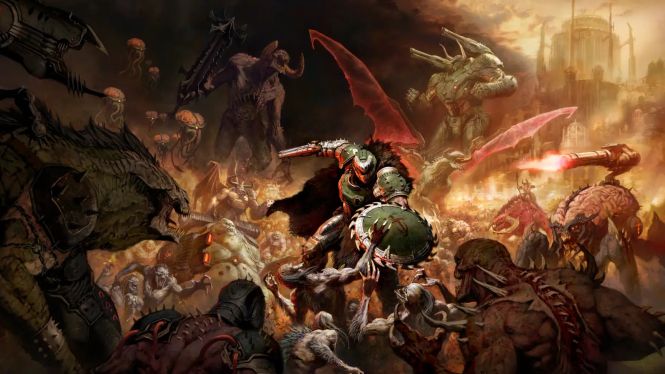
Epic Games’ technology has claimed yet another victim. Now, we’re hearing that id Software’s engine is essentially finished.
Microsoft’s Xbox division is expected to lay off 3,200 employees over the course of a year, which will significantly impact all studios operating under the company’s umbrella. id Software is one of the hardest-hit development studios. Not only were 136 developers laid off, but reportedly, the entire id Tech team (or a large portion of it) was also let go. This team worked on the impressive game engine that powered titles such as the DOOM reboot trilogy and Indiana Jones and the Great Circle. Sources told Kotaku that key positions were eliminated and entire teams were disbanded. This included the team responsible for the id Tech engine, leaving only one employee.
Such drastic downsizing of the id Tech team is tragic. Talented professionals have lost their jobs, and the remaining team member will be unable to implement fixes and updates to the engine without rehiring those who were laid off—the people with the necessary expertise for testing. The in-house expertise is lacking, and id Tech will likely disappear forever.
It is not yet clear whether the Frankfurt team will be able to fill the void, but it currently appears that this may be the end for one of the most impressive modern game engines. id Tech has provided numerous examples of how ray tracing and path tracing can transform games like DOOM: The Dark Ages and Indiana Jones and the Great Circle. It has also demonstrated how to achieve state-of-the-art graphics with excellent performance; DOOM Eternal remains a paragon of optimization.
As more developers choose Unreal Engine 5 (and likely Unreal Engine 6, with its controversial AI features, when it is released later this year) for their projects, the dominance of Epic Games’ engine in the industry will only grow stronger. However, this rapid consolidation toward a uniform gaming landscape carries the risk that the technological quirks that once set certain games apart will disappear. It is slowly transforming the creative industry into a sterile landscape where different franchises may eventually exhibit visual similarities. We’ve already seen this repeatedly in recent months with certain Unreal Engine 5–based games.














Leave a Reply