
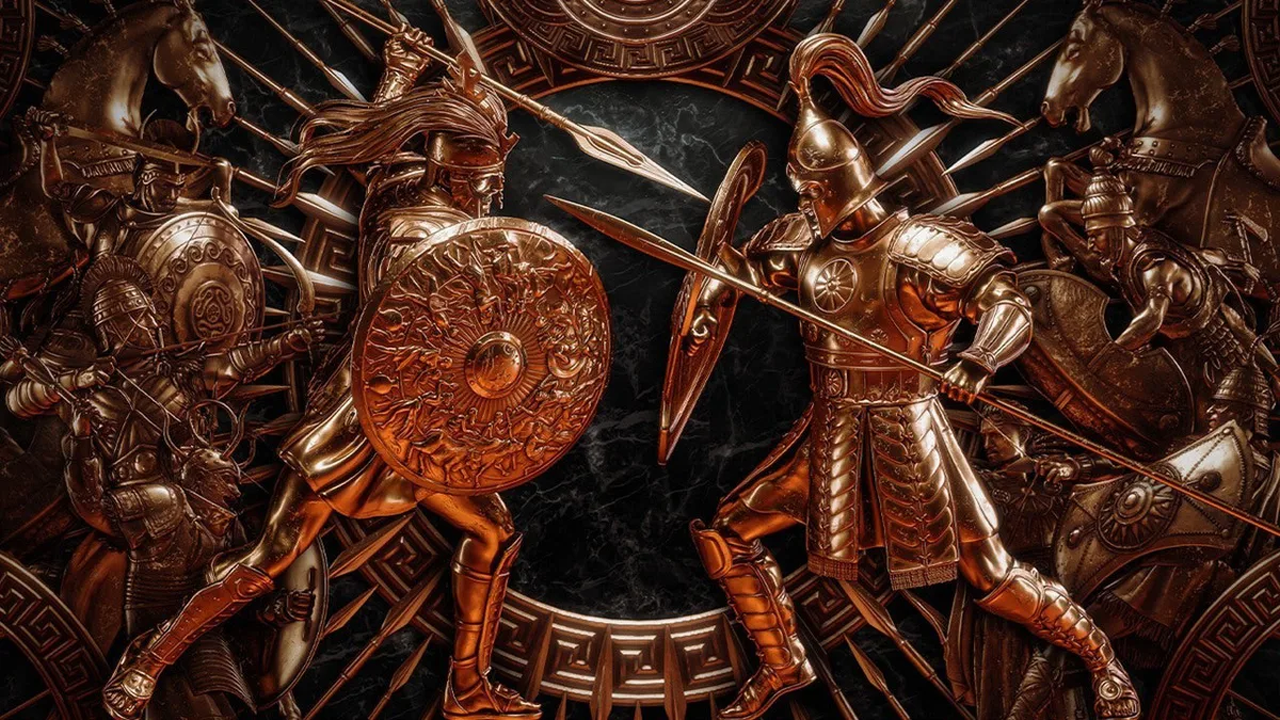
REVIEW – Christopher Nolan’s The Odyssey arrives in cinemas on July 17, 2026, but anyone who wants to explore the Trojan War, the Bronze Age Aegean, and that strange border where history becomes myth should revisit Creative Assembly Sofia’s six-year-old strategy game first. A Total War Saga: Troy is not a history book, nor does it try to turn Homer into an archaeological report, yet it shows more curiosity about the reality behind the era than most screen adaptations. On Eneba, it currently costs about $10 including the service fee, roughly the price of a Big Mac meal at McDonald’s.
When Nolan revealed the first images from The Odyssey, the internet divided almost immediately. One side argued that the director obviously knew what he was doing, because after The Dark Knight trilogy, Interstellar, and Oppenheimer, nobody needs to explain to him how to bring a monumental story to the screen. The other side wondered why helmets and armour combining different periods of Greek history appeared in a story whose roots reach far beyond Classical Greece.
That alone says nothing about the quality of the film. A director has every right to interpret Homer through a personal vision rather than turn the result into a museum exhibition, and Nolan has always constructed realism according to his own rules. The interesting part is that Creative Assembly Sofia faced exactly the same problem in 2020 and approached it from the opposite direction: how can a game depict the Trojan War without pretending every myth literally happened, while still preserving the elements that have kept people telling these stories for three thousand years?
The answer became the “Truth Behind the Myth” philosophy. The developers created neither a documentary nor pure fantasy. Instead, they attempted to reverse-engineer the real events, people, misunderstandings, and exaggerations that may have produced Homer’s legends. It was an especially ambitious task for a period with very few surviving contemporary written sources.

The Bronze Age Was Not Hollywood’s Costume Department
For centuries, the Trojan War was treated as a simple legend until Heinrich Schliemann’s excavations brought new attention to a world that had existed roughly a thousand years before Homer. Historians still do not claim that Achilles, Hector, or Agamemnon walked through the Bronze Age Aegean exactly as described in The Iliad. They do, however, accept that a conflict in the region may have inspired a story that centuries of oral tradition gradually filled with gods, demigods, and superhuman heroes.
The difficulty is that this world mainly speaks through objects. Weapons, graves, frescoes, pottery, fortifications, and fragmented records survive, but nobody left behind a manual explaining exactly how Priam’s soldiers dressed, how Agamemnon’s armies fought, or which helmet Odysseus wore on days when he felt particularly clever. The developers therefore built their world from archaeological publications, Mycenaean finds, and historical reconstructions.
The result is immediately visible in the armies. Instead of the Corinthian helmets, orderly hoplites, and anatomically enthusiastic breastplates familiar from traditional Greek epics, we see boar-tusk helmets, enormous shields, and bronze armour inspired by the Dendra panoply. The game is still not a perfectly accurate reconstruction. It occasionally mixes later Greek imagery with Bronze Age equipment, while several designs clearly serve gameplay readability more than archaeology.
Even so, the desire to avoid the version of Ancient Greece that Hollywood spent decades burning into popular culture remains obvious. Cities, landscapes, weapons, and soldiers represent the archaeological layer, while the painted-pottery interface, narration, and selected visual elements reflect how later Greeks may have imagined their legendary past. History and myth do not cancel each other out here. They become two perspectives on the same story.
There is one difficult decision to defend: the Trojan Horse does not receive the central role one might reasonably expect from a game about the Trojan War. It can be unlocked through research, but the result still feels like a Batman game where Batman only appears in the technology tree. The decision does not ruin the campaign, yet reducing the most iconic element of the entire legend remains a strange act of self-restraint.

The Minotaur Who Became a Legend Thanks to a Good Helmet
The most interesting part of “Truth Behind the Myth” is the way the game handles supernatural creatures. The Minotaur is not a half-man, half-bull monster, but a gigantic warrior wearing an enormous horned helmet. Centaurs are not human torsos growing from horses. They are riders covered in brown leather who could, from a distance, create the illusion that human and animal anatomy had merged into one body.
The approach comes from euhemerism, the idea that myths grew from real people and events before centuries of storytelling distorted, enlarged, and filled them with supernatural elements. Game director Maya Georgieva described the process as a kind of “cynical scepticism”: legends must be taken apart without mercy, but the qualities that kept them fascinating for thousands of years must also be preserved.
This philosophy is not merely background decoration. Players choose from eight legendary heroes, including Achilles, Hector, Paris, and Menelaus, then build an empire on a turn-based campaign map through diplomacy, trade, alliances, betrayal, and open war. Every so often, the game reminds us that a political promise in the Bronze Age was worth roughly as much as it is several thousand years later.
The economy is built around five resources. Food supports armies, wood and stone fuel construction, bronze produces stronger troops, and rare gold becomes valuable in diplomacy and the recruitment of elite units. This creates a far more interesting strategic map than a system where one pile of money solves every problem. A grain-rich province matters for completely different reasons than a territory with bronze deposits, placing very practical economic interests behind the offended kings and heroic speeches.
Real-time battles reflect the period as well. Infantry dominates the battlefield, making the difference between light, medium, and heavy units, terrain, flanking, and exhaustion far more important than repeated cavalry charges. Heroes remain partly superhuman figures capable of holding off entire groups, but the battles still stay more grounded than the flying monsters and magical destruction of Total War: Warhammer.
Not everything works perfectly. Unit variety can feel too limited, infantry-heavy armies cause longer campaigns to become repetitive, and the artificial intelligence occasionally makes bad decisions with the same confidence Agamemnon displayed when he turned a family dispute into a ten-year war. The Total War foundations remain strong, though, and the combination of expansion, diplomacy, army-building, and real-time combat can still consume dozens of hours.
If You Still Want Monsters, That Costs Extra
Creative Assembly later demonstrated that historical and mythological approaches never needed to exclude each other. The Mythos expansion discarded cautious explanations and introduced actual cyclopes, centaurs, Cerberus, and other creatures from Greek legend. Suddenly, it felt as though a Total War: Warhammer army had sailed into the Aegean after somebody recast every unit for a Greek mythology production.
It is spectacular and entertaining, but difficult to separate from the thought that it should have been part of the original package. The base concept was already built around history and myth existing together, making the full fantasy interpretation feel like an artificially separated second half when sold as paid DLC. The later free Historical mode at least completed the opposite direction: single-entity mythic heroes disappear, generals receive bodyguards, and the campaign becomes far more grounded.
A Total War Saga: Troy can therefore approach the same war in three different ways. Historical mode asks what may actually have happened. “Truth Behind the Myth” searches for human explanations behind the legends. Mythos tells the archaeologists to keep working while we send Cerberus into the enemy’s left flank.
Those approaches together make the game genuinely fascinating, even though accessing the complete package costs more. Its depiction of the Bronze Age remains visually impressive: sunlit coastlines, rocky mountains, menus brought to life from painted pottery, and monumental cities give the game an identity unlike any other Total War. The soundtrack rarely demands centre stage, but its drums, wind instruments, and ominous choirs reinforce the feeling that we are walking through both a lost historical era and a legend polished by centuries of storytelling.
This is where the comparison with Nolan becomes useful again. A Total War Saga: Troy does not prove that the director approached Homer incorrectly, and a film does not need to become an archaeological dissertation to have value. The difference lies in the creative choice. Nolan selected a freer and recognisably personal visual interpretation, while Creative Assembly attempted to imagine the reality hidden beneath stories that gradually became myths.
The latter is no less ambitious. Historical authenticity does not require rejecting fantasy. It means giving fantasy a credible context. A Total War Saga: Troy understands exactly that, which is why six years after release it remains one of the most interesting, beautiful, and thoughtful ways to approach Homer and the Bronze Age. After playing it, at least we will enter The Odyssey knowing that the Corinthian helmet was not the universal baseball cap of every period in Greek history.
-Gergely Herpai „BadSector”-
Developer: Creative Assembly Sofia
Publisher: SEGA
Genre: turn-based strategy, real-time tactics
Release date: August 13, 2020 (Epic Games Store), September 2, 2021 (Steam)
Pros:
+ An intelligent and distinctive reinterpretation of the Bronze Age and Greek mythology.
+ Strong campaign systems, a multi-resource economy, and spectacular real-time battles.
+ An art direction that remains beautiful and a historical atmosphere unlike anything else.
Cons:
– Infantry-heavy battles can become repetitive during longer campaigns.
– Artificial intelligence and diplomacy occasionally revive familiar Total War problems.
– The complete mythological experience of Mythos would have been better as part of the base game.
A Total War Saga: Troy
Gameplay - 8.5
Graphics - 8.9
Mythological Fidelity - 9
Music/audio - 8.4
Ambience - 9.2
8.8
EXCELLENT
Six years after release, A Total War Saga: Troy remains one of the most interesting strategy adaptations of the Trojan War because it does not choose between history and myth, but explores how one may have grown from the other. Its multi-resource campaign, legendary heroes, large-scale battles, and distinctive Bronze Age art direction still provide a strong experience, even though repetitive unit compositions and several familiar Total War weaknesses have become more visible. At this price, it is almost mandatory preparation for Nolan’s The Odyssey, except here Achilles personally beats anyone who failed to study for the exam.







Leave a Reply