REVIEW – Game Freak has put Pokémon aside and attempted to prove that it has considerably more to offer with a dark, large-scale action RPG. Beast of Reincarnation delivers fast, precise and surprisingly thoughtful combat, while the partnership between Emma and Koo carries the adventure through many of its weaker stretches. Its repetitive environments, restrained cast and desperate accumulation of secondary systems nevertheless make this feel very much like the studio’s first serious trip into unfamiliar territory.
Budapest was already sweltering before noon, and opening a window felt less like ventilation than inviting the heat inside to finish the job. The only reasonable alternative was the air-conditioned apartment, an Xbox Series X, a cold drink and the Game Pass version of Beast of Reincarnation. I closed the curtains, settled into the couch and prepared to discover what Game Freak could achieve when it was no longer responsible for arranging small monsters into turn-based encounters. Koo looked larger than most commercially available Pokémon almost immediately, while Emma’s katana made it clear that nobody would be waiting politely for their turn.
The most surprising element is not the genre change itself, but how confidently the game presents its world. Ruined highways, cities reclaimed by vegetation and enormous mutated creatures are held together by strong art direction, while animation and performance are generally respectable. On Xbox Series X, loading is quick and the majority of the campaign runs smoothly. That is especially interesting from a studio whose earlier work occasionally treated the arrival of a distant tree as a significant technical event.
During the opening hours, it is easy to believe that every system exists for a clear reason. Emma fights, Koo supports her, the regions contain hidden paths, and the combat quickly establishes why the adventure is worth continuing. Then the game begins introducing cooking, gardening, chicken farming, ammunition research, bows, crossbows, relics, shrines, several skill trees and a steady supply of equipment bonuses. By that point, it becomes obvious that somebody at Game Freak found it much easier to add ideas than to remove them.
Beast of Reincarnation consequently displays the studio’s strengths and weaknesses at the same time. It approaches an unfamiliar genre with genuine ambition and builds a combat system far more assured than many players will expect. It also tries so hard to demonstrate its range that the campaign becomes crowded with systems of questionable value. At its best, this is an exciting action RPG. At its most indulgent, it feels like a focused thirty-hour adventure carrying a small farming game and several spreadsheets on its back.

Free From Pokémon, Closely Following NieR
The story takes place in the ruins of Japan in the year 4026. Much of humanity has transferred its consciousness into artificial bodies known as Golems, while an infection called the Blight has transformed animals, plants and, in rarer cases, human beings. Smaller infected creatures are known as Malefacts, while the largest and most dangerous mutations are called Nushi. Emma is a Sealer charged with hunting them, absorbing the power stored inside their bodies and gradually approaching both the Beast of Reincarnation and the truth about her own past.
The influences are immediately visible. Ruined civilization, machine bodies, troubled memories and cities reclaimed by nature strongly recall NieR: Automata. Emma’s appearance and movement occasionally suggest Stellar Blade, while several of the huge plant-covered monsters would not seem misplaced in Wild Hearts. Game Freak does not simply copy those games, but it rarely moves far enough from them to make its own ideas dominate the experience.
Emma is infected herself, which grants her extraordinary abilities. Her plant-like hair functions as a controllable limb, creating bridges, pulling her toward higher ledges and supporting aerial attacks. She travels with Koo, an enormous Malefact dog who serves as a narrative companion, combat partner and easily the most likable member of the cast. He is not a deeply written character, but his movement and reactions communicate more than several of Emma’s longer conversations.
The story explains Emma’s emotional distance, but explanation does not make her particularly engaging. She speaks in the same quiet, restrained tone whether discussing death, immediate danger or a personal revelation. Kagura, the rescued girl at the center of Emma’s developing emotional life, is similarly subdued. Their relationship is repeatedly described as important, although the game has more difficulty making it feel important.
Brad, the irritable pilot of the mobile base, Kunai and the mysterious Violet bring more energy to the dialogue. Even with them, the plot spends too much time withholding the information that would actually make it interesting. Flashbacks, unfinished remarks and solemn hints repeat the same mysteries for hours. By the time the larger answers arrive, some of the original curiosity has already disappeared.
That is unfortunate because the background contains material for a far stronger story. The religions of isolated Golem communities, human consciousness preserved inside artificial bodies, the origins of the Blight and nature’s return all deserve more attention. The game briefly introduces these subjects before returning to Emma’s past and Violet’s secrets. That central mystery is not strong enough to carry thirty hours without more help from the characters.

Emma Stays Quiet, Koo Does the Work
The adventure is divided into large sequential regions rather than a genuine open world. These areas contain multiple routes, elevated sections, ruins and hidden spaces, making the opening hours particularly enjoyable to explore. Emma can create crossings with her hair, pull herself onto ledges and attack unaware enemies from above. The vertical design gives the regions more character, and early exploration regularly suggests that another useful discovery may be waiting behind the next ruin.
Rewards include weapons, equipment, ammunition blueprints, upgrade materials and additional abilities for Koo. Dragon Shrines improve healing after enough have been collected, while campfires function as rest points and fast-travel locations. Their placement initially feels sensible, but Game Freak eventually loses all restraint. Some shrines are visible from the previous one, while one large underground chamber contains enough campfires to resemble an exhibition for outdoor equipment rather than an ancient facility.
The abundance of rewards gradually removes the satisfaction from finding them. When almost every side path contains another chest, shrine or upgrade point, exploration stops feeling driven by curiosity. The player begins collecting objects because they are there, not because discovering them remains exciting. Fewer and more carefully hidden rewards would have made the world feel far more deliberate.
The mobile base introduces further systems. Kagura cooks, chickens can be raised for eggs, ingredients grow in a garden, recipes can be researched and meals provide temporary bonuses. Returning to the base is pleasant at first, especially while the routine is still new. Eventually, however, the quantity of ingredients and preparation begins to feel excessive for a collection of fairly simple statistical improvements.
The skill trees are similarly crowded. Numerous branches, requirements, passive effects and similarly named techniques compete for attention, while actual combat usually relies on a smaller group of dependable combinations. I stopped trying to remember the elaborate names and focused on what each upgrade changed, how many points it required and whether it helped dismantle the next armored Golem more efficiently. The menu is more complicated than the decision.
My cat Cicero understood the important part of the game much faster. When a flower-covered, antlered creature leaped toward Emma in full-screen view, he immediately climbed onto the television stand and tried to catch it. The screen survived, the creature survived, and Cicero continued watching the larger bosses with considerable interest. He slept through most of the story scenes. On this occasion, his judgment appeared entirely reasonable.

Steel, Parries and a Tactical Dog Brake
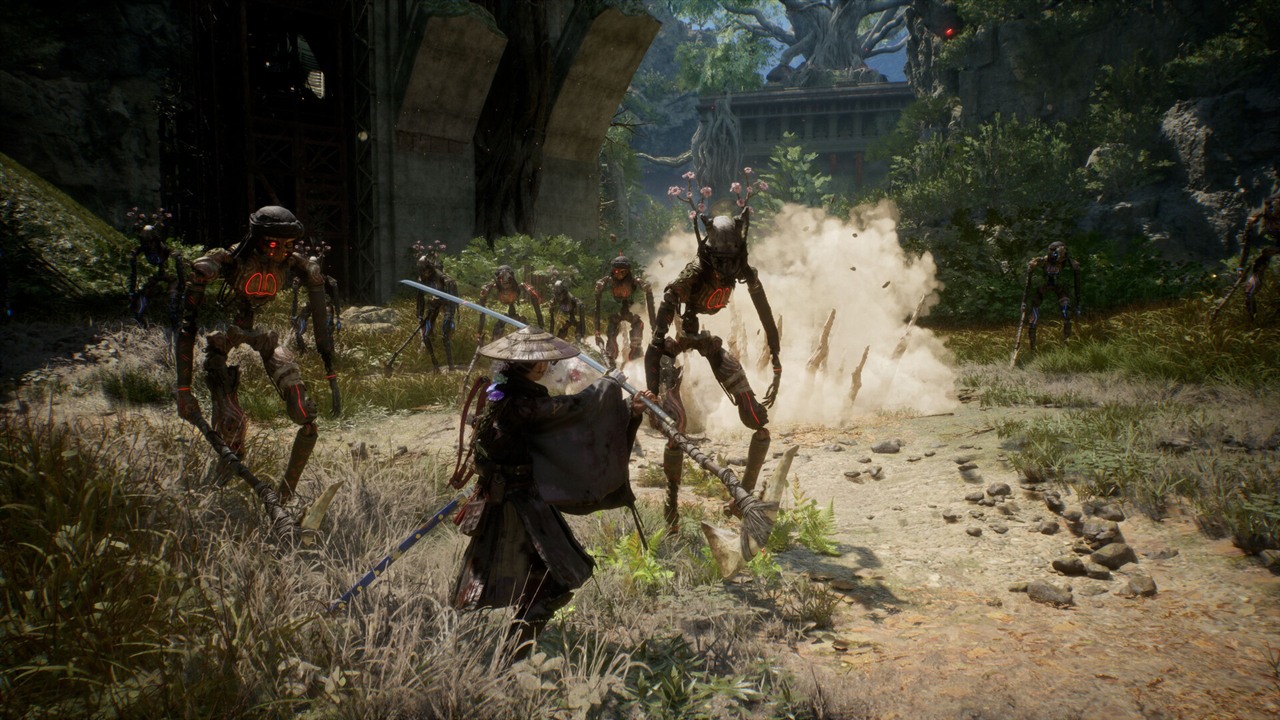
Combat is comfortably the strongest part of the game. Emma’s katana is responsive, individual strikes carry suitable weight, and different blades modify the fighting style through healing, elemental damage or other passive effects. A rapid crossbow and a slower, more powerful bow provide ranged options, while aerial attacks, area techniques and special abilities continue opening throughout the campaign. Combat therefore develops for much longer than either the environments or the narrative.
Parrying is central. Enemy movement usually provides enough warning to anticipate an attack, and Emma responds immediately to the correct input. A successful deflection produces a sharp sound and strong animation, clearly confirming that the timing was correct. Deflecting an entire boss combination creates an excellent rhythm and briefly makes the player feel fully in control rather than merely attempting to survive the effects on the screen.
Red attacks cannot be blocked conventionally and must be avoided through dodging or repositioning. Sustained pressure eventually breaks an enemy’s posture and opens the way for a powerful finishing move. The system is less punishing than Sekiro, but it still refuses to reward careless button pressing. Larger enemies demand attention to timing, position and the correct use of Koo’s abilities.
Koo is far more than a decorative companion. Holding the right shoulder button slows time and opens his ability list. He can bind enemies, apply fire or poison, throw acid or oil and prepare elemental combinations for Emma. The slowdown provides enough time to make a decision without completely interrupting the pace of the fight.
His special abilities consume a limited resource, preventing players from using the entire arsenal against every minor opponent. During tougher encounters, the relationship between the two characters becomes essential. Koo weakens or restrains the target, and Emma immediately uses the opening. When the system is functioning at its best, they feel like a genuine combat pair rather than a hero accompanied by an automated pet.
The Nushi bosses are generally spectacular, large and challenging without pushing the game toward Soulslike punishment. Their structure becomes predictable, however. Emma encounters the creature, wounds it, follows it after it escapes and eventually defeats it in a two-stage battle. The sequence works several times, but later hunts feel increasingly procedural because the player already knows every step.

Too Much of Everything, Not Enough Variety
Repetition becomes one of the game’s largest problems. Reclaimed cities, ruined highways, flooded forests and underground facilities are individually attractive, yet most rely on the same green, gray and brown palette. The consistency creates a strong atmosphere during the opening regions, but the second half offers too few substantial changes. The world remains attractive while revealing surprisingly few new faces.
The enemy selection is also too limited for a campaign of roughly thirty hours. Standard Golems and Malefacts return quickly, and several bosses reappear with minimal alteration. That is particularly disappointing because the combat system could support a much broader range of opponents. Emma and Koo have varied abilities, but they are too often asked to answer the same attacks in the same ways.
Equipment changes have little visible effect on Emma. Armor pieces provide different statistics, but the protagonist wears essentially the same outfit throughout the apocalypse, with only a limited selection of headwear. Several of Koo’s more noticeable cosmetic options are connected to preorder or deluxe content. In a game that distributes equipment constantly, allowing so little of it to appear on the characters is an odd decision.
On Xbox Series X, performance was generally solid throughout my playthrough. The 60 frames-per-second mode rarely produced noticeable instability during combat, loading times remained short and the controls were consistently precise. Effect-heavy moments and larger regions caused occasional minor hesitation, but I encountered no serious technical problems. Some textures and shadows appear less impressive at close range, while character animation can become stiff during dialogue, yet the art direction usually hides these weaknesses.
Audio is strongest in battle. Sword impacts, parries, Koo’s growls and the movement of larger creatures all carry appropriate weight. The music supports the melancholic setting, although few themes remain memorable after the game is closed. Quiet sections occasionally strengthen the sense of isolation, while others simply remain quiet for too long.
The campaign continually moves between two different levels of quality. One is a fast, precise and surprisingly confident action RPG built around an excellent partnership between Emma and Koo. The other is an overextended and repetitive journey convinced that every secondary system deserves equal attention. Whenever the first game dominates, Beast of Reincarnation can be very good. Whenever the second takes control, the pace begins to collapse.
Game Freak has nevertheless demonstrated that it can produce a viable and interesting game outside Pokémon. Beast of Reincarnation is not a polished masterpiece, but it establishes strong foundations and contains several ideas worth carrying into a sequel. A tighter narrative, fewer secondary systems, more varied regions and a broader enemy roster would make a substantial difference. The combat system, however, could return with very few changes.
Through Game Pass, the game is easy to recommend because Emma and Koo’s partnership, the parry-focused combat and the larger bosses are worth several evenings on their own. At full price, the repetitive regions, restrained story and excessive progression systems become much harder to excuse. This dog will never fit inside a Poké Ball, but Koo is still a better companion than most of the human cast.
-Gergely Herpai „BadSector”-
The Game Pass access used for this review was provided by XboxPR.
Developer: Game Freak
Publisher: Fictions
Genre: single-player action RPG
Release: August 4, 2026 (PC, PlayStation 5, Xbox Series X|S)
Pros:
+ Fast, responsive and satisfying parry-focused combat.
+ Emma and Koo’s combined abilities provide genuine tactical depth.
+ Strong art direction and rewarding early exploration.
Cons:
– Emma and several important characters are overly restrained.
– Environments, enemies and boss structures become repetitive too quickly.
– Cooking, gardening and convoluted progression systems unnecessarily bloat the adventure.
Beast of Reincarnation
Gameplay - 8.2
Graphics - 7.6
Story - 6.1
Music/Sound - 7.2
Atmosphere - 6.9
7.2
GOOD
Beast of Reincarnation proves that Game Freak can create an interesting game outside Pokémon through its strong combat system and effective partnership between Emma and Koo. Its narrative, repetitive environments and excessive secondary systems repeatedly interrupt that momentum. It is a good Game Pass choice, while full-price buyers should mainly be players willing to tolerate the slower stretches in exchange for excellent sword combat.