
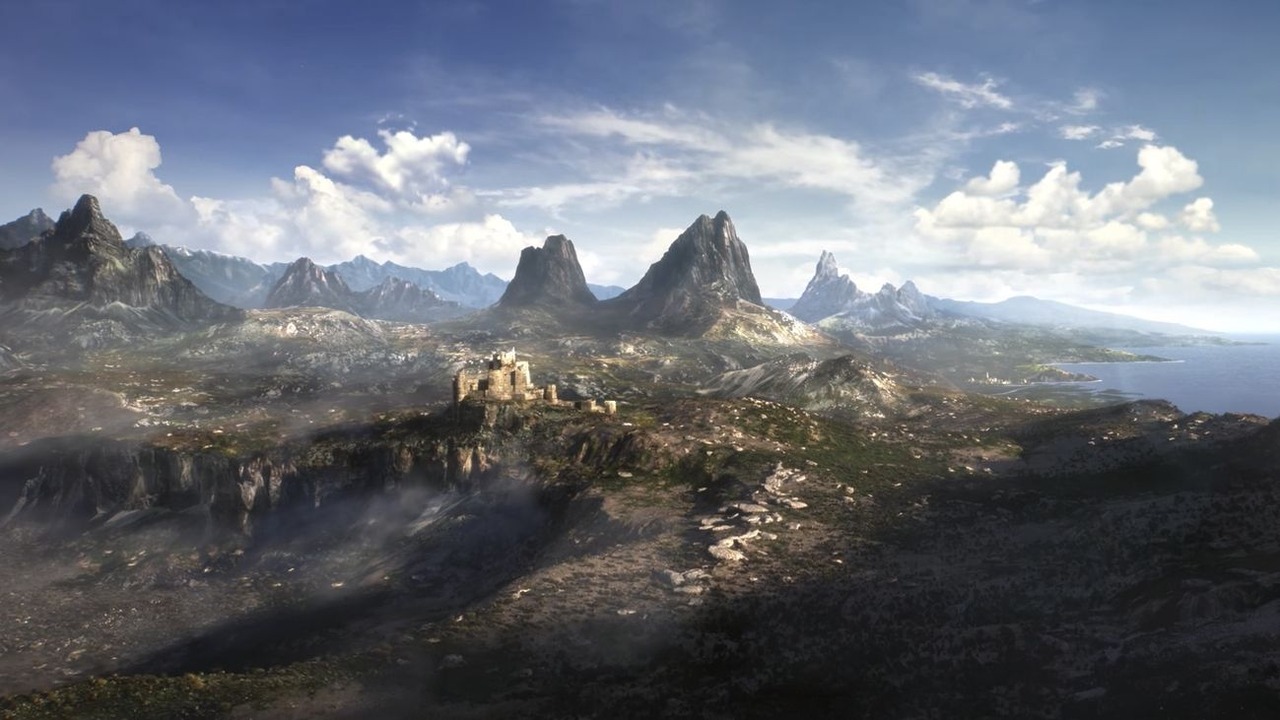
Many Bethesda developers reportedly assumed that The Elder Scrolls VI would naturally follow Fallout 4, but Todd Howard had a very different roadmap in mind. According to Skyrim co-lead Kurt Kuhlmann, Fallout 76 came first and was then followed by Howard’s long-held dream project, Starfield, even though much of the studio would have preferred to return to Tamriel.
After the enormous success of The Elder Scrolls V: Skyrim in 2011, it would hardly have been surprising for Bethesda to move directly toward another Elder Scrolls game once Fallout 4 was finished. Kurt Kuhlmann, a longtime developer on the franchise and one of Skyrim‘s co-leads, told FRVR that this was essentially what people inside the studio expected to happen. “We all expected [TES6] to be directly after Fallout 4,” he recalled. “Why wouldn’t it be? That’s what we were doing, and that was kind of the expectation.” Then Fallout 76 entered the picture and Bethesda’s roadmap began moving in an entirely different direction.
According to Kuhlmann, the multiplayer Fallout project was not originally supposed to consume the full attention of Bethesda Game Studios’ main team. The initial plan was for BattleCry Studios, now known as Bethesda Austin, to shoulder much of the project, with developers from the primary studio assisting in supporting roles where necessary. Things ultimately changed, and Fallout 76 required significantly more involvement from Bethesda’s core developers than initially expected. Even then, Kuhlmann says many people still wanted the next major project to be The Elder Scrolls VI, until Todd Howard told the team that something else was coming first.
“Todd was like: ‘No, we’re doing Starfield. I got that approved. It’s going to be a new IP. It’s going to be this ambitious game. It’s going to be the greatest space RPG ever made,’” Kuhlmann recalled. Starfield had long been one of Howard’s dream projects, and after the back-to-back success of Skyrim and Fallout 4, Bethesda’s executive producer had enough influence to push for an entirely new science-fiction universe. Kuhlmann believes convincing ZeniMax leadership to approve that decision must have been difficult in itself: Bethesda already had two enormously successful franchises, yet Howard was asking the company to delay the obvious next Elder Scrolls release in favor of a costly and risky new IP.
The decision, however, was apparently not the result of a wave of studio-wide enthusiasm for making a space game. Kuhlmann said he personally would have much rather been working on The Elder Scrolls VI than on Fallout 76 and Starfield, and he suspects that sentiment applied to much of the studio. “That’s what most of us wanted to do,” he explained. In his telling, Starfield was not born from everyone approaching Howard and demanding a science-fiction RPG. The dynamic was closer to Howard telling the studio: “Guess what, team? We’re making this space game.”
Bethesda’s Development Rhythm Changed Along With It
Prioritizing Fallout 76 and then Starfield did more than push The Elder Scrolls VI further into the future. It also disrupted a development cadence Bethesda had followed comfortably for years, moving back and forth between Fallout’s post-apocalyptic setting and the fantasy worlds of The Elder Scrolls. Kuhlmann considered that rotation healthy because every few years developers could switch into a completely different tone and setting rather than burning out on one universe. Even people who deeply loved one franchise could benefit from temporarily leaving it behind before returning with renewed enthusiasm.
Starfield broke that familiar rhythm by introducing a third major universe into Bethesda’s production cycle. Kuhlmann does not dismiss the game, and he stresses that the studio treated it as an enormously ambitious project and worked hard to create something memorable for science-fiction RPG fans. His own preference nevertheless remained clear, and he believes many colleagues would have been happier returning to Tamriel much sooner. That makes his account particularly interesting because from the outside, Starfield could easily have looked like the collective passion project of the entire studio, whereas Kuhlmann describes it much more as Todd Howard’s personal vision that the wider team was asked to pursue.
The continued presence of The Elder Scrolls Online may also have reduced some of the pressure to produce a new single-player installment immediately. Kuhlmann points out that while Bethesda Game Studios focused on other projects, ZeniMax Online Studios was constantly generating new Elder Scrolls content, meaning the franchise itself never actually disappeared from the market. He personally prefers the traditional single-player side of the series, but acknowledges that for a large number of players, The Elder Scrolls Online has effectively become their primary experience with The Elder Scrolls. For those fans, Tamriel remained an actively expanding world rather than something frozen after Skyrim.
None of that changes how extraordinary the wait for The Elder Scrolls VI has become. Bethesda announced the game with a brief teaser in 2018, yet eight years later it still has no official release window, subtitle or substantial public gameplay presentation. Full production only began much later as Bethesda moved beyond the most intensive work on Starfield. From the player’s perspective, the eventual order of projects therefore became almost the exact opposite of what many Bethesda developers and fans assumed would happen after Fallout 4.
The project is at least no longer an abstract concept existing only on paper. Bethesda has repeatedly indicated that the game can now be played internally and has been moving through major development milestones, even though the company remains in no hurry to reveal it publicly. Recent reports have also indicated that senior Xbox figures have seen the game running and came away impressed by its scale and grandeur. That does not mean release is imminent, but it does confirm that after years of waiting, The Elder Scrolls VI is finally one of Bethesda’s central development efforts.
Perhaps the most ironic part of the story is that the enormous gap before The Elder Scrolls VI was not caused by a single game spending fifteen years in development. Two complete Bethesda projects were deliberately moved ahead of it. Fallout 76 consumed more resources than originally expected, and Starfield then became Todd Howard’s ambitious new universe. Judging from Kuhlmann’s recollection, plenty of people inside Bethesda were asking the same question fans have been repeating for years: when do we finally get to go back to Tamriel?
Source: 3DJuegos















Leave a Reply