
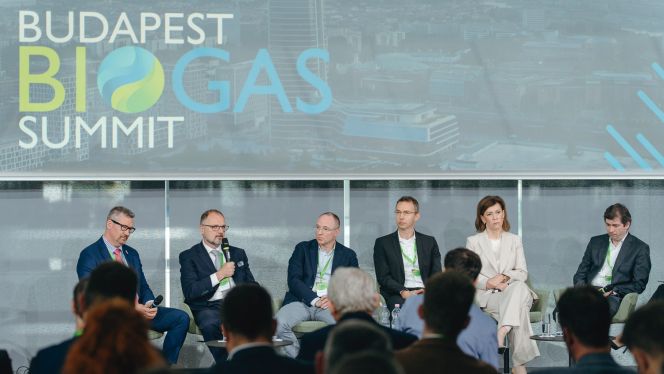
The inaugural Budapest Biogas Summit, organized by White Paper Consulting, brought together representatives from 18 countries and over 100 companies to discuss the role of biogas and biomethane in the energy transition, as well as the opportunities and challenges within the industry.
Speakers and participants agreed that biomethane is a present-day solution for reducing CO₂ emissions. It is one of the cheapest ways to meet the EU’s decarbonization targets and has the key advantage of being compatible with existing natural gas infrastructure without any modification. However, since biomethane is more expensive than natural gas, a stable support system and a clear legal framework are needed to develop the sector.
“Biogas is strategically important for several reasons. It’s a reliable, weather-independent energy source and a foundation for collaboration between agriculture and the energy sector. It also brings a range of social and economic benefits, and it’s the most cost-effective way to meet the goals outlined in the RED III directive,” said Viktor Horváth, Deputy State Secretary for Energy Transition.
He added that the government plans to support biogas and biomethane production with both financial and non-financial tools. A new support scheme worth HUF 40 billion will be launched in the coming weeks.
“Biomethane isn’t a miracle solution, and it won’t dominate the energy market. However, it meets all the criteria of the so-called energy trilemma: it’s sustainable, secure, and affordable,” said Ádám Horváth, Vice President for New and Sustainable Businesses at MOL Group. He noted that MOL already has biomethane projects in Hungary and Croatia, and aims to become a key player in the biomethane value chain in Central and Eastern Europe.
Zsolt Borsányi, Director of MVM Partner – MVM Ceenergy, commented that while MVM is actively seeking profitable biomethane projects, the process is hindered by multiple uncertainties. He stressed that the sector cannot rely solely on subsidies and must adopt models that are sustainable for both producers and consumers.
Other speakers also agreed that biomethane is a vital part of decarbonization, but it should not be discussed only in the context of energy security. Szabolcs Ferencz I., Chairman-CEO of FGSZ, cited an industry survey showing that 255 million cubic meters of biomethane production is a realistic goal for Hungary by 2030, well above the national strategy’s target. Even so, this would only meet 2–3% of Hungary’s gas demand.
The European Biogas Association (EBA) is more optimistic about the future. “Our estimates suggest that biomethane production could reach 101 billion cubic meters by 2040, covering 80% of Europe’s gas fuel needs,” said Anna Odina, Policy Officer at EBA.
There is no rivalry between the biogas and agricultural sectors – close cooperation is essential, since farmers play a key role in providing sustainable raw materials for biogas plants, emphasized Viktória Bodnár, Managing Partner at IFUA Horváth & Partners.
Tom Howes, Advisor at the European Commission, said that the situation is similar across all EU countries – each faces the same challenges. He highlighted two main areas: boosting demand and supporting research and development to increase production from existing feedstocks.
In Poland, major changes have taken place in renewable gas regulation, with important laws passed in the past two years. A new bill currently in parliament, expected to pass this summer, would allow investors to apply for 20-year state support – noted Michał Tarka, founder and director of the Polish Biomethane Organisation (PBO).
Raluca Alexandra Covrig, Director of Public Affairs and Communication at the Romanian Federation of Energy Employers (FPE), highlighted that Romania has significant biogas potential. Biogas capacity is expected to reach 23 megawatts by 2025 and could grow to twice the EU average within a decade.
Ukraine is also a key regional player. According to estimates from the Ukrainian Bioenergy Association, the country could supply 20% of the EU’s 2035 REPowerEU target of 35 billion cubic meters of biomethane. Its greatest advantage is its vast agricultural land.
“The fuel sector is becoming greener, and this shift is irreversible – though it will take time,” said Csaba Zsótér, Executive Vice President for Fuel at MOL. In his view, internal combustion engines will still dominate over the next decade, but with an increasing share of green components. That means there’s no single solution to decarbonizing transport, but rather several competing technologies.
















Leave a Reply