
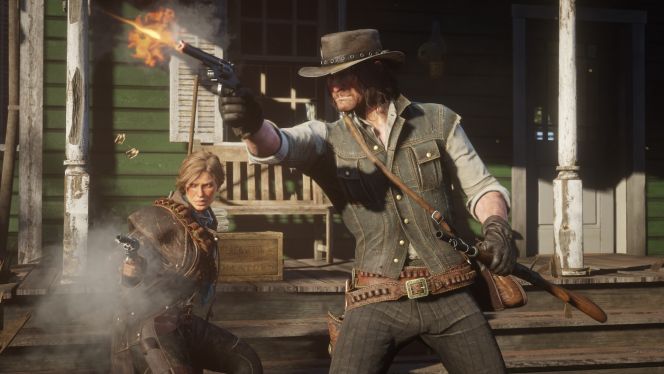
Ray tracing may not be so easy to add to Rockstar Games’ nearly seven-year-old blockbuster, according to Digital Foundry’s latest analysis.
Bringing ray tracing (RT) to Red Dead Redemption 2 would be significantly more challenging than what was done for Grand Theft Auto V, largely due to the sheer complexity and variety of the game’s environments. When a supporter asked if RT could be added in a rumored next-gen remaster, the editors at Digital Foundry pointed out (in the video linked below) that it’s technically possible—after all, RT was added to GTA V on current-gen consoles and PC, meaning the Rage engine can be adapted for it even in older forms.
However, Red Dead Redemption 2 presents a far bigger technical hurdle. The rendering pipeline has changed dramatically since GTA V, and the world of Red Dead Redemption 2 is not only much more varied but also much denser with vegetation. This makes the visual rendering fundamentally different: the absence of glass structures, the predominance of green and brown tones, and the specific way light interacts with this world means that flashy lighting is less obvious than ambient occlusion.
Even if Rockstar were interested in taking on the challenge, it’s unlikely that a complete suite of RT effects would make it in. More likely, we’d see select features—such as RT global illumination, which would enhance the game’s SSAO with static AO that shifts with the time of day. RT ambient occlusion would also be a great fit, while RT shadows might add little, as Red Dead Redemption 2 already features superb shadow rendering.
Even though Red Dead Redemption 2 was released in late 2018, it’s still one of the best-looking open-world games ever made. Most fans would be satisfied just playing the game at a stable 60 FPS on current-gen hardware, even if there weren’t any other visual upgrades at all.
Source: WCCFTech










Leave a Reply