
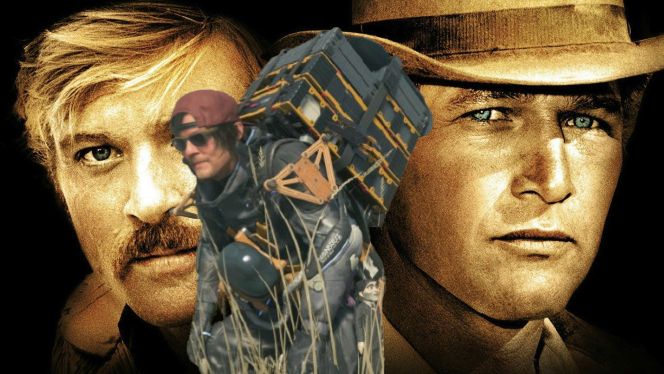
MOVIE NEWS – Hideo Kojima’s latest game isn’t just a showcase of gaming innovation, but a true love letter to cinema history. In Death Stranding 2, one of the most memorable recurring elements is the song Raindrops Keep Fallin’ on My Head, hummed and sung by Rainy and other characters—directly referencing the legendary film Butch Cassidy and the Sundance Kid. The sequence in which Tomorrow’s apple is transformed in the game is a clear nod to the iconic bicycle scene where Paul Newman munches an apple beside Katherine Ross. Kojima doesn’t simply use nostalgia—he transforms it into a sophisticated homage, connecting classic American movies to his own mythos, while also honoring the influence of this Western on games like Red Dead Redemption.
Film has always been Kojima’s creative lifeblood, and in Death Stranding 2, it pulses through every detail. The repeated motif of Raindrops Keep Fallin’ on My Head—a 1969 classic by Burt Bacharach and Hal David—was immortalized as the theme to Butch Cassidy and the Sundance Kid. In the movie’s most unforgettable moment, Paul Newman’s Butch rides a bicycle with Katherine Ross’s Etta, biting into an apple, all set to B. J. Thomas’s award-winning vocals. The use of this song marked a revolution for western soundtracks, and Kojima’s decision to have Sam (Norman Reedus) accept and transform Tomorrow’s apple is a playful, symbolic echo of that moment, giving new meaning to an old cinematic touchstone.
The Layers of Song, Film, and Nostalgia
As Vanity Fair’s analysis reveals, “the song that played in the least expected moment of a western became one of cinema’s most defining musical moments.” That bicycle scene shattered genre conventions, offering joy and freedom instead of grit and violence. Kojima seizes this energy, infusing his world with the same spirit: Rainy’s humming and the omnipresent melody give narrative depth to Death Stranding 2’s journey. The past isn’t just remembered here—it’s reinterpreted and reborn.
The song’s narrative function in Death Stranding 2 goes far beyond a simple soundtrack. It becomes a recurring motif, a bridge between player, character, and story. Kojima’s method is always layered: he transforms nostalgia into meaning, memories into new experiences, and pop culture into universal storytelling.
Red Dead Redemption: Another Heir to Butch Cassidy
Butch Cassidy and the Sundance Kid inspired not only Kojima’s work but also the western legacy in games—most notably, Rockstar’s Red Dead Redemption series. As GameRant describes, the finale of the first Red Dead Redemption and the narrative arc of the sequel borrow heavily from the film’s themes of brotherhood, inevitability, and outlaw romance. “Red Dead Redemption essentially preserves the atmosphere of a wild west world both brutal and poetic, just like Butch Cassidy and the Sundance Kid,” GameRant writes. Fans online have often pointed out how Arthur Morgan and Dutch’s leap in RDR2 is a direct homage to the film’s cliff-jumping climax—cinematic echoes rippling across media.
Kojima, ever the cinephile, recognizes that this legacy is a living thing. The adoption of Raindrops as a narrative device and Tomorrow’s apple as a subtle wink to Paul Newman’s famous bite—these are not mere references but intricate, authorial strokes. In his hands, the game becomes a tapestry of memory, tribute, and reinvention, with cinema and games in constant dialogue.
Kojima’s Cinematic Vision and the Legacy of Pop Culture
Kojima has always claimed his references are not surface-level, but deep narrative tools. In Death Stranding 2, Raindrops Keep Fallin’ on My Head symbolizes both lightness and melancholy; just as in the film, it marks a moment of levity amid chaos. The passing of Tomorrow’s apple is a kind of ritual—an echo of the hope, intimacy, and impermanence of that classic bicycle scene.
Every filmic nod in Death Stranding 2 adds a new layer to its narrative world. For the attentive player, Kojima’s pop-cultural homages are invitations to look deeper—discovering the links that tie past and present, cinema and gaming, memory and meaning. The director honors what came before, even as he shapes the future of interactive storytelling.
Other Western Homages in Kojima’s Games
This isn’t the first time Hideo Kojima has woven cinematic western references into his games. In Metal Gear Solid 3: Snake Eater, there is an iconic radio conversation where Para-Medic discusses the spaghetti westerns of Sergio Leone, like Once Upon a Time in the West and For a Few Dollars More, with Naked Snake. This reference is more than a small wink; it shapes Ocelot’s character: young Revolver Ocelot’s mannerisms, dress, quick-draw style, and his charismatic, self-aware attitude all evoke the archetype of a classic Sergio Leone western hero. Kojima has thus long infused his universes with western motifs, and these cultural touchstones resurface in Death Stranding 2, continuing the creative conversation between cinema and games on a new level.
Source: Vanity Fair, GameRant





Leave a Reply