
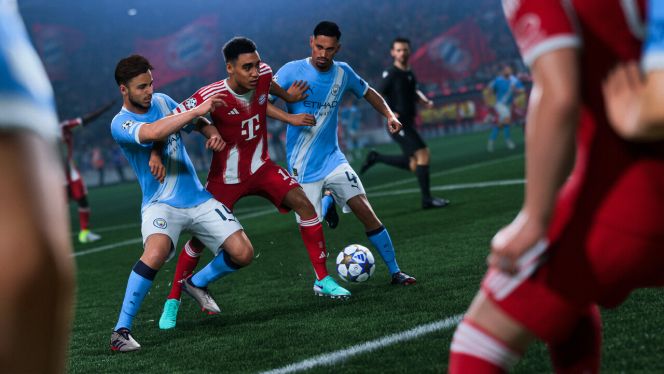
“The priorities have shifted,” says Sam Rivera, the lead producer of EA Sports FC 26, who claims that from now on it’s all about balance: finding common ground between community expectations and the creative vision behind football simulation. But is this truly the dawn of a new era for football games, or are we just hearing more empty promises?
After our first impressions, we finally got the chance to talk with the developers of EA Sports FC 26: is this attention to community feedback really built on solid ground? The future of the franchise now lies in the hands of producer Sam Rivera, who promises a completely new direction with this installment.
Visiting the EA Vancouver offices, it was impossible not to notice how excited fans were about the trailer, whose main message was listening to player criticism. But after so many years—and especially last year’s fiasco—can they really rewrite everything from scratch?
The Community’s Voice: Is It Truly Driving Change?
“This year, we only wanted to fix the issues that the community said were problems.” Rivera explains, looking like someone who finally sees the right path ahead. “If someone says they dislike something for any reason, we immediately rework that area. This has been true since the January FC 25 patch.” The producer believes they can no longer chase their own creative whims if those don’t engage players: “It’s always about balance: what the community wants, and what football simulation means to us. We want to keep this ongoing collaboration going.”
As I listen, I can’t help but wonder: is this the series’ salvation or the beginning of new troubles? Every gamer imagines their perfect football title differently—some crave deeper simulation, others want a faster, arcade-style experience. How can you filter out what should make it into the next patch, and what simply doesn’t work? It’s the definition of management chaos.
“There’s constant, healthy debate among producers, designers, animators, and programmers; almost everything we do demands a serious discussion,” says Rivera, who’s worked at EA for 16 years and knows exactly which ideas work and which are just ‘theoretical concepts.’ “Sometimes there’s a brilliant idea that everyone accepts instantly, but that’s rare. Normally, every single proposal has to be chewed over.” The feedback gets consolidated, analyzed, and then sent to the Design Council for approval.
They’re lucky that, with today’s tools, processing all this feedback is much faster and more efficient than it was twenty years ago. “It’s a long process, but if something doesn’t turn out as we hoped, we fix it quickly. With FC 26, the community asked for faster fixes, so we sped up updates, communication, and feedback handling.”
From the outside, the intention is admirable, but the ever-growing game, with all its new features and the promise of rapid updates, is hard to believe. The key, according to Rivera, is clear: “Priorities have shifted.” The industry and its expectations have changed, and they’ve had to adapt as well. “After the patch, we have to focus on the new game and find the right balance. With EA FC 26, by better understanding the community and being closer to them, we have a clear plan for what we need to do throughout the year—react faster, make more changes, and have all the necessary tools. I won’t go into organizational details, but in terms of gameplay—my area—we’re investing far more than before.”
But there’s Rivera, sitting across from me as his team makes sure he doesn’t let any surprises slip. Suppose they are constantly listening to feedback and making changes throughout the year. In that case, the differences between versions will inevitably shrink, as the game will have undergone significant changes since its release. “Our goal is for the experience to be more balanced by the end of FC 26 and to continue receiving updates. That doesn’t mean there’ll be fewer changes for FC 27: we want to focus more on the current version, and FC 27 will have its own surprises.” Rivera smiles again—not openly mentioning the open world mode, but from his grin, you can tell what he’s hinting at. “There won’t be less innovation year after year; there’ll just be more attention and investment in the current game—this time, FC 26.”
“Our aim is for EA Sports FC 26 to offer a more balanced experience and to keep receiving updates by the end of its lifecycle.”
For years, it was mandatory to showcase revolutionary graphical leaps with every new release, but now the focus is on smaller, incremental changes. These might not be as headline-grabbing as Ultimate Team, but behind the ever-expanding Clubs, Career, and other modes, there’s real development work. “We want the new game to feel genuinely different and more authentic. It’s getting tougher because the game already looks and plays a lot like real football. Still, we have an advanced team working with AI and machine learning—these support pillars like responsiveness, visual quality, depth, and variety. That investment is solid and lets us roll out new features every year.”
It’s hard to imagine how AI can help beyond data processing and stats, but Rivera is passionate about how much more can be accomplished this way. “The challenge is balancing that innovation with what the community wants today—maybe they want us to focus on trivela shots. The goal is to balance innovation with community needs. That’s FC 26’s core idea, and we’ll keep investing in tech. For instance, machine learning-powered goalkeepers are part of that process.” The only question is whether all these promises will be fulfilled by the time EA Sports FC 26 launches this September, or if the community will keep complaining as much as ever. At least, this time, the aim is for their criticism to actually improve the game.
Source: 3djuegos











Leave a Reply