
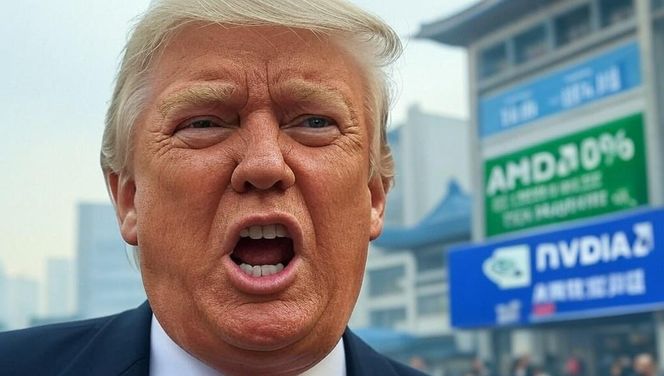
TECH NEWS – According to the terms of the licensing agreement, the two companies must pay a certain percentage of their sales revenue to the US government.
According to the Financial Times, Nvidia and AMD agreed to pay 15% of their sales revenue to the US government as part of an agreement with the Trump administration aimed at securing licenses to sell AI GPUs to China. In July, both companies received a reprieve from the government after their chip sales licenses were put on hold, and on Friday Reuters reported that Nvidia had received the licenses. Both companies have suffered revenue declines due to Chinese sales restrictions. The FT reports that the affected sales involve Nvidia’s H20 GPUs and AMD’s MI308 AI accelerators.
On Friday, the press reported, citing government sources, that the United States had begun issuing AI GPU export licenses to Nvidia after AMD’s CEO revealed in an interview that his company had not yet received approval. In its latest quarterly report, AMD reported a significant decline in operating revenue, which the company attributed in part to a decline in sales in China. Although Nvidia has begun issuing licenses, it is unclear whether AMD’s applications have progressed.
Before the sales restrictions affecting the H20 GPU, Nvidia earned $4.6 billion from GPU sales in the first quarter, with China accounting for 12.5% of the company’s total sales. In May, the company’s shares rose after Nvidia announced that the sales loss due to H20 restrictions was $1 billion less than expected. Global demand for Nvidia’s products and optimistic analyst estimates of long-term AI demand pushed its shares to record highs this year, making Nvidia the world’s most valuable company again after the disastrous DeepSeek sell-off in January.
According to the Financial Times, Nvidia and AMD have agreed to pay 15% of their revenue from chip sales in China to the U.S. government. However, sources do not clarify how the government will use the revenue, as it imposes tariffs on most of its trading partners to reduce the U.S. trade deficit. AMD did not respond to the FT’s request for comment, and Nvidia—while not confirming the levy—noted that it complies with U.S. government rules regarding participation in the global market. Trump could use the money from Chinese AI GPU sales to reduce the trade deficit or further stimulate U.S. chip manufacturing. The 15% commission that Nvidia will pay to the U.S. government could mean that the government will earn more than $2 billion in revenue from Chinese chip sales in 2025. AI GPUs have become a hot topic in U.S.–China trade negotiations, and the Chinese side is eager to see the restrictions lifted.
Beijing is interested in purchasing advanced high-bandwidth memory (HBM) chips, which are also subject to U.S. restrictions because they incorporate U.S. technology in their design and manufacture. HBM chips are key components of AI GPUs, which means that if future chips not approved for sale in China rely on HBM memory, they will be restricted by default even without new rules.














Leave a Reply