
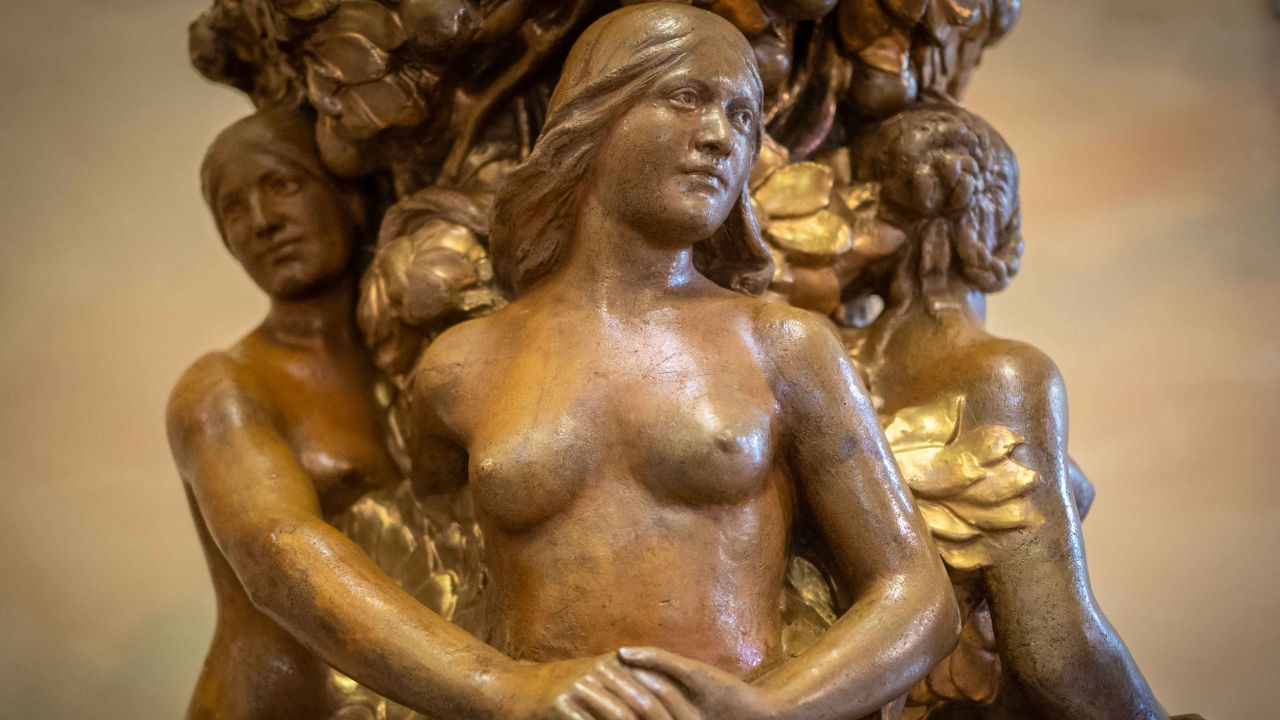
A remarkable work of art has been unveiled in Budapest, one whose very existence had been uncertain for more than a century. Crafted in Pécs, the Zsolnay ceramic piece depicts dancing women around a pomegranate tree and is believed to have adorned the Hungarian Pavilion rebuilt after the devastating fire at the 1906 Milan World’s Fair. After decades hidden from view, the masterpiece recently surfaced at a French auction house. Hungarian collectors András Szabó, founder of the ResoArt Foundation, and István Törő, co-owner of the Virág Judit Gallery, joined forces to bring this invaluable treasure home. The stunning 120-year-old vase was revealed at the Kőrössy Villa in Budapest.
In 2013, the Virág Judit Gallery auctioned off, for what was then a record 19 million forints, a vase that had been the centerpiece of the Hungarian Pavilion at the 1906 Milan World’s Fair. At that time, no one knew a twin piece existed. That changed in spring 2025, when a 109 cm tall, 46 cm wide Zsolnay vase appeared at a French auction, decorated with dancing figures around a pomegranate tree — a symbol of idealized beauty and fertility. The work was created and signed by the legendary Sándor Apáti Abt.
“We instantly realized what it was — the lost, or rather, never-before-seen twin. I called István Törő and we agreed to work together to bring this masterpiece back to Hungary. We are both collectors, and Zsolnay and cultural preservation are causes close to our hearts,” said András Szabó, owner of the Kőrössy Villa.
The Hungarian Pavilion at the 1906 Milan World’s Fair drew huge attention, especially for its applied arts section, widely praised by the international press. On August 3, however, tragedy struck when the building burned down under mysterious circumstances, reducing almost everything to ashes. Miraculously, the pomegranate-themed Zsolnay vase survived, though damaged.
“Twelve years ago, at our Virág Judit Gallery auction, we sold a ceramic piece marked by traces of the fire. The Janus Pannonius Museum acquired it, and it remains one of the highlights of their collection in Pécs. It is a tremendous artistic event that the twin has now surfaced, and together with András Szabó, we managed to secure it,” said István Törő, co-owner of the Virág Judit Gallery.
It is believed that after the pavilion’s destruction, this vase was displayed in its place, as the Zsolnay factory often produced pairs for major exhibitions. Legend has it that the ceramic later belonged to the Romanian royal family.
Zsolnay ceramics are today considered the most valuable examples of Art Nouveau worldwide. Especially prized are the unique, technically masterful pieces created for world exhibitions. The pomegranate tree, a recurring motif in Zsolnay’s work, symbolizes the Tree of Life, a connection between earthly and spiritual realms.
“The pomegranate had outstanding significance in ancient Jewish culture: it was seen as a symbol of fertility, abundance, love, and beauty. Early Christianity adopted it as well. In Hungarian Kalotaszeg and Mezőség embroidery, it symbolized fertility, life, prosperity, and wealth,” explained István Törő.
“Despite its aesthetic and symbolic power, the ceramic doesn’t force its message upon us; rather, it invites admiration and contemplation. It is a magnificent artwork,” added András Szabó.
The collectors have decided to make the vase available to the public. From September 19–23 (opening hours: 11 a.m.–2 p.m.), anyone can view the treasure free of charge in the garden of the Kőrössy Villa. Starting October 1, Milan-themed guided tours and cultural evenings will take place every Wednesday at 6 p.m., honoring the World’s Fair. According to ancient symbolism, the pomegranate tree is said to bring love and fertility, especially recommended for young couples and married pairs wishing to strengthen their bonds. While such beliefs are not guaranteed, the artwork itself offers a unique cultural and artistic experience.
Source: AstoriaAgency

















Leave a Reply