
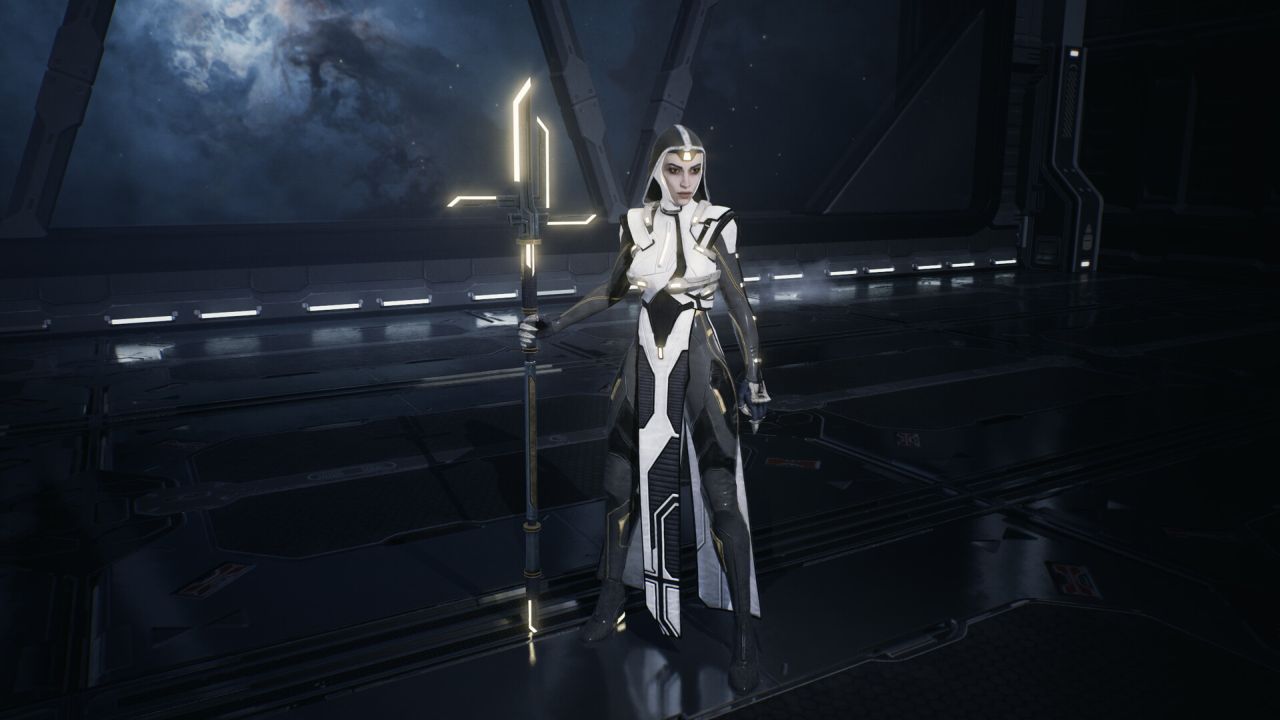
REVIEW – At first glance, 2nd EVE feels like someone took the soulslike template, a doomed colony ship, a spear-wielding nun, and a dose of sci-fi body horror, then shoved the whole thing through an Early Access airlock. Gamer Cloud’s game occasionally shows real promise in its atmosphere and art direction, but its combat, storytelling, and suspiciously artificial-feeling presentation drag it back down from deep space. It is not a hopeless project, but in its current state, it feels more like a rough prototype than something that truly earns the soulslike label.
The protagonist of 2nd EVE is Sister Superior Zola, a nun trying to rescue what remains of the crew aboard the colony ship Argos after something has gone very wrong. Much of the crew has become lifeless husks, while zombie-like creatures, soldiers, and mechanical enemies patrol the ship’s corridors. The setting aims for a cold, industrial, unholy atmosphere, the kind that could easily support a strong sci-fi action RPG. The premise is not bad at all; in fact, a spear-wielding nun wandering through a cursed spaceship is strange enough to make the player at least curious.
The problem is that the game does not yet know what to do with that idea. The story is delivered through short cutscenes, dialogue, and scattered lore fragments, but these rarely give the world real weight. The writing is mostly serviceable, only flat, while the characters lack strong definition and Zola could be far more interesting than she currently is. The biggest issue, however, is the voice acting: several lines are so monotonous and lifeless that it can be hard to tell whether we are hearing tired performances or some kind of machine-made solution slipping through the airlock.

Soulslike With a Spear, but Without Weight
In a soulslike, combat carries everything. The story can be weak, the graphics can be cheaper, and the worldbuilding can be rough, but if attacking, dodging, timing, and reading enemies work, the game can still save itself. In its current form, 2nd EVE fails hardest exactly there. Zola fights with a spear, has a quick attack and a heavier strike, but the latter goes on cooldown, which is already a strange decision in a genre where rhythm and risk are usually shaped by stamina, positioning, and the weight of animations.
The cooldowns too often feel like artificial brakes. It makes sense for certain abilities to recharge: the lightning-like warp push and attacks that knock down or stun enemies are stronger, so they should not be spammed endlessly. But putting the dash on a cooldown cuts into one of the genre’s most important nerves. In a soulslike, dodging should be instinctive, dangerous, but reliable. Here, it feels as if the game sometimes allows the player to survive and sometimes reminds them that even escape requires an appointment.
Enemy variety is not bad on paper. There are zombie-like creatures, soldiers, and mechs, so the game at least tries to present different types of threats. In practice, however, patterns are too easy to read, getting behind enemies is too often the simple solution, and bosses rarely become proper events. They have more attacks, hit harder, and last longer, but they rarely carry that memorable rhythm that makes a good boss fight leave the player swearing and smiling at the same time.
The progression system and terminals found across the ship provide at least some structure. After defeating enemies, abilities can be upgraded, and further improvements can be found on the ship, such as more effective healing. These are useful, but they do not fundamentally change the feeling that 2nd EVE‘s combat is slow, awkward, and too repetitive. The game is not tight enough to work as a strong soulslike, and it is not spectacular enough to carry weaker mechanics as a pure sci-fi action game.

The Argos Looks Good, but Does Not Always Feel Alive
Exploration works somewhat better. The corridors of the Argos, its cargo bays, larger rooms full of cryopods, and cold sci-fi backdrops occasionally add something meaningful to the world. The ship is not especially varied, but its larger interior spaces, layered industrial environments, and lonely oppressive atmosphere at least sell the idea of a dying colony vessel. This part is absolutely needed, because the narrative alone would not be enough to keep the player invested.
The art direction has strengths in places. The dark, synthetic sci-fi environments mixed with religious motifs could serve as the foundation for a much more distinctive game. Zola’s character, the contrast between a nun and futuristic hell, and the oppressive spaces of the ship all suggest that there is some vision here. The problem is that the presentation does not always follow that vision consistently. The loading screens, for example, sometimes look suspiciously artificial, with broken visual details and elements that do not quite belong together. For a small studio, saving resources is understandable, but AI-flavoured visuals now feel less like a technical compromise and more like a trust issue.
The music holds the atmosphere together more effectively. The synth tracks and techno beats fit the cold world of the ship, while darker electronic textures help maintain the oppressive, slightly sacred sci-fi tone the game seems to want. Environmental audio is decent, with ship noise, empty halls, and enemy presence providing enough background texture. It is a shame that the voice acting weakens this atmosphere in several places, because in a world like this, sound should not merely deliver information; it should carry fear, faith, and doubt.
It is important to add that 2nd EVE is an Early Access game, not a finished product. The current version contains only the first three chapters, while the full release is planned to expand later. That gives the project some room to breathe, but not a free pass. Early Access does not mean every flaw should be ignored; it means the direction should be visible. Here, that direction can still be recognized, but the road is full of mechanical and presentational potholes that the game hits far too often.
There Is a Future Here, but It Needs More Than Prayer
In its current state, 2nd EVE is not a good soulslike, and as a sci-fi action RPG, it only partly works. The world concept is interesting, some areas of the ship have atmosphere, and the synth soundtrack does a lot to keep the experience from falling apart completely. But the slow, unresponsive combat, poor use of cooldowns, flat story, weak voice acting, and potentially AI-generated assets make it difficult to truly recommend.
This does not mean the game is beyond saving. The combat could be tightened, the dodge could be redesigned, bosses could become more distinctive, and the voice work and presentation have plenty of room for improvement. The question is whether Gamer Cloud can use Early Access not only to add content, but to recalibrate the game’s basic feel. Because if more chapters arrive with the same combat and the same tone, the Argos will not feel like a colony ship waiting to be saved, but a longer corridor leading toward disappointment.
2nd EVE, then, is more of a promise than a real experience for now. It has atmosphere, an idea, and a few effective sci-fi images, but the game that would shape this vision into something genuinely functional has not yet arrived. Soulslike fans can currently approach it only out of curiosity, while anyone with serious expectations should wait to see whether Early Access truly improves it, or merely expands the already creaking ship.
-Gergely Herpai „BadSector”-
Pro
+ Some areas of the Argos have atmosphere
+ The synth soundtrack fits the world well
+ Early Access means it can still be improved and expanded
Contre
– Slow, awkward, and not responsive enough combat
– The story and voice acting struggle to make the world interesting
– Suspiciously AI-flavoured assets and uneven presentation
Developer: Gamer Cloud
Publisher: Gamer Cloud
Genre: sci-fi action RPG, soulslike
Platforms: PC
Release Date: April 14, 2026 – Early Access
2nd EVE
Gameplay - 4.8
Graphics - 6
Story - 4.5
Music/audio - 6.2
Ambience - 5.8
5.5
AVERAGE
2nd EVE tries to become a soulslike sci-fi action RPG with an atmospheric premise, but its combat and story are currently too weak for that ambition. The Argos and the soundtrack occasionally work, yet the cooldown-heavy combat and flat voice acting damage the experience badly. As an Early Access title, it can still be saved, but for now it is only worth approaching with patient curiosity.





![Moon Studios Has Postponed the Release of No Rest for the Wicked! [VIDEO]](https://thegeek.games/wp-content/uploads/2024/04/thegeek-no-rest-for-the-wicked-2024-302x180.jpg)
![Dragon’s Dogma II: Dark Arisen: Major Free Update Ahead of the DLC [VIDEO]](https://thegeek.games/wp-content/uploads/2026/09/dragons-dogma-dark-arisen-1280x720-2-302x180.jpg)

Leave a Reply