
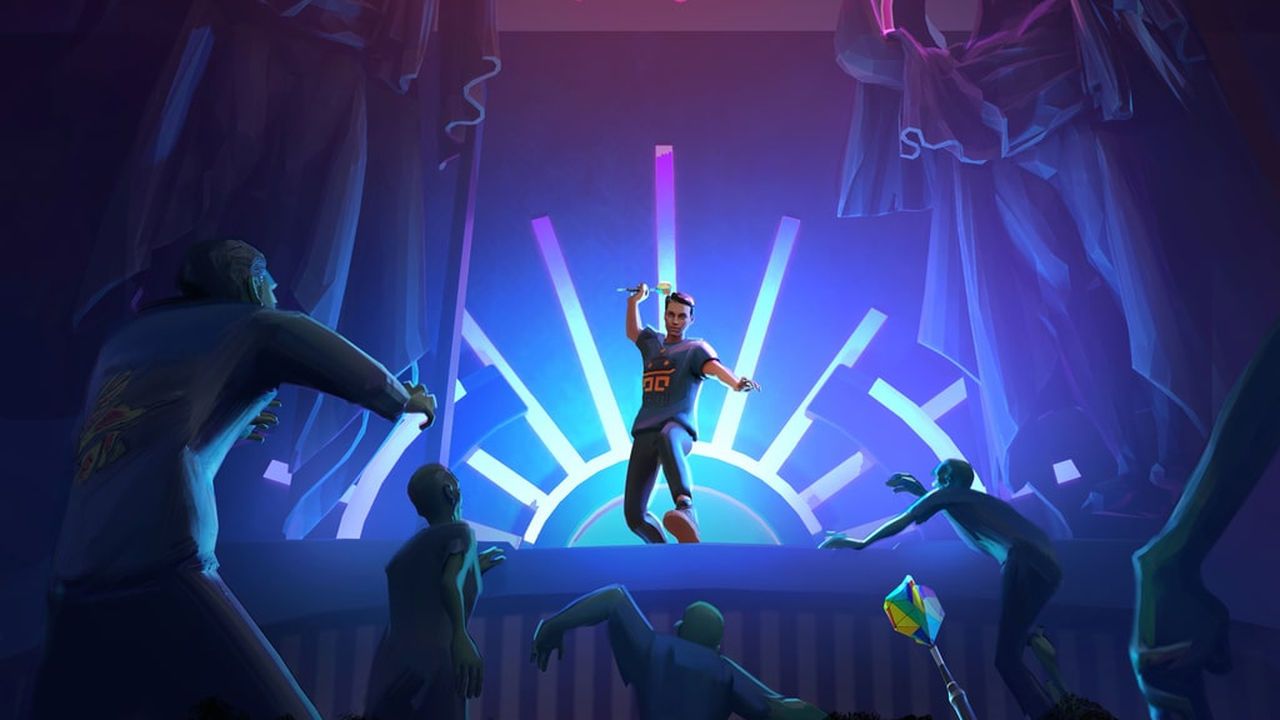
REVIEW – Darts VR2: BullsEye tries to do exactly what makes VR sports games either surprisingly good or quietly abandoned after five minutes: it takes a simple, familiar, pub-flavoured sport and tries to make it feel physical, while occasionally deciding that a few arcade fireworks would not hurt either. Gamitronics Studio’s game is, at its core, a surprisingly respectable darts simulation where the weight of the throw, the wrist movement, the aim, and the nerves all matter. Then it throws in zombies, rhythm-based challenges, and enough side attractions to make you wonder whether the developers left the pub and walked straight into an arcade fever dream.
Darts is always a strange thing to turn into a video game. On paper, a board, a few darts, and some numbers should be enough, but in VR the situation becomes more complicated: if the throw does not feel right, the whole thing collapses. Darts VR2: BullsEye understands this part rather well. It does not try to look like a world championship broadcast, it does not build a pointless story around itself, and it does not pretend that darts has suddenly become the king of video game sports. It simply gives us a board, darts, VR space, and enough modes to make this classic pub sport feel like a serious affair from time to time.
The game is the sequel to 2017’s Darts VR, and that is easy to feel: this is no longer an early VR experiment, but a more focused, more modern version prepared for several current platforms. On PlayStation VR2, Meta Quest, and PCVR, it offers the same basic loop: throw, hit, miss, get annoyed, then throw again. The only real question is how far that can carry a full game, and how much the serious simulation is affected by modes that clearly were not satisfied with the idea of simply throwing darts at a circular board.

The Throw Finally Does Not Feel Like Plastic
The most important part of Darts VR2: BullsEye is its throwing physics, and this is where the game performs quite well. VR darts only works if the player feels that the motion matters: how far the hand is pulled back, the angle of release, how rushed the movement is, and whether the wrist decides to betray its owner. Here, throws have weight, darts do not float around aimlessly, and when a triple 20 or a bullseye lands properly, the result is genuinely satisfying. That little moment of smug satisfaction is the essence of darts, only here it does not require a chalky board, a beer-stained counter, or someone heckling from the corner.
On PlayStation VR2, the haptic feedback improves the sensation nicely. It is not aggressive and does not try to massage your wrist with every throw, but it gives just enough subtle response to make the moment of release and impact feel more physical. This does not turn the game into a technological miracle, but the combination of physics and feedback reaches the point where the player does not blame the system for every bad throw. At least not always, and in VR that already counts as progress.
It is not flawless, of course. During quicker sequences, under pressure, or in multiplayer matches, small inconsistencies can appear. Sometimes the trajectory does not quite match what the player expected from the movement, and at other times tracking or latency can slightly disturb the illusion. These issues do not make Darts VR2: BullsEye unplayable, but they can become irritating in competitive moments. In darts, a millimetre can be a lot, and in VR, one tiny oddity is enough to make you stare at the controller as if it had turned against you on purpose.
The important point is that the sequel feels far more reliable than the original. Gamitronics Studio has not reinvented the sport, but it has managed to make the throw feel like more than a button press wearing a VR costume. There is rhythm, timing, tension, and after a good round, the player feels that ridiculous but familiar urge to play one more. Darts has never been a grand narrative genre, but it knows the lie of one last round very well.

Classic Darts, Properly Assembled
In terms of traditional modes, Darts VR2: BullsEye offers a solid package. 501, Cricket-style variants, and Around the World provide a reliable foundation for players who do not want zombies, rhythm-game elements, or any other VR sauce around the sport. Those who want to play darts really do get darts here: aiming, counting, finishing, pressure, and that very specific punishment of knowing exactly what should be thrown while the hand decides to do something completely different.
The AI difficulty scales well. At lower levels, the game allows the player to settle in instead of immediately behaving as if the ghost of Phil Taylor has moved into the headset. At higher levels, opponents become more accurate and more strategic, making checkouts and consistent targeting more important. That matters because the game remains meaningful in solo play, even if the real flavour of darts still comes from the quiet psychological warfare of playing against another human being.
Around the World works particularly well in VR. Physically following the segments around the board, making small adjustments with the head and hand, and dealing with the target order makes the mode feel fresher than it would on a flat screen. Not because it is revolutionary, but because VR earns its place in exactly these small spatial differences. A darts game does not need a space battle when the board itself already feels close enough to matter.
Still, the traditional modes are slightly conservative. They are well made and work properly, but they rarely go beyond what one would expect from a darts adaptation. This is not necessarily a flaw, because the sport lives from the simplicity of its rules and the difficulty of execution. Even so, it is clear that the developers wanted something flashier next to the traditional modes, as if they were afraid that pure darts could not carry the entire VR package on its own.

When Zombies Wander Into the Bullseye
The arcade modes are where Darts VR2: BullsEye visibly tries to break out of the classic framework. Killstreak, for example, is no longer a simple darts match, but a pressure-based scoring gauntlet where consistency, nerves, and rhythm all matter at once. This is less about the tactical side of the sport and more about how long the player can stay composed while the game increasingly demands one thing: do not miss, or the momentum is gone.
The Zombies mode is even stranger. Here, darts effectively become weapons against incoming undead, which sounds completely absurd at first, but in short bursts it does work. It is not deep, not refined, and not the thing that will make the game a classic, but it has a dumb arcade energy that can be entertaining in VR. The problem is that it moves so far away from the core darts experience that it feels more like a separate minigame than an organic part of the package.
The rhythm-based reinterpretations are also interesting. The rhythm versions of Around the World and Killstreak ask for a different skill: it is not enough to aim, because the throw also has to happen on time. In theory, this is a strong VR idea, because movement, music, and targeting could meet naturally. In practice, the result is mixed. Players who enjoy hybrids may find energy in it, while purists may reasonably wonder why the sport had to be dragged into a dance lesson.
The arcade selection therefore gives the game more variety, but also stretches its identity. One moment, it is a serious physics-based darts simulation; the next, it is a zombie shooting gallery; then it turns into a rhythm game. That variety helps in short sessions, but over time it pulls the overall picture apart slightly. Darts VR2: BullsEye sometimes feels like a pub where a proper darts tournament is happening in one corner, while someone on the other side is trying to hit undead heads under disco lights.

Multiplayer Gives It the Pub Kick
One of the game’s strongest areas is multiplayer. Online matches supporting up to 16 players, league structures, and voice chat are not just simple extras, but a real social foundation for the package. Darts is a social sport by nature: the throw matters, but waiting, talking, pressure, and quietly hoping the other player messes up are just as much a part of the experience.
In larger lobbies, Darts VR2: BullsEye can capture that pub-like atmosphere. It does not need a photorealistic bar to achieve this; it needs people talking, watching, waiting, and occasionally throwing something genuinely impressive. Spectating, leagues, and community structures all suggest that the developers were not simply thinking about a lonely throwing game, but about a longer-term VR meeting place.
The issue is pacing. In darts, waiting is natural, but in VR it can more easily become dead time. In a full 16-player lobby, the time between turns can occasionally drain engagement, especially for players looking for a faster, more immediate VR experience. In a way, the game is authentically modelling the sport, but that authenticity sometimes comes at the cost of patience.
Even so, multiplayer gives Darts VR2: BullsEye its longer-term strength. Throwing alone is fine, but playing against people makes the tension work much better. When someone is waiting for your throw, when you miss the final dart on a checkout, when you hear the others react, the game moves beyond dry simulation. It will not become an esports revolution, but it can give a VR community enough reason to return from time to time.

Clean Target Picture, Little Flash
The presentation is functional, and in this case that is not an insult. Darts VR2: BullsEye does not try to be a visual showcase. The boards are cleanly rendered, the environments are simple, and the pub-style settings provide enough atmosphere to avoid feeling sterile without distracting from the target. In a darts game, that matters more than overdecorated backgrounds, because if board readability suffers, the entire experience falls apart.
On PlayStation VR2, depth and lighting are handled well. Board distance, environmental scale, and hand movement generally feel convincing. This is not the game one shows to a neighbour because the graphics will make their jaw drop, but it is good enough to make VR presence feel natural. Darts VR2: BullsEye does not shout; it simply puts the light where the dart should go.
The sound design is restrained but effective. The dull impact of darts hitting the board, environmental noise, multiplayer ambience, and small reactions all add to immersion without overplaying themselves. This is not a sport that needs orchestral support for a good throw. A dry little thud is enough, followed by either a satisfied nod or silent swearing.
The interface is less elegant. It is functional, but mode selection and multiplayer navigation could be smoother, cleaner, and faster. Menus are always a sensitive point in VR, because something that is only mildly awkward on a flat screen can quickly become irritating inside a headset. Darts VR2: BullsEye does not fail because of this, but the UI sometimes feels like a badly kept score sheet: usable, just not pleasant to look at.
A Good Throw, but Not Always Dead Centre
Overall, Darts VR2: BullsEye is a confident, significantly improved sequel that understands the most important question in VR darts: the feel of the throw matters more than the visuals. In that area, it is strong. The physics are mostly convincing, the classic modes are stable, the multiplayer fits the social nature of the sport well, and the arcade experiments provide enough short-term variety to make the package feel like more than a digital dartboard.
The problem is that the game’s identity sometimes pulls apart. Serious simulation, rhythm-game ideas, and zombie nonsense do not always sit together naturally. The physics are not perfect, the UI is not refined enough, and larger multiplayer sessions may feel slow to some players. None of this ruins the package, but it prevents Darts VR2: BullsEye from becoming a truly outstanding VR sports title.
Those who like darts, own a VR headset, and do not mind the game occasionally leaving the pub for an arcade attraction may be pleasantly surprised. It is not perfect, but it works. And in this genre, that is already more than many VR sports games can say for themselves.
-Gergely Herpai „BadSector”-
Pro
+ Surprisingly good throwing physics and satisfying VR feel
+ Strong multiplayer foundations, with online matches for up to 16 players
+ Classic modes and arcade variations offer solid variety
Against
– Physics and tracking can occasionally stumble in competitive situations
– Arcade modes make the game’s identity feel fragmented
– The interface and multiplayer pacing could be more refined
Developer: Gamitronics Studio
Publisher: Evolution Publishing Ltd.
Genre: VR sports, darts simulation
Platforms: PlayStation VR2, Meta Quest, PCVR/SteamVR
Release Date: April 9, 2026
Darts VR2: BullsEye
Gameplay - 7.8
Graphics - 6.8
Music/Sound - 7.4
Ambience - 8.2
7.6
GOOD
Darts VR2: BullsEye does not revolutionise VR sports games, but its throwing feel, classic modes, and multiplayer foundations make it a genuinely enjoyable darts adaptation. The arcade modes give it extra life, even if they sometimes stretch the identity too far. It does not always hit the bullseye, but it lands near the triple 20 often enough.


![Sony Is Following the Same Path Xbox Took in 2013! [VIDEO]](https://thegeek.games/wp-content/uploads/2026/09/Live-TV-on-PS5-1280x720-exact-302x180.png)











Leave a Reply