
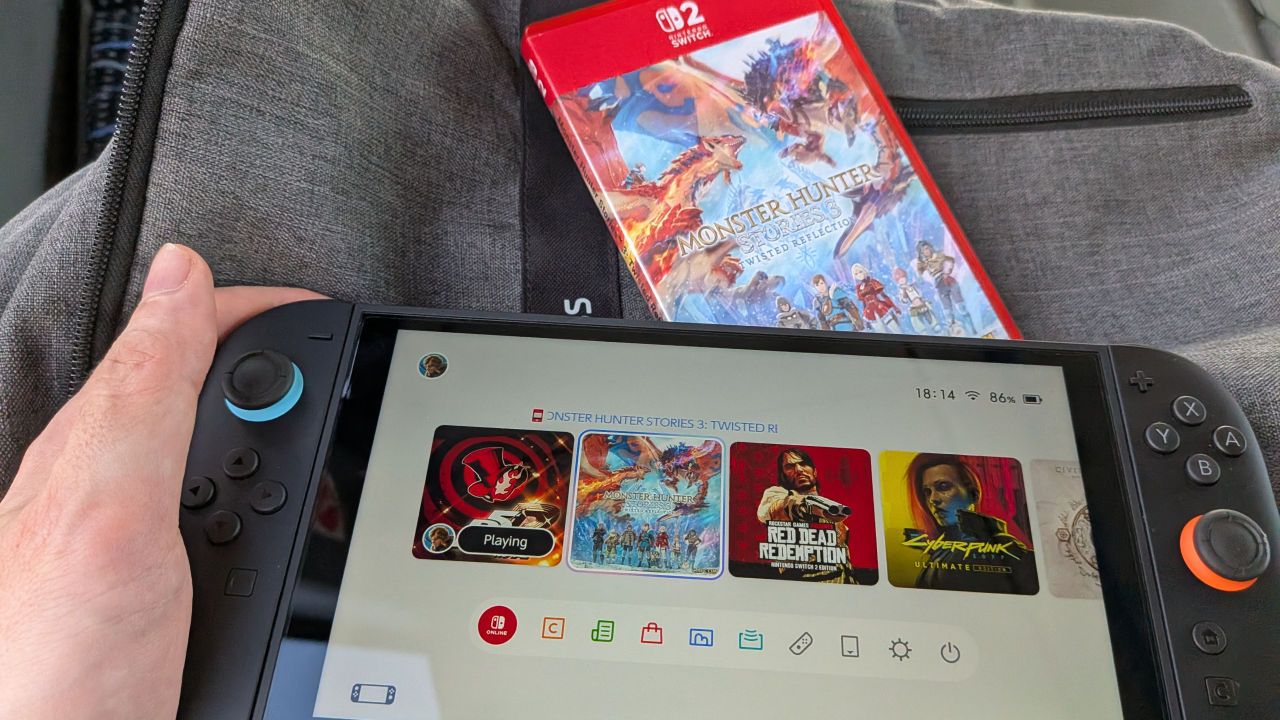
REVIEW – We tested Monster Hunter Stories 3: Twisted Reflection on Nintendo Switch 2, and Capcom’s third Rider adventure makes one thing clear in its opening hours: this series is no longer the cute, colourful side attraction next to Monster Hunter. The eggs, Monsties, turn-based battles, and gene systems are all still here, but the world, conflict, and characters finally carry the weight this series has deserved for years. The complete loss of multiplayer hurts, yet Twisted Reflection is such a strong single-player JRPG that it stays with you not as a spin-off, but as one of Capcom’s best role-playing games this year.
Monster Hunter Stories has always occupied a strange place in Capcom’s monster-hunting universe. While the main series is fundamentally about waking up, finding a giant angry creature, and politely convincing it to relocate with an even larger weapon, Stories offered another idea: do not kill it immediately, steal its egg, hatch it, name it, and then go together to defeat something even bigger. The first two games already made that formula work, but they always carried the impression that this was merely a charming, child-friendly diversion for players who would rather hide inside a Rathalos egg than spend another hour hunting one.
The third game raises the stakes immediately. Two nations drift toward war, the shadow of an older conflict reaches into the present, special Rathalos alter the balance of power, and an ecological crisis threatens the world itself. The collision between Azuria and Vermeil, the mystery surrounding the monsters, and the personal stakes carried by the party create a darker and more serious framework that never needs to apologise for being a spin-off. This is not simply about deciding which Rathalos looks best in the stable anymore.
The protagonist matters enormously here too. Rather than playing the usual helpless JRPG newcomer who spends the first ten hours discovering why their sword is glowing, we play an experienced prince with history, skill, authority, and a genuine role in the world. That decision changes the entire opening. Tutorials no longer feel like exhausting mandatory lessons where the game explains which button attacks. They flow naturally into the story because we are teaching and helping others. For once, we feel like someone important to the world’s events rather than a royal intern accidentally released into the wilderness beside an Anjanath.
The familiar foundations remain intact. We are Riders rather than Hunters, meaning we search dens for eggs, raise Monsties, craft equipment, build teams through the gene system, and keep refining our favourite creatures until something that looked harmless at first becomes the local problem everyone wisely avoids. The Power, Speed, and Technical rock-paper-scissors system remains easy to understand, but now it connects far more effectively with combat, equipment, and Monstie abilities.

The Throne Room Has Monsters Too, They Just Wear Better Clothes
Twisted Reflection’s greatest strength is clearly its story. Earlier entries had emotional moments, and there was always someone prepared to explain very seriously why friendship with monsters matters, but the characters here are more than mission-starting signposts. Eleanor, princess of Vermeil, tries to survive the political and personal pressure around her country, while the rest of the party also receive proper motivations, backgrounds, and arcs. We become interested in them not because they hold the next quest, but because we want to see what they will do next.
Capcom also fully voices the protagonist and the major characters, which makes the entire journey feel far more cinematic. Scenes have rhythm, conflicts have real weight, and a serious twist does not have to survive inside a silent text box while a cheerful Felyne suspiciously cooks something in the background. The English and Japanese voice work is strong, the characters are easier to remember, and several scenes hit harder because of it. It is unfortunate that the game offers no additional dubbing languages, because this story could easily have reached an even wider audience.
The main campaign runs for roughly thirty hours, which may not sound frightening at first, but proper exploration, side quests, den hunting, gear upgrades, and Monstie optimisation can easily push the adventure into the forty-to-fifty-hour range. This is not one of those Japanese role-playing games that declares after twenty hours that everything so far was merely the prologue, but it does not run out of steam just as the party becomes truly likeable. The narrative maintains a steady pace and rarely feels as though it is wasting time with artificial gathering tasks.
Character creation is another well-judged compromise. It does not pretend to be the deepest personalisation system on the market, but it gives enough options to keep the protagonist from looking like every other Rider who escaped from the same royal boarding school. There is one amusingly strange flaw, though: changing the hero’s skin tone or eye colour does not alter the appearance of their parents. Childhood scenes adjust the player character, while mother and father remain untouched, as though genetics were an optional feature planned for a future update.

Rock, Paper, Scissors Finally Has Some Teeth
The combat system looks familiar at first, but Monster Hunter Stories 3 does much more than reheat the strongest ideas of its predecessors. We still need to read enemy attacks, choose when to switch Monsties, decide when a double attack is worthwhile, and spend kinship abilities at the right moment. The new stamina system adds a genuinely meaningful tactical layer, though: by breaking down the meter beneath an enemy’s health, we can exhaust monsters, force them into a weakened state, and open them up for far more effective attacks.
That becomes especially valuable against larger threats. Invasive species and ferocious monsters can appear fairly early, but they quickly demonstrate that the game allowing us to challenge something does not necessarily make challenging it a wise idea. The correct Monstie matters, but gear, weapons, party composition, and basic self-preservation matter just as much. This smartly breaks up the more gradual progression of earlier games, because powerful threats are visible on the map long before we are ready for them.
The weapon range has expanded too, although we still do not receive a full mainline Monster Hunter arsenal. Swords, bows, and hammers remain at the centre of the system, but there are more useful variations within those groups. Their animations are fast, weighty, and easy to read, special moves look fantastic, and kinship attacks still deliver that enjoyably excessive anime energy that can make even an ordinary victory look like the climax of an entire season.
Monsties retain their own impressive animations as well, even if returning players will recognise several familiar moves from older entries. That does not become a serious issue, because the overall pace, direction, and importance of decisions are far stronger now. A well-timed counter, an exhausted enemy, or a perfectly executed double attack delivers the same satisfaction as finally receiving the rare material you wanted after three failed hunts in the main Monster Hunter series.
Exploration has grown richer too. There are more materials, hidden chests, recipes, and smaller rewards worth leaving the main route for. Side quests are less consistent: collect this and defeat that tasks do their job honestly, but they are not especially memorable. Companion quests are much better, because we travel and fight alongside those characters while learning more about who they are and why they matter.
Multiplayer Is Gone, but the Solo Road Is No Longer Empty
The game’s greatest step backward is the complete disappearance of multiplayer. There is no cooperative hunting, no PvP, and none of the shared endgame life that gave Monster Hunter Stories 2: Wings of Ruin another reason to return after the credits. Players who enjoyed the previous game’s online features will understandably miss them. Capcom has clearly chosen to spend that energy on the campaign, the characters, and the story instead.
That choice works overall. Twisted Reflection does not try to throw a small amount of every system at the player and then wonder why none of them stay memorable. It builds a classic, well-paced, emotionally effective JRPG where Monsties remain essential without drowning out the cast or the world’s conflicts. The two Rathalos, the fate of Azuria and Vermeil, and the relationships within the party create a story where saving the world matters for more than the simple reason that somebody has to save it.
The music deserves special praise. Compared to the lighter and more adventurous tone of earlier entries, this game relies on more dramatic, emotional compositions that support its serious direction beautifully. Some players may miss the breezier themes, but the chosen sound is consistent and effective. In major scenes, the score adds real tension and repeatedly turns moments filled with colourful anime characters into unexpectedly powerful emotional scenes.
On Nintendo Switch 2, the game is technically impressive as well. This is the best-looking Stories entry, with more detailed environments, stronger lighting, and a more refined overall presentation without losing the series’ vivid colours. It ran steadily in both TV and handheld modes, we encountered no serious slowdown, and the visual experience does not feel weaker than on the other versions. A texture can occasionally load a moment late during sudden camera movement, but that is a minor cosmetic flaw rather than a meaningful problem.
Monster Hunter Stories 3: Twisted Reflection ends by proving that this series outgrew a second-tier role long ago. Capcom did not force the hunting formula of the main games into a JRPG shell, but built an adventure with its own identity, a surprisingly serious tone, and enormous charm. The lack of multiplayer and limited weapon range prevent perfection, yet when the game leans on its story, characters, battles, or world, it is so confident that a fourth entry should no longer need to prove anything. It simply needs to go even further.
-Gergely Herpai “BadSector”-
Pros:
+ Easily the series’ strongest story and best cast.
+ Deeper, faster, and more tactical turn-based combat.
+ A beautiful, stable, and highly convincing Nintendo Switch 2 version.
Cons:
– The complete loss of multiplayer is a major step back after Stories 2.
– Weapon selection remains narrower than the name suggests.
– Several side quests handle gathering too mechanically.
Developer: Capcom
Publisher: Capcom
Genre: role-playing game
Release date: March 13, 2026, Nintendo Switch 2, PlayStation 5, Xbox Series X|S, PC
Monster Hunter Stories 3: Twisted Reflection
Gameplay - 9.1
Graphics - 9.4
Story - 9.5
Music/audio - 9.3
Ambience - 9.2
9.3
EXCELLENT
Monster Hunter Stories 3: Twisted Reflection finally stands as a major, serious, and excellent JRPG in its own right rather than a charming side branch beside Monster Hunter. Its story, cast, more strategic combat, and Nintendo Switch 2 technical quality create the clear high point of the series. Multiplayer is missed, but Capcom delivers a single-player adventure that makes it very difficult to call this franchise second-tier anymore.


![Stranded Deep 2: After Two Years, We Finally Get to See More of It! [VIDEO]](https://thegeek.games/wp-content/uploads/2026/09/Stranded-Deep-2-1280x720-1-302x180.jpg)
![Sony Is Following the Same Path Xbox Took in 2013! [VIDEO]](https://thegeek.games/wp-content/uploads/2026/09/Live-TV-on-PS5-1280x720-exact-302x180.png)






Leave a Reply