TECH NEWS – Even the top-of-the-line GeForce graphics cards based on the Blackwell architecture have an extremely high power consumption, and it can get even worse.
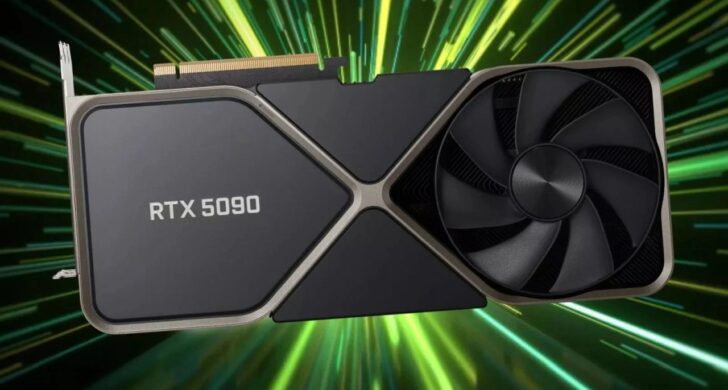
Nvidia’s latest DLSS 5 Neural Rendering technology significantly reduces performance; even the RTX 5090, the top-of-the-line card, can barely maintain triple-digit frames per second (FPS). DLSS 5 certainly places a heavy load on the system. However, it appears that the real bottleneck may be the amount of performance it can draw upon. Tom’s Hardware tested DLSS 5 on the RTX 5090 in a few games, but there was a twist to the story. Rather than testing the new DLSS technology on a single RTX 5090, the site tested the feature on two different RTX 5090 cards. One was the RTX 5090 Founders Edition, which has a power limit of 575W; the other was the MSI RTX 5090 Lightning Z, likely the most powerful 5090 model currently available, with significant headroom.
The RTX 5090 has a single 12V 2×6 power connector; the MSI RTX 5090 Lightning Z, however, can draw massive power (up to 1000W) through its dual-power-connector configuration. The site used OptiScale to integrate DLSS 5 into the games. This reportedly takes eight milliseconds to execute per 4K frame, matching the official Streamline framework. In Cyberpunk 2077, the Lightning Z already outperformed the FE at 4K; however, with DLSS enabled, the performance gap widened to 17%. The Founders Edition consumed 551 W with DLSS 5 enabled, very close to its TDP. In contrast, the Lightning Z drew nearly 723 W, a staggering 24% increase after enabling DLSS 5.
Further tests yielded similar results. For instance, in Hogwarts Legacy, the RTX 5090 FE’s performance dropped more significantly than the RTX 5090 Lightning Z’s. The FE consumed approximately 547W, while the Lightning Z drew over 700W with DLSS 5 enabled. This explains the 16% performance difference between the two cards, despite them producing nearly identical FPS without DLSS 5. In Control, the performance difference was also significant with DLSS 5 enabled. The Lightning Z remained 21–22% faster than the RTX 5090 FE in both cases, mainly because the MSI card consumed 691–802W, while the RTX 5090 FE stayed at 563–575W. While Control may not be the best example to demonstrate the performance impact, other games have already proven this.
DLSS 5 officially launches today in NBA 2K27. In the coming days, we will likely see similar comparisons that may shed light on the performance gap between standard RTX 5090s and premium, overclocked editions that require higher power consumption.
Source: WCCFTech, Tom’s Hardware






![Monster Hunter Wilds: Ascendance’s Daily Boosted Action Overviews Have Begun [VIDEO]](https://thegeek.games/wp-content/uploads/2026/09/bca47e7d475d4cc4-302x180.jpg)
![Lost Museum: Echoes of the Chromageists: Adventures in the Lost Museum [VIDEO]](https://thegeek.games/wp-content/uploads/2026/09/1c2bd0af3f56a59c-1-302x180.jpg)