
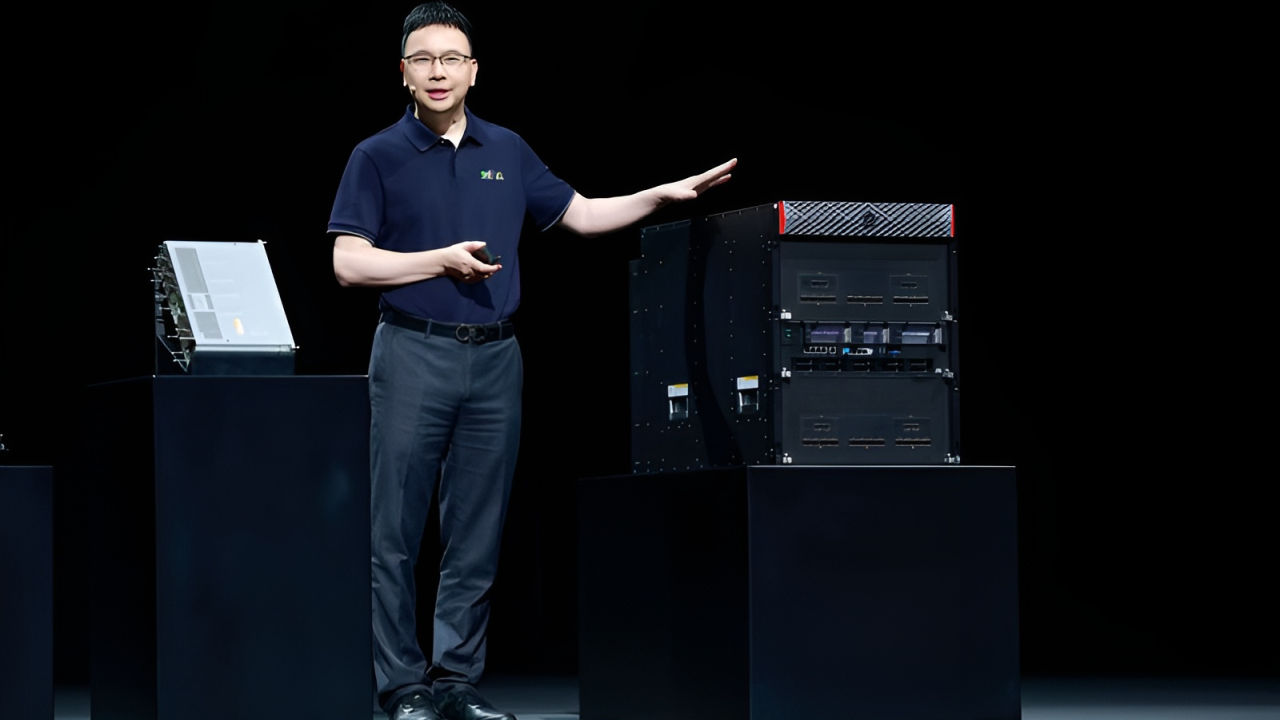
TECH NEWS – The Chinese tech giant will unveil its hardware, which could potentially rival Nvidia’s, for the first time at MWC.
Huawei plans to unveil its most powerful artificial intelligence cluster, the Atlas 950 SuperPoD, marking its first public appearance. Competition for infrastructure in China has become much more aggressive since Beijing decided to double its efforts to prevent American technology from influencing Chinese developers. The recent progress of Huawei, Biren, Cambricon, and Moore Threads has made headlines, mainly due to the country’s efforts to achieve sustainability in the AI race.
Huawei‘s decision to unveil the supercomputer in Europe underscores its ambitions to compete with the global market leader, Nvidia, outside of China and reinforces the idea that China can produce advanced chips. Here’s what we know about the Atlas 950 SuperPoD: Huawei plans to incorporate 8,192 Ascend 950 AI chips, resulting in 8 EFLOPS FP8 and 16 EFLOPS FP16 cumulative performance and a total interconnect bandwidth of 16.3 PB/s. Since memory capacity is essential for performing AI tasks, the Atlas 950 offers 1,152 TB of capacity.
The Atlas 950 SuperPoD will be equipped with Huawei‘s new UnifiedBus interconnect technology, said to be an alternative to Nvidia‘s NVLink. While it remains to be seen whether the Atlas 950 will deliver the announced performance figures, it’s worth noting that Huawei is pushing the limits of energy and thermal efficiency to achieve “impressive” computing results on paper. This is evident from the fact that a single rack contains 8,192 Ascend 950 AI chips. Interestingly, an Atlas 950 rack can reportedly occupy up to 1,000 square meters.
Huawei‘s introduction of the Atlas 950 SuperPoD at this year’s MWC signals its intention to pursue the computing performance race more aggressively. However, the Chinese company is constrained by industry realities when it comes to customer acceptance. Although solutions such as CloudMatrix 384 have emerged as viable alternatives, the real question is whether Huawei will be able to meet the demand for expansion.

Source: WCCFTech, Nikkei Asia












Leave a Reply