
MOVIE REVIEW – At first glance, György Pálfi’s Hen sounds like the kind of idea that either makes you laugh out loud or instantly put your guard up, because Hungarian cinema can be at its most dangerous when it is trying very hard to look unusual. Then Hen steps in not with clowning or gimmicks, but with formal discipline, grotesque humor, and a remarkably ugly view of humanity, and it quickly becomes clear that this is not some festival-ready heap of tossed-off cleverness but a carefully thought-through, uncomfortably timely allegory. Pálfi throws the instinct-driven world of his feathered heroine against a human drama of guilt and crime simmering in the background, and the result is at times genuinely dazzling, at times deliberately uncomfortable, but consistently worth paying attention to. We saw the film at the press screening held at Corvin Mozi on March 11, 2026.
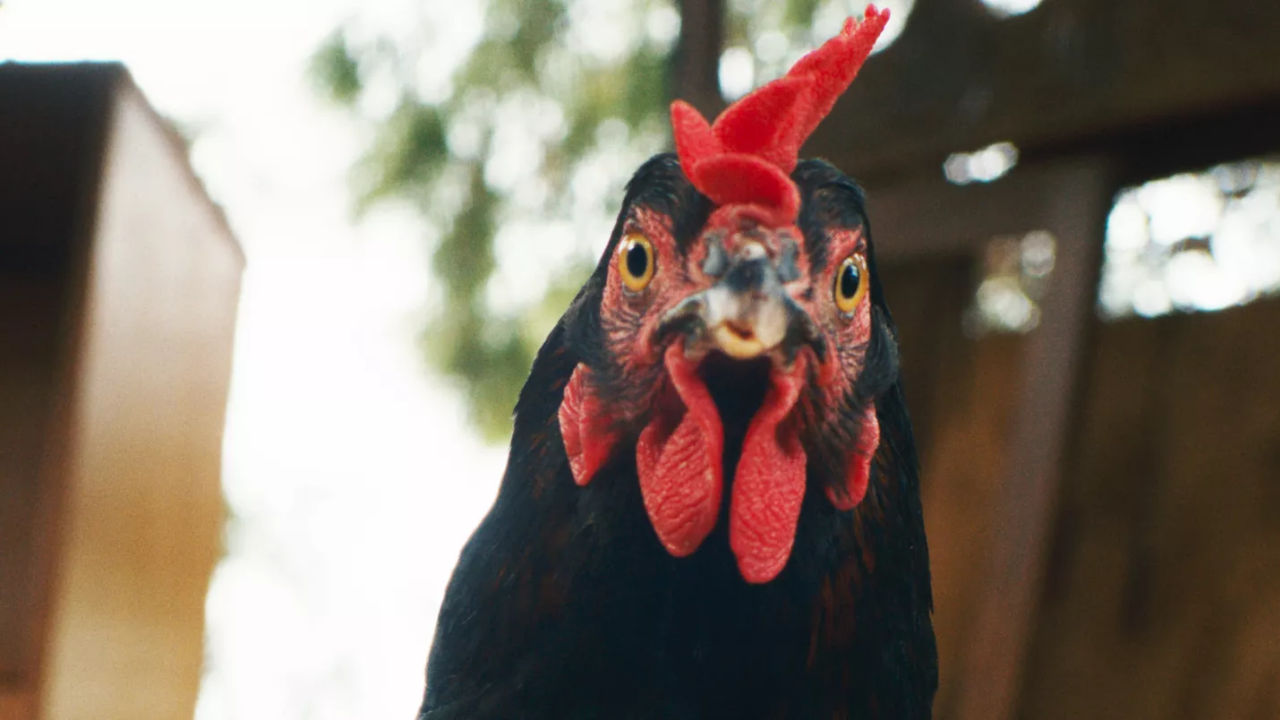
One of Hen’s greatest strengths is that it refuses to rely on cheap tricks in the way so many films now do almost by reflex. There is no CGI chicken guiding the viewer along, no digital sleight of hand trying to Photoshop a soul into an animal’s face, but rather a very precisely conceived film language built around a low vantage point and a patient, watchful eye. Pálfi does not turn the hen into a human being, he turns the hen into a protagonist, and that distinction matters more than anything else. This is not a parody, not a sugar-coated animal tale, and not some concept piece fattened up for festival circulation. It is closer to a grotesque parable in which a creature with one simple, clean goal – to survive, lay eggs, and hatch her chicks – crashes headfirst into the rotten, self-excusing, greedy machinery of the human world.
The premise alone is already more than strong enough: a hen escapes from a farm that means certain death, and after a long stretch of wandering ends up in the courtyard of a ruined Greek restaurant, where she finds love, rivals, a pecking order, and new dangers. But Pálfi, obviously, was never going to be interested in taking a good idea and marching it neatly from point A to point B. In the background of Hen, a human tragedy is also unfolding, and as the film gradually fuses this feathered survival story with the crime simmering behind it, the whole thing turns into an animal tale, a social portrait, a black comedy, and a Greek tragedy all at once. On paper, that could easily sound like the last desperate pitch thrown out in a bad-tempered development meeting, but in Pálfi’s hands it works for a surprisingly long time.

Chicken Fate, Human Filth, and Pálfi’s Grotesque Beautiful Mess
One of the film’s smartest moves is that, while it sticks tightly to the hen’s perspective throughout, it never pretends the animal is suddenly being elevated into some sort of Disney princess. This bird is not wise, not ironic, and definitely not humanly intelligent. What she has is a stubborn, raw survival instinct, and that instantly makes her more interesting than most of the humans around her. Pálfi clearly understands that the hen’s perspective is not compelling because it is cute, but because it is mercilessly simple. She eats, flees, chooses, bonds, protects, survives. Next to that, the human world immediately starts to look like an overcomplicated circus tangled up in its own lies, where everybody is explaining, bargaining, sneaking around, or striking moral poses while failing at the most basic task imaginable: not being awful.
That is exactly why the film’s grotesque humor lands so well. Pálfi does not throw jokes at the screen, he rubs situations against each other until the sparks come out. The hierarchy of the coop, the mating rituals, the scrambling around the eggs, the pompous self-importance of the roosters, the petty greed of the humans – all of it is absurd and painfully recognizable at the same time. One of Hen’s nastiest pleasures is that it never jerks the audience out of the film with loud declarations, and yet it shows with perfect clarity that compassion does not disappear from a world because someone one day decides to become a monster, but because everyone quietly learns how to live with their own little share of ugliness. That is why the film is not sentimental but corrosive. It does not pat you on the head, it calmly slides the point under your nose: this hen has more backbone than a good number of the people in the film.
It also matters that the human drama running in the background is not just decorative wallpaper. This is not a case of a chicken adventure occasionally interrupted by a side plot that would like to seem important, but a case of Pálfi deliberately setting the two worlds against one another. The little winged creature’s story increasingly follows the instinctive arc of survival and motherhood, while behind it a human tragedy darkens with the logic of Greek drama. That gives the film a strange, double pulse: one moment you are on the verge of laughing, the next you feel that this stopped being satire a while ago and turned into an autopsy.

Eight Real Hens, Zero Digital Crutches – and More Cinematic Nerve Than Half a Funding Cycle
Hen is also serious work on a formal level, and it shows. The images are not interesting merely because they observe the world from lower down, but because Pálfi and his cinematographer know exactly when to hold the camera with documentary attention, when to wait with the patience of a nature film, and when to construct a shot with something close to classical elegance. In this film, it often does not feel as though we are watching a scene so much as being trapped inside the movement range of an animal. The human characters, as a result, sometimes loom into the frame like threatening, unpredictable giants, and that choice says more than any spoon-fed piece of social commentary ever could.
The fact that the title role is performed by eight real, trained hens without CGI could on its own have remained just another press-kit curiosity, but here it genuinely becomes part of the film’s strength. Not because we are meant to sit there constantly admiring the technical feat, but because the unpredictability and bodily presence of a living animal are woven directly into the texture of the whole film. That is what gives Hen its rough, tangible reality. It is not plastic, not sterile, not the kind of festival movie that reeks of self-importance from miles away. Sometimes it is deliberately awkward, sometimes almost unnervingly precise, but all the way through it feels like a living organism.
Of course, it is not flawless. Hen also has stretches where you can feel the construction, where you can sense Pálfi pushing hard to underline a point, and for a moment the film feels a bit less alive and a bit more eager to display itself. The balance between the grotesque and the tragic is not always perfect either: one scene is still impishly playful, the next goes dark as if it drifted in from a different movie. But even those wobbles are more interesting than the sterile confidence of most domestic productions, because at least there is risk here. There are stakes. There is authorial will, not just the dutiful smell of grant-application diligence.
Not Flawless, but Alive – and That Is Exactly Why It Sticks
György Pálfi’s new film is not good because every moment has been polished to a spotless sheen, but because it has a point of view, stubbornness, and cinematic imagination. Hen does not try to simplify either the animal or the human being. It does not try to sell you the old line that nature is pure while humanity is rotten, because it is a far smarter and more uncomfortable film than that. What it really shows is that, in the struggle between instinct and morality, humanity does not always come out ahead. The hen simply wants to live, while the humans go about their business, which somehow keeps curdling into violence, exploitation, and selfishness. That gives the film a slow-creeping anger that stays with you long after the screening ends.
Hen is not audience-friendly in the comfortable sense of the term, but it also does not set out to repel you. It is watchable, and at times genuinely entertaining, but all the while there is a disturbing realization scratching away inside it: that Pálfi can say more about motherhood, vulnerability, social hierarchy, and human corruption through the story of a single barnyard bird than many loud, self-important prestige films can manage with a full human cast. This is not his most immediately lovable work, but it is one of his freest and cheekiest. And for that alone, it is good to see that films still exist which do not ask permission to be strange, uncomfortable, and alive.
-Gergely Herpai “BadSector”-
Hen
Direction - 8.7
Actors - 7.9
Story - 8.4
Visuals/Music/Sounds/ - 8.8
Ambience - 9
8.6
EXCELLENT
Hen is at once an animal tale, a grotesque social portrait, and a dark human tragedy, and the best thing about it is that it never turns any of those into a cheap trick. György Pálfi has made a film that sometimes wobbles, sometimes feels deliberately uncomfortable, but remains alive, daring, and stubbornly original from start to finish. It does not flatter the viewer, it does not bow before them, it simply places a hen in front of them - and before long, you realize that this feathered protagonist sees more truth in humanity than we do ourselves.








Leave a Reply