
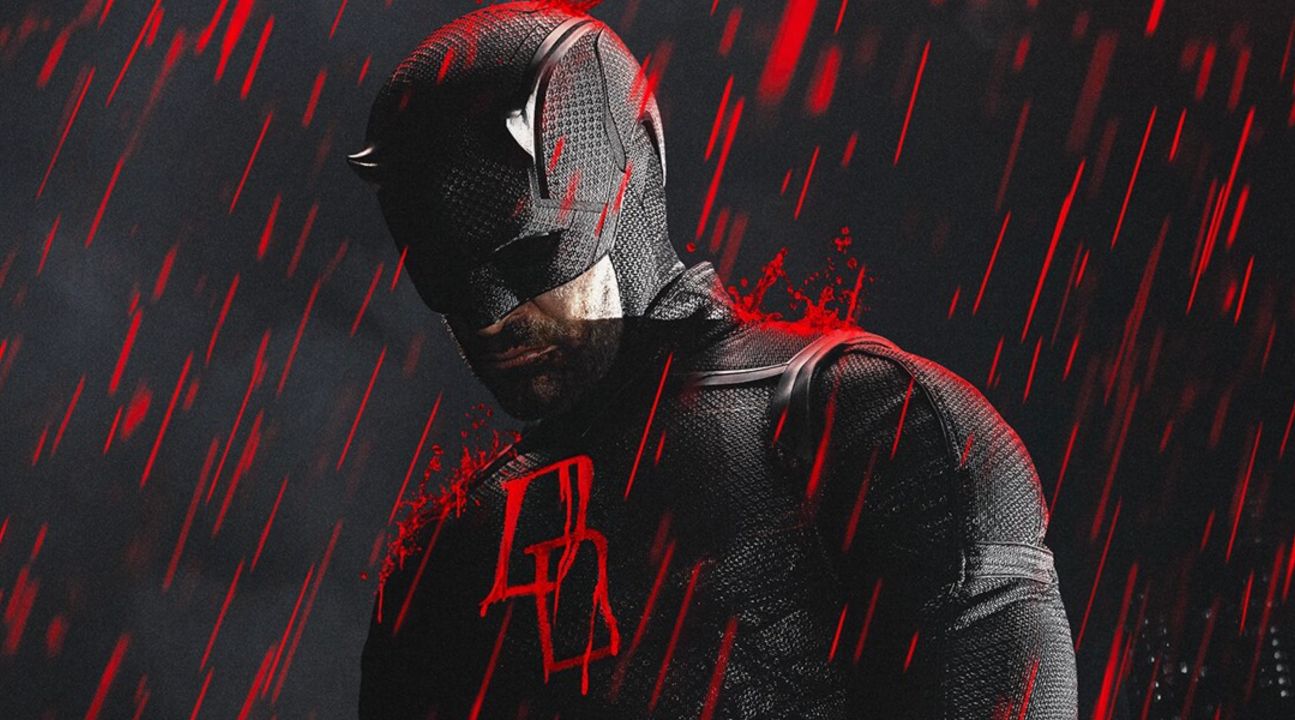
SERIES REVIEW – Season 2 of Daredevil: Born Again is exactly the dark, bruising, politically charged, emotionally battered Marvel series many viewers have been waiting for since the Netflix years. Matt Murdock and Wilson Fisk’s renewed war does not work because it becomes louder, but because it becomes sharper, tighter, angrier, and more certain of itself. This is no longer a patched-together revival; it is the full-blooded return of a character who finally feels dangerous again.
The first season of Daredevil: Born Again had strong moments, but the scars of its creative overhaul were visible. It often felt like several different shows had been stitched into the same body, and while Charlie Cox, Vincent D’Onofrio, and a handful of brutal set pieces kept the series standing, the result did not always seem sure whether it wanted to be a legal drama, a street-level crime story, a Marvel continuation, or a dose of Netflix nostalgia. Season 2 has no such identity crisis. It knows what it wants, it knows who it wants to break, and more importantly, it understands how far it can push the darkness before it becomes mere posturing.
Across these eight episodes, Matt Murdock is treated less as a superhero than as a damaged man whose two identities are no longer engaged in an elegant moral debate, but in a desperate internal war. That makes Cox’s performance far more compelling than any version of Daredevil as simply a righteous lawyer who happens to punch harder after dark. Here, Matt is not only fighting Fisk; he is fighting the possibility that the city, his losses, and his own anger have already shaped him into someone he can no longer defend when the mask comes off.
The smartest thing about the season is not that it adds more blood, more pain, or more moral anguish. It is that it finally treats power itself as the monster. Wilson Fisk as mayor is no longer merely a criminal, not just a mob boss wrapped in expensive fabric, but institutionalized violence. In Season 2, New York is not a backdrop. It is occupied territory: a city where the language of law, order, and public safety has been hijacked by the same old predator, now armed with official authority.

Kingpin No Longer Threatens The System, He Becomes It
Vincent D’Onofrio’s Fisk is more frightening than ever here. Not because he is louder, but because he is more human and more unstable. Beneath Kingpin’s cold control, the cracks are constantly visible: repressed rage, humiliation, revenge, and the terrifying conviction that his brutality is not a crime, but a historical necessity. D’Onofrio is not playing a monster. He is playing a man who knows he is a monster, but still expects the world to thank him for it.
The political parallels are not subtle background noise. The series speaks openly about authoritarian power, police overreach, state violence, corruption, and the way fear becomes a tool of governance. That will divide viewers, but that is also why it has weight. Season 2 of Daredevil: Born Again does not want to be comfortable for everyone, and in Marvel’s current television landscape, that alone feels rare. There is no embarrassing retreat, no safety-first neutrality, no sanding down of the point. Fisk’s system suffocates, and Matt’s resistance is not glossy heroism, but moral survival.
The supporting characters fit into the story far better than they did before. Karen Page is restored to where she has always belonged: the emotional and moral center of this world. Deborah Ann Woll’s presence is not a nostalgia play, but a necessity, because without Karen, Matt’s world always feels lopsided. Michael Gandolfini’s Daniel Blake also grows into a surprisingly shaded figure, someone who is more than a political instrument, carrying vulnerability and uncertainty beneath his usefulness. Wilson Bethel’s Bullseye, meanwhile, enters every scene like someone has opened a gas valve in a locked room.
Matthew Lillard has limited screen time, yet he turns every moment he is given into character, danger, and strange disruptive energy. He is not decorative, not a joke, not a wink to the audience, but a presence the show could clearly develop further. Krysten Ritter’s return as Jessica Jones works in a similarly controlled way: no forced fanfare, no applause break disguised as drama, just a character stepping back into a world she should never have had to leave. That restraint gives her reappearance actual weight.
The Action Is No Longer A Showcase, It Is A State Of Mind
Daredevil: Born Again still understands what makes a proper Daredevil fight work. The long-take brawls, grimy close combat, and choreography that makes physical exhaustion feel real are still here, but the season no longer treats them as the main attraction. The best action scenes land because they come from Matt’s mental state. They do not hit as technical flexes, but as desperation, rage, guilt, and stubborn survival instinct.
That distinction is what lifts Season 2 above most Marvel television. The fights are not hard-hitting simply because there is more blood or a longer take, but because every blow carries the consequence of a choice. Matt is not just beating opponents down; he is constantly trying to redraw the limits of who he is. In the show’s strongest moments, the mask does not free him. It traps him. Daredevil is not an escape from Matt Murdock, but proof that Matt can no longer cleanly separate redemption from self-destruction.
The finale follows that logic. It is not just a season-ending spectacle, but a genuine pile-up of consequences. The series pays off tensions that have been building for a long time, closes character arcs, opens new wounds, and refuses to soften its own argument. Most importantly, it does not end up feeling like an extended trailer for the next Marvel project. It feels like a complete, forceful season in its own right. The larger Marvel machine is still there at the edges, but this time it does not swallow the show.
The greatest achievement of Season 2 is that it restores the edge to Daredevil that many had assumed was gone. It is not flawless, since a few supporting threads could still be bolder, and at times one can feel the Marvel apparatus preventing the series from fully cutting itself loose from franchise obligations. But those are no longer fatal fractures. Daredevil: Born Again is no longer merely trying to prove itself worthy of the Netflix legacy. It surpasses it in a tighter, angrier, more political, and often more painful form.
-Herpai Gergely “BadSector”-
Daredevil: Born Again Saison 2
Direction - 9.2
Actors - 9.6
Story - 9
Visuals/Music/Sounds/ - 8.8
Ambiance - 8.9
9.1
AWESOME
Season 2 of Daredevil: Born Again is that rare Marvel production willing to be uncomfortable, angry, and politically direct. Charlie Cox and Vincent D’Onofrio deliver some of their finest work in this world, the supporting cast finally feels essential rather than ornamental, and the action hurts again. Hell’s Kitchen has not been this dark in years, but it also has not felt this alive.

![Power, Intrigue and Execution: How the Tudors Lost Their Heads Comes to National Geographic [VIDEO]](https://thegeek.games/wp-content/uploads/2026/08/noguchi-tudorok-official-1280x720-1-302x180.jpg)






![Harry Potter Fame Did Not Pay the Bills – OnlyFans Saved Jessie Cave [VIDEO]](https://thegeek.games/wp-content/uploads/2026/08/theGeek-Jessie-Cave-OnlyFans-302x180.jpg)
![[GC 2026] Afterworld: Post-Apocalyptic Paradox Survival in North America [VIDEO]](https://thegeek.games/wp-content/uploads/2026/08/vnews-afterworld_2026_08-25-26_001-300x365.jpg)
![[GC 2026] Silver Palace Is Coming to PS5 and Teases a Mysterious Multiplayer Mode [VIDEO]](https://thegeek.games/wp-content/uploads/2026/08/theGeek-GC2026-silver-featured-300x365.jpg)
![[GC 2026] Showa American Story Goes Wild in a New Post-Apocalyptic Trailer [VIDEO]](https://thegeek.games/wp-content/uploads/2026/08/theGeek-GC2026-showa-featured-300x365.jpg)
![[GC 2026] Road Kings Delayed to March 2027 – The Trucking Sim Gets a New Date [VIDEO]](https://thegeek.games/wp-content/uploads/2026/08/theGeek-GC2026-road-featured-300x365.jpg)
Leave a Reply