
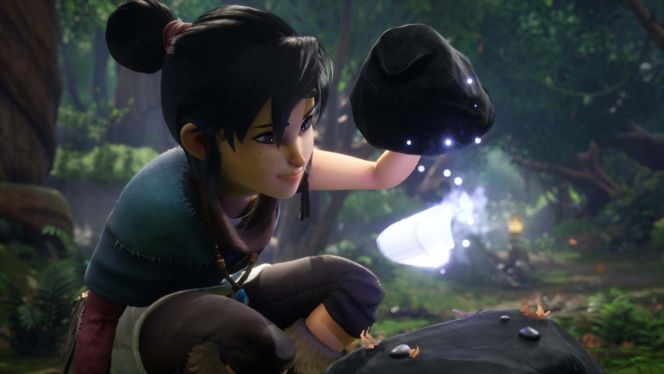
Kena: Bridge of Spirits has finally made its way to Nintendo’s new console, but this version arrives with more visible compromises than players may have hoped for. Even so, despite the technical cutbacks, Ember Lab’s charming adventure still preserves the magic that made it stand out in the first place.
Little by little, Kena has reached every major current platform. It launched first on PlayStation 5 and PC, later found its way to Xbox, and always felt just a bit too demanding for the original Switch. There is no doubt that Ember Lab did not want to miss the chance presented by the Switch 2, especially with the already announced Kena 2: Scars of Kosmora giving the studio every reason to prepare players across as many platforms as possible.
This Switch 2 version, however, comes with obvious trade-offs. Kena is a beautiful and fairly cleanly designed game, but it is still graphically demanding despite not being one of those giant open-world showcases built around dynamic lighting. The first thing that immediately stands out is that the frame rate is locked to 30 fps, with no visual settings that let players lower the resolution in exchange for 60 fps, whether in handheld mode or docked.
There are games where that difference hurts more and others where it matters less, and in Kena’s case I did not find it especially painful. The controls are simple, and while combat does have moments that ask for timely dodges and counters, it does not become so imprecise that the 30 fps lock ruins the experience. Kena was never really built as a punishing game anyway, so on normal difficulty, especially during a first run, the missing 60 fps does not feel like a deal-breaker.
The cost of upscaling is easy to spot in motion
What stands out much more in this version is the upscaling itself. Kena uses a DLSS-based solution adapted for Nintendo Switch 2, and that decision is clearly visible on screen. It is hard to say exactly what the native resolution is, but it is equally hard to miss that it seems fairly low. This is especially noticeable in docked mode, though it can also be seen in handheld play. The more movement there is on screen, the more the image starts to show its weaknesses. Elements in the scenery, especially trees and grass, can take on a slightly blurry, murky, almost dirty look.
It is not disastrous, but it is most obvious around Kena herself. Even just running through an environment, you can see the artifacts produced by the upscaling around her silhouette, and during combat, with all the particle effects flying around, the issue becomes even more noticeable. This is a familiar weakness of upscaling techniques when they start from a low internal resolution and simply do not have enough clean information to reconstruct the image properly once lots of motion enters the frame.
Different version, same charm
Beyond that, the biggest advantage is still being able to enjoy Kena on a handheld system at all. It is a somewhat peculiar game – adored by some, underwhelming to others – but I would call it straightforward rather than simplistic. Its puzzles and platforming do not aim to challenge the player constantly, but the level design is still carefully built and often quite engaging. Combat, on the other hand, felt a little more repetitive to me. The game tries to stay dynamic, forcing you to adapt depending on the enemy and work for healing during the chaos, but the limited parry windows and the narrower dodge and combo options keep it from fully reaching its potential.
That said, there is no denying how charming it still is. The game remains beautiful from start to finish, and the presence of the Rots, along with the way they occasionally factor into gameplay, only makes it more endearing. It is clear that Ember Lab’s greatest strength lies in presentation, which makes perfect sense given the team’s background in animation. That is probably why so many people are already looking toward Kena 2, hoping it will be a more mature work that applies the lessons learned here and pushes the design further.
This Switch 2 version could perhaps have been more ambitious. Based on the general results, the game at around 900p with medium settings can comfortably clear 60 fps on stronger hardware. The obvious problem is battery life. Once the TDP is pulled back to a more moderate range – something closer to the ROG Ally at 17 watts – performance tends to hover more around the 40 to 50 fps range. It is possible Ember Lab could have left the frame rate unlocked and pushed a bit further, but it seems more likely the team chose to lock the game at 30 fps to stay within a conservative handheld power budget of roughly 7W to 12W and avoid overtaxing the battery, while using the extra headroom in docked mode to improve resolution for a cleaner result on larger TVs.
Of course, the package does include all the improvements that have built up over the years. That means the Anniversary Edition DLC is here too, bringing new costumes, extra gems, and, most importantly, the Spirit Guide Trials challenges. New Game+ is also included, letting players restart the adventure with all upgrades, costumes, and Rots already unlocked. In short, if Switch 2 is your main platform because of its portability, or simply your only real option for playing Kena, this edition is more than acceptable. It may not be the most impressive port the system has seen so far, but it is still a solid one.
Source: 3DJuegos


![[TGA 2025] Tomb Raider: Legacy of Atlantis: Another Remake of the First Game! [VIDEO]](https://thegeek.games/wp-content/uploads/2025/12/theGeek-Tomb-Raider-Catalyst-Legacy-of-Atlantis-Remake-Crystal-Dynamics-302x180.jpg)


![[TGA 2025] Tomb Raider: Legacy of Atlantis: Another Remake of the First Game! [VIDEO]](https://thegeek.games/wp-content/uploads/2025/12/theGeek-Tomb-Raider-Catalyst-Legacy-of-Atlantis-Remake-Crystal-Dynamics-300x365.jpg)
Leave a Reply