
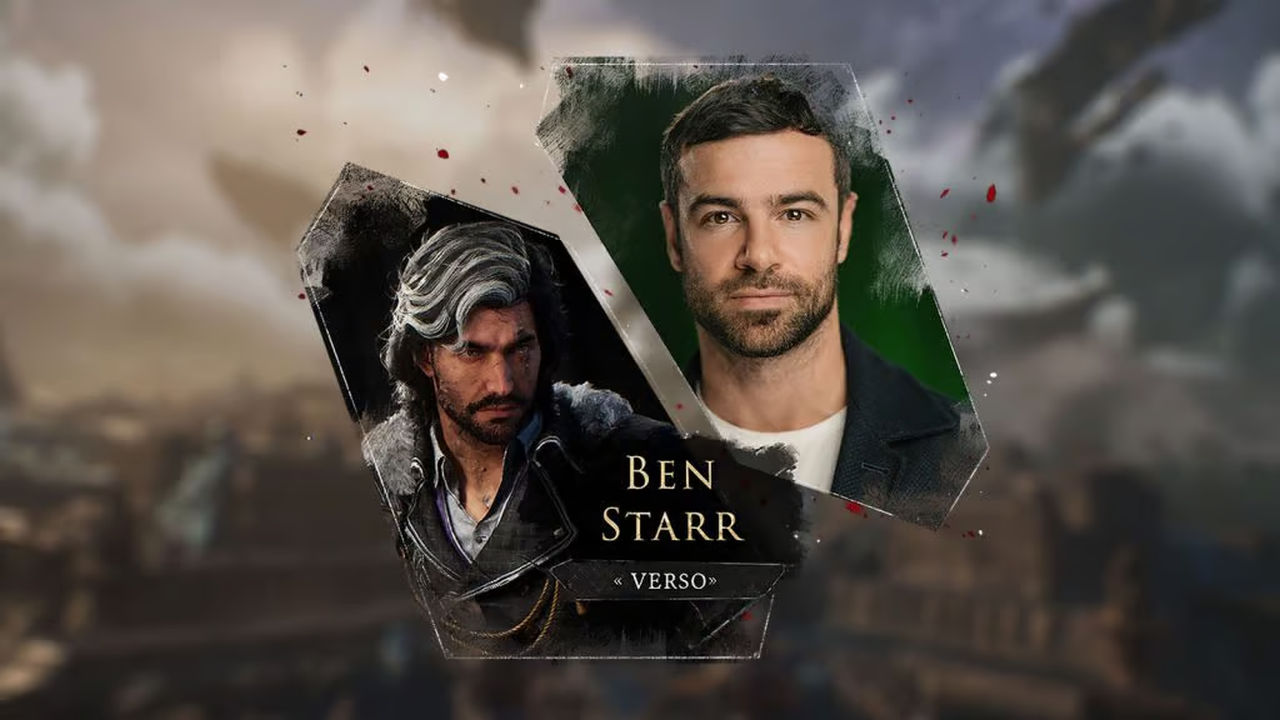
Ben Starr, one of the stars of Clair Obscur: Expedition 33, has just said something about video game adaptations that cuts much deeper than the usual “movies based on games are bad” argument. He is not rejecting adaptations outright, and he is not claiming they should stop being made. His point is sharper than that: video games do not need film or television to validate their quality. And that lands much harder in a moment when the industry seems increasingly eager to treat every successful game as a future streaming pitch.
Starr, best known as Verso in Clair Obscur: Expedition 33 and Clive in Final Fantasy XVI, made the comment while speaking around the 2026 BAFTA Video Games awards. Asked what game adaptations he would like to see, he chose not to build a wishlist. Instead, he challenged the assumption behind the question itself. Yes, he acknowledged that major properties such as God of War and Assassin’s Creed are continuing down the adaptation road, and yes, he wished them luck. But he also argued that games do not need those projects in order to prove they matter.
That matters because the current climate around adaptations has changed dramatically. After years in which game-based films were often embarrassing, shallow, or simply broken at the script level, recent successes like Fallout, Arcane, and The Last of Us have convinced studios that there is now real money and prestige in mining game libraries for film and television. The result is a kind of gold rush logic: if a game becomes a hit, somebody immediately starts imagining the series, the movie, the spin-off, the rights package. Starr is pushing back against that reflex by saying something very simple. A game does not become better because another medium decides it is worth borrowing.
His Real Problem Is Not the Adaptations Themselves, but the Idea That Games Still Need Outside Approval
This is where his point becomes genuinely interesting. Starr argues that television and film need games almost as much as games need them. That is not empty bravado. It is a reminder that games are no longer a lesser medium waiting to be elevated by cinema. They have their own grammar, their own rhythms, and their own emotional logic. They do not exist as rough drafts for more “respectable” formats. And when they are forced into the structures of conventional film or television, some of what made them powerful can disappear along the way.
That does not mean he thinks adaptations should stop. It means he thinks they should stop being treated as proof of artistic legitimacy. A game is not good because Amazon turns it into a prestige series or because a Hollywood screenwriter suddenly sees awards potential in it. It is good because it works as a game. Because in that form it can do things other media cannot reproduce in exactly the same way. That distinction tends to get buried in the current excitement, where every major gaming success is instantly followed by the question of who will adapt it first.
What Starr is really asking for, then, is not less ambition but more self-respect from the industry and from the culture around it. His frustration is aimed at the lingering assumption that games only fully “count” once they succeed somewhere else too. That idea made sense, if it ever did, in a much earlier era. It makes far less sense now. Video games do not need permission to be taken seriously, and they do not need to be translated into another form to prove they were meaningful in the first place. Starr is not attacking adaptations. He is attacking the insecurity that still clings to the conversation around them.
Sources: 3DJuegos










Leave a Reply