
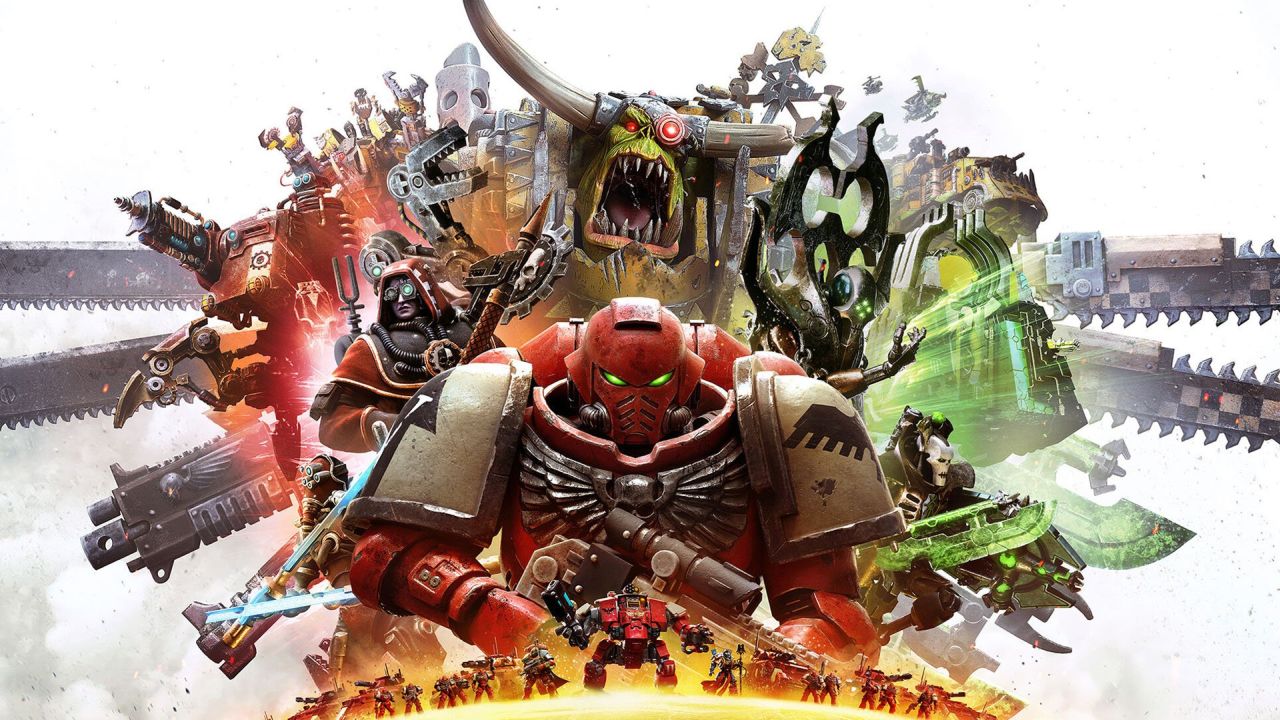
Warhammer 40,000: Dawn of War IV brings the legendary RTS series back in September, but KING Art Games knows that simply copying the first game will not be enough. The biggest challenge is not the old game itself, but the way fans remember it more than twenty years later.
This year, real-time strategy fans have an important date to mark on the calendar: Warhammer 40,000: Dawn of War IV launches for PC on September 17, roughly nine years and five months after Dawn of War III almost seemed to bury the series in the eyes of many players. Games Workshop thankfully did not abandon the IP, but the new installment has to do more than survive as another Warhammer game. It has to return to a legacy that fans remember not only as a game, but as a formative RTS experience, an atmosphere and the imprint of an entire era.
Now that the date is on the calendar, Jan Theysen, creative director at KING Art Games, has shared more about the thinking behind the project. The studio is known by many players for Iron Harvest, which was not a massive mainstream hit, but remained a solid and distinctive RTS among strategy fans. This time, Theysen is not mainly talking about which features are still being polished in the new Dawn of War, but about the kind of expectation the team has to face: the strongest part of the series today is no longer only the first game, but the memory of the first game.
The Enemy Is Not Dawn Of War 1, But Its Memory
Anyone familiar with the Dawn of War series knows that the third entry did serious damage to the franchise’s reputation. Dawn of War III tried to innovate with mechanics that felt to many players more like a MOBA than a traditional RTS, and in the process alienated precisely the audience that wanted the original game’s large battles, base building, resource control and brutal Warhammer atmosphere. KING Art Games therefore does not seem to be choosing the path of reinventing the genre at all costs, but is instead trying to understand how to revive the feeling that made Dawn of War matter in the first place.
In an interview with PCGamesN, Theysen described the problem clearly: “We’re not competing with Dawn of War 1, we’re competing with people’s memory of how it felt to play it.” That sentence captures the trap waiting for a sequel so heavily tied to nostalgia. If the developers copy the old game too slavishly, the result can easily feel outdated. If they go too far in the other direction, they risk repeating what happened with the third game: a new direction that a large part of the audience does not experience as evolution, but as betrayal.
The Goal Is Not To Overturn The Genre, But To Recover A Lost Feeling
According to the creative director, the developers are not simply bringing back mechanics from the first game, even if several iconic elements are returning or being expanded. One example is sync kills, the spectacular unit-on-unit execution animations that gave the original much of its memorable atmosphere. KING Art Games says it has not only recreated that technology, but improved it. The campaign is also receiving major attention: the plan is to deliver a substantial single-player experience with 70 missions, where all factions have a meaningful role.
Theysen argues that most players do not remember their favorite RTS games mainly for specific buttons, menus or balance values, but for the epic adventure: the worlds, the atmosphere, the factions and the stories. That is why the most important job of Dawn of War 4 is not to invent a brand-new RTS formula at any cost, but to adapt what worked in the 2000s to modern expectations. After StarCraft II, Company of Heroes and the first Dawn of War, the genre spent a long time outside the spotlight, so this return needs to reach not only old fans, but also those who may know that era of RTS design only as legend.
That is why it matters that KING Art Games is not trying to continue the more radical directions of the second and third entries. Dawn of War II and Dawn of War III both moved away from the original formula, though in very different ways. This time, the studio is instead examining what worked in the series and what turned out to be a dead end. The Warhammer 40,000 universe is especially useful for this, because the density of the lore, the identity of the factions and the brutality of endless war already provide the kind of material from which a strong RTS campaign can be built.
Dawn Of War 4 Does Not Want To Lock Nostalgia In A Display Case
For the developers, then, the central question is not how to reconstruct the 2004 experience with museum-level precision. The real task is to understand why the first Dawn of War felt so powerful, and then reproduce that effect through modern systems. In that sense, KING Art Games is not looking for an exact copy of the old game, but for its essence: large battles, savage melee combat, sharp faction identities, the feeling of base building and battlefield control, and the Warhammer 40,000 sense of apocalypse where every victory is only another step toward the next massacre.
One of Theysen’s strongest ideas is that this situation strangely echoes the Warhammer 40,000 universe itself. Space Marine Chapters are fragmented heirs of the old Legions, while the Adeptus Mechanicus works with degraded copies of lost technologies. Dawn of War 4 is attempting something similar: to recover something that is gone, while knowing full well that it can never be the same again. The question is whether the new version can be strong enough not only to evoke the old legend, but to matter in its own right.
Warhammer 40,000: Dawn of War IV therefore arrives not merely as a sequel, but as a test. KING Art Games has to win back players who turned away after the third game, restore something of the first game’s memory, and avoid being trapped by pure nostalgia. If it succeeds, this could become one of the most important RTS comebacks in years. If it fails, Dawn of War may prove once again that the hardest thing to follow is sometimes not the old game itself, but the version players have built inside their heads over twenty years.
Source: 3DJuegos, PCGamesN, PC Gamer



![PlayStation’s Digital-Only Future Is Financially Unavoidable, Says God of War Creator [VIDEO]](https://thegeek.games/wp-content/uploads/2026/07/thegeek-David-Jaffe-302x180.jpg)



![PlayStation’s Digital-Only Future Is Financially Unavoidable, Says God of War Creator [VIDEO]](https://thegeek.games/wp-content/uploads/2026/07/thegeek-David-Jaffe-300x365.jpg)
Leave a Reply