
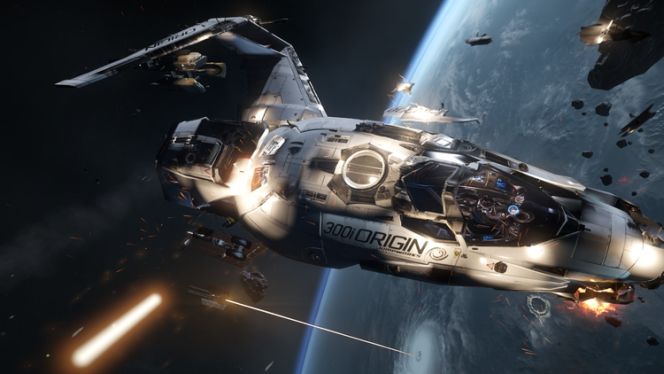
Star Citizen has reached another absurd milestone: Cloud Imperium Games’ space simulator has now passed $1 billion in revenue, while still lacking a final release date. The situation becomes even stranger with the Anvil Odin, a $5,000 concept ship that players can already buy, even though the finished, fully functional version is not yet available in the game.
Star Citizen remains one of the strangest, largest and hardest-to-compare projects in the video game industry. Cloud Imperium Games first revealed the space sim in 2012, when the game existed largely as a hangar and a huge promise. More than a decade later, the project now has a massive playable alpha, a large community, constantly expanding systems and an unprecedented financial base, but it still does not have a final release date. Its standalone campaign, Squadron 42, has also been in development for years, while the funding model around the game continues to generate controversy.
The project has now crossed a threshold most game developers could only dream of: Star Citizen has surpassed $1 billion in community funding. That money comes from ship sales, access packs, cosmetic content and other backer purchases, while the player base has continued to grow. Registered accounts have passed six million, and the latest major boost came from the DefenseCon event, which made the game free to play for several days and significantly increased community activity.
The milestone is remarkable on its own, but in the case of Star Citizen, the number always comes with a question: what exactly are players funding, and when will the endless development state finally end? The project has reached a financial league normally associated with the most successful mobile games and the biggest franchises, while Star Citizen remains unfinished and without a full final release. That is the tension at the heart of the whole story: the game is playable, enormous, technically ambitious and still not complete.
A $5,000 Concept Ship That Cannot Yet Be Used as a Finished Ship
Shortly before passing the $1 billion mark, Cloud Imperium Games put the Anvil Odin up for sale. This is not a small fighter or luxury spacecraft, but a huge 762-meter battlecruiser designed as a full military command vessel. According to its descriptions, it includes a hangar for smaller ships, a mess hall, medical facilities and even an internal tram system, which gives a clear sense of the scale involved. What buyers do not currently receive, however, is a fully functional, finished Anvil Odin ready to use in the game.
The ship costs $5,000 and is being sold as a concept ship. In Star Citizen terms, that means buyers are paying in advance for content still in development, which will arrive in a future update. This model is not new for the game, but the price and scale of the Anvil Odin make it an especially striking example of how far Star Citizen’s funding system has gone: this is not simply a digital extra, but a multi-thousand-dollar promise.
Buying it is not just a matter of paying the price, either. Interested players must apply for membership in the Odin Founders Club, meaning access to the purchase is tied to a separate selection process. That makes the ship even more exclusive: it is expensive, club-linked and built around prestige. Until the final model is finished, buyers receive a temporary loaner ship, which reinforces the sense that the money is currently going toward a future commitment rather than a completed piece of playable content.
That is why Star Citizen remains in a category of its own inside the industry. Other games have expensive editions, microtransactions, cosmetic bundles and preorders, but very few projects have managed to sustain this level of community funding for this long while still being unfinished. Part of the fanbase still believes Cloud Imperium Games is building an unprecedentedly detailed space simulator that requires both time and money. Critics, however, see a project that continues to raise money through increasingly expensive promises more than a decade after it began.
The Anvil Odin has therefore become more than just another ship. It is a near-perfect symbol of the Star Citizen funding model: a huge, spectacular, heavily described warship whose concept can already generate revenue, while its finished in-game version remains part of the future. The project keeps growing, the revenue keeps rising, and players continue to put money into a vision that is both fascinating and deeply unusual.
The current state of Star Citizen is genuinely worth studying. Very few games have ever passed $1 billion without a final full release. Even fewer have done so while selling $5,000 ships that are still in development. The question is no longer only when Star Citizen will be finished. It is also how long player trust can keep funding a project that has already grown far beyond the usual boundaries of a video game.
Source: 3DJuegos,













Leave a Reply