
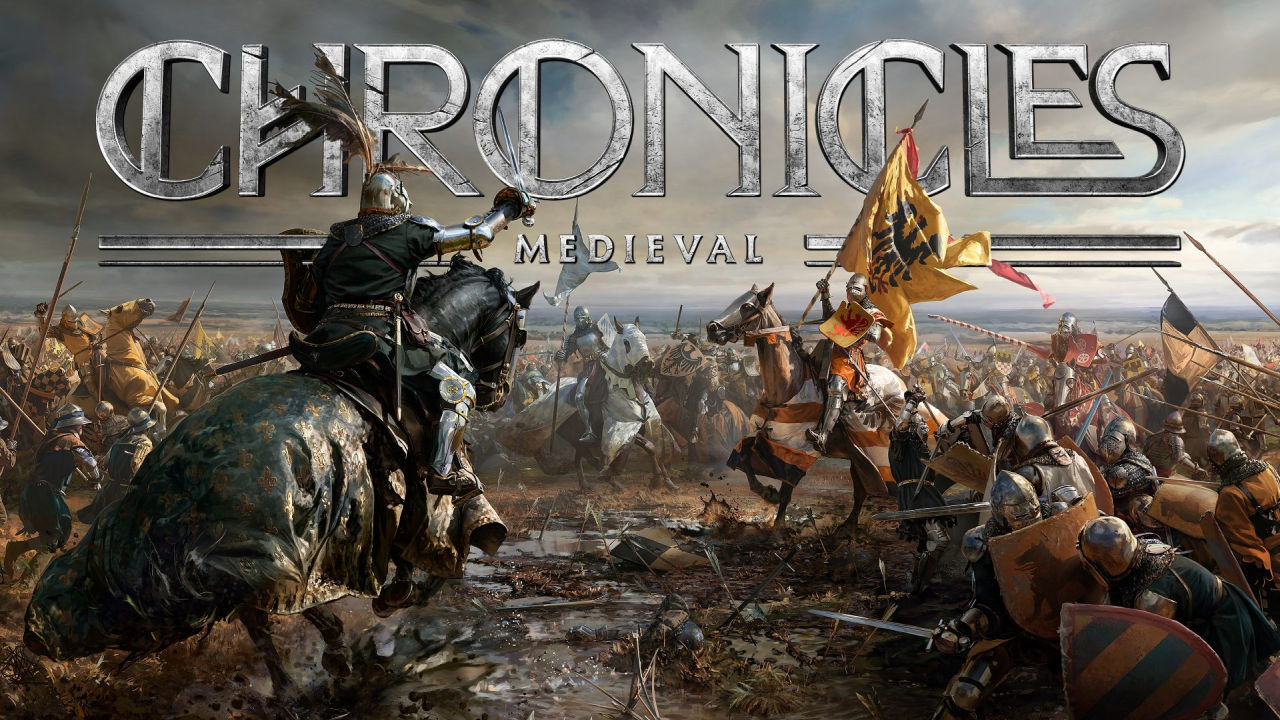
Raw Power Games revealed a new gameplay trailer for Chronicles: Medieval during Summer Game Fest 2026 and confirmed that the medieval sandbox RPG will enter Steam Early Access on PC later this year. The Danish studio is made up of around 100 industry veterans whose credits include The Witcher 3, Assassin’s Creed, Hitman, Red Dead Redemption 2, Cyberpunk 2077, and Grand Theft Auto.
Chronicles: Medieval is clearly aimed at players who like the Mount & Blade style of medieval sandbox, but want more historical authenticity, a deeper tactical layer, and greater battlefield control. Raw Power Games’ debut title is set in 14th- and 15th-century Europe, in a world where war, trade, diplomacy, politics, and ambition are not background decoration, but systems that continue to move without waiting for the player. Kings rise and fall, reputations can collapse overnight, and the player is not treated as the center of the world, but as one participant within it.
The Summer Game Fest 2026 presentation was important because it marked the first proper gameplay reveal for the battle system in Chronicles: Medieval. The developers also unveiled the Holy Roman Empire as the third playable faction, joining England and France. According to the studio, large-scale battles are one of the game’s core pillars, with hundreds of soldiers clashing on dynamic battlefields, while the current target is to support up to 2,000 characters on screen on suitable hardware. That means 1,000 versus 1,000 battles at the absolute upper end, though the system will scale depending on the player’s machine.
The Battle Begins Before the First Sword Stroke
Battles in Chronicles: Medieval begin with a planning phase. Players deploy their armies into battle lines, though these are not rigid formations: units naturally gravitate toward preferred positions based on type and cultural identity. French heavy cavalry pushes toward the vanguard, eager to charge; English longbowmen prefer the flanks, where they can get clear lines of sight; Holy Roman Empire forces favor a dense vanguard and main battle line, forming a wall of armored men. Players can still reposition any unit manually, and a later army management UI will allow preferred auto-deployments to be locked in for repeat battles.
Every unit runs on standing orders, which act less like constant micromanagement and more like a behavioral rulebook. Aggressive units seek contact and engage; defensive units hold ground; adaptive units decide contextually, so a cavalry unit facing a shield wall may switch to wedge formation on its own. Initial orders let players script each unit’s very first action at the start of battle, after which the unit returns to its standing order. Formations are split into two tiers: base formations such as Line, Block, and Loose are easier to move and connect maneuvers together, while advanced formations like Shield Wall, Spear Wall, Square, Schiltron, and Wedge are brutally effective in one role and deliberately poor in others. A Spear Wall can barely walk, a Square struggles to maneuver, and timing becomes less of a detail than a survival problem.
Once the fighting starts, the player drops into third-person perspective as both commander and combatant. It is possible to fight alongside your troops, pull back and direct the battle, or try to do both within the same minute. Command Mode is activated by holding Left Control, slowing time without stopping it. Global commands – advance, hold, fall back, engage, charge, retreat – are communicated through horn calls, while local commands control individual units more directly, including movement, targets, facing, formation changes, and standing order changes. There is also an important limitation: players cannot command across the entire field from anywhere. In a medieval battle, shouting from too far away does not work, so the commander has to be within a meaningful distance of the troops.
Morale Matters More Than Body Count
One of the most important systems in Chronicles: Medieval is morale, because units are more likely to break before they are wiped out. Each unit moves individually through five states: Inspired, Confident, Concerning, Wavering, and Broken. Casualties, charges, flanking attacks, and nearby friendly units collapsing all drag morale down. The Inspired state, however, can only be triggered by the player through personal action: kills, headshots, lance kills, and brutal executions performed where nearby soldiers can see them. No horn call or standing order can create that effect.
If morale collapses, a unit routes and is permanently lost as deserters. That is not the same as retreating: retreat can be ordered by the player or triggered automatically when army strength falls below a threshold, and those troops remain part of the army. Even after a defeat or victory screen appears, the battle does not instantly end. Players retain control, allowing them to cover a withdrawal, chase down routing enemies, or simply stand down. If the player dies, nearby soldiers who witness the commander’s death suffer a major negative morale event, and the rest of the battle continues without player control, watched through a spectator camera.
The campaign layer feeds back into morale as well. Senior game designer Gareth Bourn explained that it is not enough to perform well during battle: soldiers must be fed, paid, and supplied if they are expected to deploy in good condition. If an army is deep in enemy territory, badly damaged, poorly supplied, and demoralized, that will affect not only the next battle, but the next strategic decision too.
Historical Authenticity, Modding, and Sieges
Chronicles: Medieval will inevitably be compared to Mount & Blade, and the developers are not avoiding that. Bourn described himself as a fan of the genre, but said the biggest difference is that Chronicles: Medieval is rooted in the Hundred Years’ War, while Calradia is a fantasy setting. That allows the team to draw from real kingdoms, empires, cultures, weapons, armor, and battlefield preferences. Community lead Clemens Koch added that the game also has a much deeper tactical layer in its battle gameplay.
Units progress too, not just the player. Surviving soldiers gain experience and have progression trees, allowing them to move from peasant toward more advanced military roles such as sergeant. As for the balance between battles and story adventures, the developers do not define it rigidly. Since this is a sandbox, the exact proportion depends on how the player engages with the world; Bourn suggested roughly 50/50, but as a flexible idea rather than a fixed structure.
Modding is another core pillar. The developers described it not as an afterthought, but as something baked into system design from the beginning. The map generator, battlefield tools, castle systems, and data-driven AI strategy are all being built with community tools in mind. Raw Power Games is also working with experienced modders, with the goal of giving the community serious creative capabilities in version 1.0.
The project began in 2022 with a small team, and Raw Power Games now has around 100 people working on it. Bourn said one of the biggest design challenges is that the game has to function both as an RTS-style commander experience and as a third-person action game. Sieges are especially difficult, particularly because players can also build their own castles. The studio plans to bring more on that side of the game in a later release. Raw Power Games also announced that Danish actor Lars Mikkelsen, known from Netflix’s The Witcher, Disney’s Ahsoka, and Netflix’s Frankenstein, will voice Johannes Gutenberg, who narrates parts of the player’s journey.
Chronicles: Medieval will enter Steam Early Access on PC in 2026, with the studio currently planning to remain in Early Access for about a year. Raw Power Games is clearly not thinking small: historical sandbox, command decisions, personal combat, a 1,000 versus 1,000 target scale, modding, and sieges are all part of the pitch. It is a dangerous undertaking, but if it works, Mount & Blade may finally get not just a follower, but a real challenger.
Source: Wccftech

![Pregnant Anne Hathaway Shows Off Her Baby Bump at New Film Premiere [VIDEO]](https://thegeek.games/wp-content/uploads/2026/08/theGeek-Anne-Hathaway-302x180.jpg)





![Tom Hardy’s MobLand Is Heading to Blu-ray Before Season 2 Arrives [VIDEO]](https://thegeek.games/wp-content/uploads/2025/05/theGeek-MobLand-1-302x180.jpg)

![Pregnant Anne Hathaway Shows Off Her Baby Bump at New Film Premiere [VIDEO]](https://thegeek.games/wp-content/uploads/2026/08/theGeek-Anne-Hathaway-300x365.jpg)



Leave a Reply