
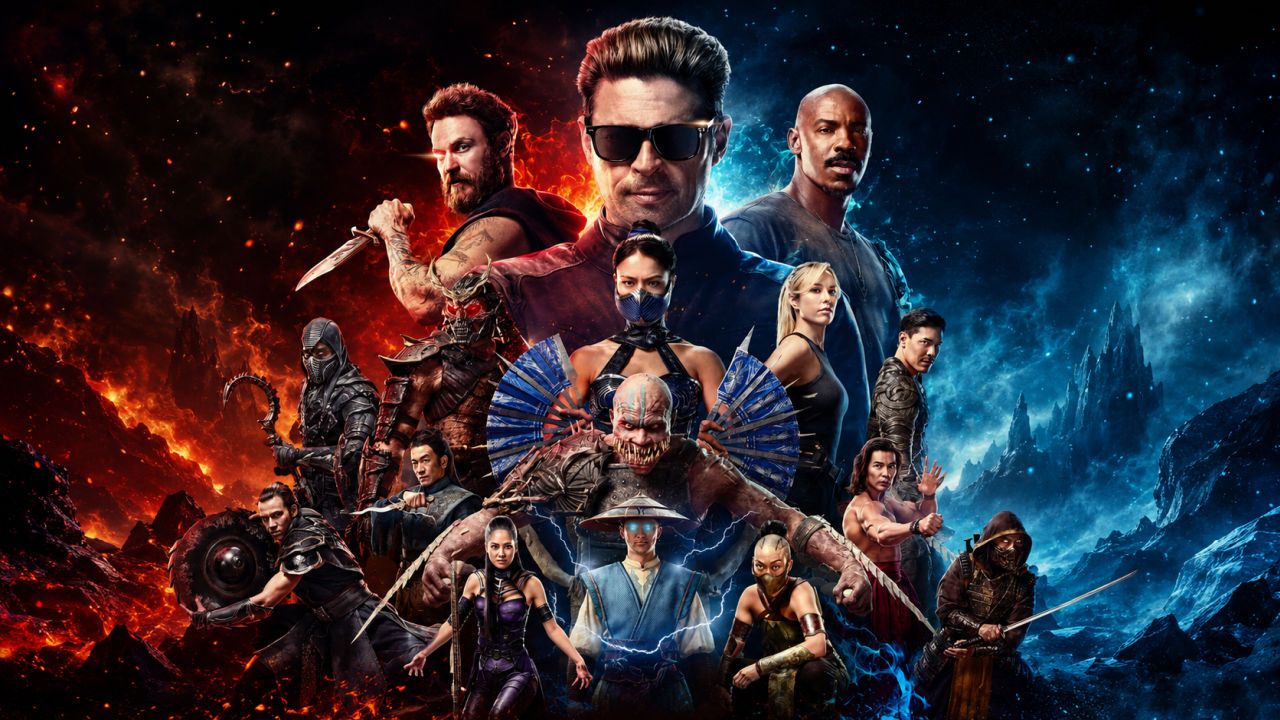
MOVIE REVIEW – Mortal Kombat II is exactly the kind of film where, after about fifteen minutes, you can already feel that the story will not win this fight, only the franchise’s twitching corpse will keep moving out of habit. Simon McQuoid’s sequel is louder, bloodier, and more crowded with names than the 2021 reboot, but it still has no real idea what to do with its world, characters, or stakes. I was not at the press screening; I watched it weeks later at home, on a projector, and without the noise of a theater around it, the film’s tired, plastic, self-parodying nature became even harder to ignore.
Mortal Kombat II opens by carefully announcing that this is going to be serious business, because Shao Kahn defeats King Jerrod with severed fingers, a shattered body, a traumatized child, and all the accessories a video-game fantasy film uses when it wants to look dark and merciless. The problem is that brutality alone is not weight. When a film spends every few minutes proving how bloody, cruel, and grown-up it is, while its characters remain about as deep as the background animations on a character-select screen, the result is not drama. It is a digital meat counter.
The story once again revolves around the clash between Earthrealm and Outworld. Shao Kahn wants conquest, Raiden gathers the champions, and Sonya Blade, Liu Kang, Jax, Cole Young, and the others do what people do in this franchise: stare seriously, say a few solemnly stupid lines, then wait for somebody to start punching somebody else. The film is supposedly moving toward a final tournament that could decide the fate of entire realms, but the stakes ring so hollow that, at times, the real suspense is who approved this dialogue as a full-time job.
I did not see it at the press screening, so this was not an experience shaped by collective fan reaction, opening-night franchise fever, or theater volume doing half the work. I watched it weeks later at home, on a projector, which turned out to be a harsher test: if a film cannot sell itself through its own images, rhythm, and characters, there is no crowd around to applaud on its behalf. With Mortal Kombat II, it becomes clear very quickly that much of the film works best only when someone else remembers why they once loved the game.
That does not mean every minute is hopeless. Karl Urban, as Johnny Cage, brings at least some life into this mostly grim costume parade, and Josh Lawson’s Kano remains the kind of vulgar joke machine who can occasionally wake the movie up. But if the greatest virtue of a Mortal Kombat sequel is that two characters sometimes make funny remarks while the entire world-saving plot around them is made of cardboard, we are not talking about victory. We are talking about a wreck with two usable seats left inside.

Lots of Blood, Very Little Weight
The film’s biggest problem is not that it is stupid. Mortal Kombat was never meant to be Shakespeare, and nobody expects a martial-arts fantasy about interdimensional combat to suddenly turn into Bergman-level self-examination. The problem is that the stupidity here is written in a boring way. The film constantly speaks with deadly seriousness about dynasties, champions, bloodlines, revenge, and destiny, while most scenes feel as if someone tried to carve emotional arcs out of a wiki summary.
Kitana’s adult revenge story could have worked in theory, because it contains a lost father, oppression, enslavement, and an identity waiting to be reclaimed. Adeline Rudolph, however, is not given enough strong material to make it genuinely tragic. The blue sash, the family past, and Shao Kahn’s rule are all elements from which a better film would build real character drama. Here, they are mostly pre-marked dramatic stations. We know where it is going, but barely care how it gets there.
Shao Kahn, played by Martyn Ford, is physically imposing, no question. He is tall, brutal, threatening, and looks roughly like a gym nightmare that won a cosplay contest. But the film cannot write him a presence beyond size and stern staring. The main villain ends up standing inside his own monumental poses rather than generating real fear. After a while, you do not feel that the tyrant of Outworld is sweeping everything away. You feel that someone would very much like you to believe he is.
The fights, of course, keep coming. Fatality fans get their required portion, and the film occasionally offers a decent-looking backdrop or a more visually engaging clash. Yet most of the action is predictable, overcut, or dramatically weightless. If everyone enters a scene only to hit, slice, laser, or explode someone, while the audience barely connects to the people involved, the blood does not intensify the experience. It simply makes the indifference redder.

Johnny Cage Enters, But He Cannot Save the Tournament
Karl Urban’s Johnny Cage is clearly the best new element in the film. A faded action star trying to become a hero again from inside his own parody is exactly the kind of role Urban understands: self-mocking, arrogant, likeably irritating, and experienced enough to squeeze rhythm out of even the weakest lines. The “It’s showtime!” energy, the Uncaged Fury self-parody, and the nods to straight-to-video action heroes from the 1990s are genuinely more entertaining than most of the film around them.
But Johnny Cage is not a magic potion. Urban gets scenes with good energy, yet the film’s entire structure still drags itself forward. Cage’s jokes land here and there, but around him the movie repeatedly collapses back into the same plastic solemnity, where somebody says that strength must be found within, or that one must discover the person they were meant to be. These lines would feel embarrassing inside a 1997 CD-ROM menu, never mind a 2026 studio movie.
Kano’s return also injects life into the film. Josh Lawson still understands that this world becomes more tolerable when at least one person is not acting as if he is attending a fantasy parliament’s memorial session. The crude insults thrown at Quan Chi, the red laser eye, and the Australian pub-aggression attitude really do shake the movie awake. But that is revealing too: when a character this cartoonishly exaggerated feels like one of the most human people on screen, something is seriously wrong around the supposedly serious heroes.
Bringing back Sonya Blade, Liu Kang, Jax, and Cole Young feels more like mandatory administration than real character continuation. Jessica McNamee, Ludi Lin, Mehcad Brooks, and Lewis Tan are not beyond saving, but the material gives them very little to work with. Cole Young remains the franchise invention the films keep insisting is important, while iconic characters from the games stand nearby and seem more interesting just by existing. It is like stopping a concert because someone insists the intern with the tambourine must remain center stage.

The Visuals Flicker, Then Sink Back Into Plastic
Mortal Kombat II can occasionally produce images. The astral backdrops, otherworldly arenas, dark fantasy sets, and some of the more elaborate power effects show that this universe does have visual potential. Benjamin Wallfisch’s score, especially around the end credits when it plugs into the game’s classic musical energy, also gives the film a pulse. But a pulse is not the same as life.
Simon McQuoid’s direction is mostly functional. Not every scene collapses, the geography is not always incomprehensible, but the film also lacks a cinematic personality of its own. It feels like the 2021 reboot was given more blood, more characters, and a few fan-favorite names, while the central question was avoided again: what makes this more than a sequence of character entrances, fights, and spectacular death animations?
Better video-game adaptations have moved beyond the point where recognizable costumes, quotable phrases, and game-accurate moves are enough. The Last of Us, Fallout, Cyberpunk: Edgerunners, and even the Sonic films understand, at very different levels, that adaptation is not simply fan-service inventory. Mortal Kombat II, by contrast, too often behaves as if it is enough for someone to say or perform a thing players recognize. It is not.
The film also feels outdated. Not because the core idea of Mortal Kombat is obsolete, since a brutal interdimensional fighting tournament could still be deliriously entertaining with style, humor, world-building, and character behind it. It feels outdated because the film brings back the same 1990s logic: loud music, tough faces, archetypes in costume, bloody executions, and somehow maybe a movie will emerge from that. It does not. At best, it becomes a longer trailer.

The Solemnity Is a Bigger Enemy Than Shao Kahn
One of the most exhausting elements is the film’s grand speechmaking. Lines about how “strength is not a closed fist” or how someone must “discover the man you were meant to be” do not deepen the world; they land like motivational-calendar slogans that accidentally wandered into a slicing-and-dicing fantasy. Mortal Kombat II would be much better if it accepted that its strongest side is not wisdom, but overblown, self-aware brutality.
Instead, the film keeps trying to give weight to relationships and past traumas it never properly develops. Kitana’s childhood loss, Jax’s military past, Cole’s chosen-one angle, Sonya’s combat determination, and Raiden’s mentor role are all familiar elements, but they receive few new shades. Most characters are functions rather than people: fighter, mentor, joke machine, villain, traitor, avenger. The film does not move characters so much as combat categories.
Quan Chi, Shao Kahn, and the Outworld side do not make things much more interesting either. Damon Herriman gets a few more distinctive moments as Quan Chi, but the film too often settles for villains looking evil, talking evil, and standing in evil surroundings. That might have worked at an arcade machine, where deep motivation was not required between two rounds. In a feature film, it is very thin.
The movie sometimes seems aware that there is too much solemn posturing, so it quickly throws in a Johnny Cage joke or a Kano insult. These mostly work, but they do not solve the underlying problem. It is like someone shouting a good joke during a dry, overlong presentation. For a few seconds, you are grateful. Then you have to look back at the slide.
This Series Needs New Thinking, Not Another Tournament
Mortal Kombat II is not unwatchable, and that may be the most annoying thing about it. It has a few visually effective scenes, Karl Urban and Josh Lawson genuinely lift it, fans can recognize favorite characters, and the amount of blood is not exactly lacking. But none of that adds up to a good movie. It is more of a long, noisy, uneven fan package that sometimes knows what to show, but rarely understands why it should work.
Watching it at home on a projector made the emptiness of the rhythm especially clear. On a larger image, everything that should theoretically work was there: arenas, monsters, heroes, blades, lasers, music, poses. Yet it never became a real moviegoing experience. Mortal Kombat II feels more like reinstalling an old game for nostalgia, then realizing the resolution was never the real problem. The world, and our expectations, have moved on.
The possibility of a third film hangs in the air, but based on this, the franchise does not need another continuation so much as a serious change of direction. The Mortal Kombat universe is strange, bloody, and rich enough to work on film or television. Just not like this. Not with such flat storytelling, such solemn pseudo-wisdom, such weightless character arcs, and not with the false belief that a Fatality is automatically drama.
In the end, Mortal Kombat II is weak not because it is too faithful to the game, but because it is faithful only to the most superficially recognizable parts. There is blood, there are icons, there are one-liners, there are executions, but there is barely a film around them. The franchise does not deserve a mercy killing as much as it deserves intelligent treatment, but this installment mostly proves that someone is still confusing a fan checklist with storytelling. The game’s famous command should now be aimed at the studio: “Finish it!”
-Gergely Herpai “BadSector”-
Mortal Kombat II.
Direction - 4
Actors - 4.7
Story - 3.5
Visuals/Music/Sounds/ - 4.5
Ambience - 4.3
4.2
WEAK
Mortal Kombat II is bloodier, louder, and more packed with fan-favorite names than the 2021 reboot, but that does not make it a good film. Karl Urban as Johnny Cage and Josh Lawson as Kano occasionally bring real energy to the scenes, but the story is flat, the stakes are weightless, most characters are empty functions, and the solemn dialogue is often more painful than any botched Fatality. This sequel does not execute its opponents; it simply exhausts its own franchise.



![The Trailer for Robert Eggers’s Medieval Horror Film Werwulf Has Arrived [VIDEO]](https://thegeek.games/wp-content/uploads/2026/07/theGeek-werwulf-302x180.jpg)


Leave a Reply