
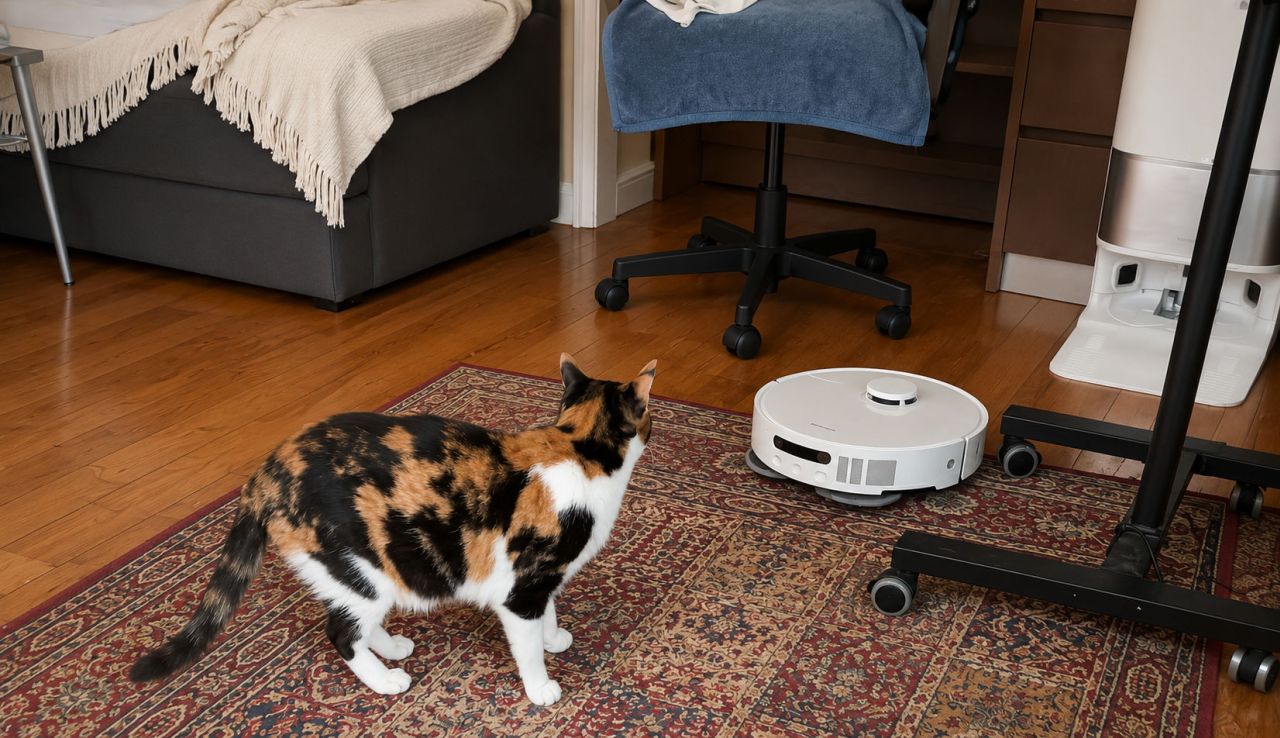
TECH ANALYSIS – The true value of a robot vacuum does not become clear when it glides through an empty, perfectly arranged showroom, but when it has to cope with a real home: thresholds, rugs, chairs, cables, crumbs, hair, and all the everyday obstacles that fill every household. A modern robot vacuum is no longer just a cleaning machine, but also a navigation system, a mapping tool, an automated household routine, and, with a little exaggeration, a home-awareness exam in one device.
It is easy to form a sterile image of robot vacuums. A nicely arranged living room, a smooth floor, one or two carefully placed crumbs, then the machine arrives, elegantly picks them up, and everyone is satisfied. Except most homes are not like that. There is the living-room rug, whose edge sometimes curls upward. There are chair legs that are not always pleasant to weave between even as a human. In the bedroom there is a charging cable, in the hallway a shoe, in the kitchen crumbs, in front of the bathroom a threshold, and under the sofa the layer of dust we only remember when something rolls underneath.
The real usability of a robot vacuum starts with these details. The question is not whether it can move in a straight line on a completely empty parquet floor. The question is what it does with a home where people actually live. Where not everything is always put away. Where a rug is followed by hard flooring, then another rug, with table legs, a bookcase, a chest of drawers, a docking station, a child’s chair, a dog bowl, or a forgotten slipper along the way. The difference between modern robot vacuums becomes tangible exactly here: not in whether they can start, but in how intelligently they adapt.

The Threshold Is Not a Detail, but a Boundary Line
In many Hungarian homes, smaller and larger thresholds, level differences, rug edges, and floor transitions are still part of everyday life. For a person, these are at most annoying details, but for a robot vacuum they are actual terrain obstacles. If a machine gets stuck at every second doorway, asks for help, turns back, or misjudges a height difference, the point of automation disappears very quickly. From that moment on, we are no longer saving time with it, but supervising yet another device.
A good robot vacuum does not merely want to cross a threshold, but also tries to interpret the structure of the home. It needs to know where the door is, where another room begins, which route is worth taking, and when it is not worth forcing an obstacle. This is especially important in apartments with several rooms, where cleaning does not take place in one large open space, but across a series of smaller rooms with different layouts.
Modern docked robot vacuums such as the Dreame L10s Ultra Gen 3 point exactly in this direction: they do not try to solve cleaning with suction power alone, but with mapping, automatic route planning, and app-based control as well. This is the difference between “it will somehow get around the place” and genuinely usable household automation. The robot does not only have to be strong. It also has to find its way.

The Rug Is One of the Best Stress Tests for Robot Vacuums
A rug is a category of its own. A robot vacuum can easily look impressive on hard flooring, where dust, crumbs, and hair become a relatively predictable task. A rug is much more treacherous. Dust settling between the fibers, pet hair, the edge of the rug, surfaces of different thickness, and the transition between floor types all put the machine to the test. A better robot vacuum has to recognize that it is on a rug and adjust its operation accordingly.
In real use, this means not only cleaning efficiency, but comfort as well. It matters whether the robot constantly gets caught on the edge of the rug, pushes it out of place, runs over it with a wet mop, or is able to treat different floor types separately. One of the important directions of development for modern robot vacuums is precisely that they should not approach every surface with the same logic. Kitchen tiles, living-room parquet, and a rug do not require the same thing. A truly useful machine does not leave this to the user, but tries to handle it on its own.
This is also where the role of the docking station comes in. The robot vacuum itself is important, but the whole system only becomes convenient if dust emptying, mop handling, and maintenance routines require as little manual intervention as possible. With models such as the Dreame L10s Ultra Gen 3, the dock is not a prop, but the other half of the system: with automatic emptying, mop-pad handling, and the goal of keeping cleaning from becoming yet another daily micromanagement task.

Cables, Chairs, Slippers – A Real Home Is Not an Obstacle-Free Course
For a long time, one of the greatest enemies of robot vacuums was the cable. A charging cable, an extension cord, a headphone wire, a toy left in a child’s room, a piece of fabric dropped beside the sofa: these are the things that a less capable robot can easily turn into a problem. It winds them up, gets stuck, stops, reports an error, or, in worse cases, drags them along behind it. At that point, the user feels exactly what they do not want to feel: that because of the robot, they first have to tidy up, then check, then rescue the machine.
This is why obstacle recognition has become one of the most important topics in robot vacuums. A home is not the same every morning. A chair gets moved, a shoe is not in the same place, the edge of a rug folds up, a charging cable remains in the living room. A smarter robot vacuum does not only map walls and large pieces of furniture, but also reacts to smaller obstacles while it is working. This does not mean the home never has to be kept tidy again, but it does mean it does not have to be turned into a museum display before every start.
Cleaning under furniture is just as important. The areas under the sofa, bed, chest of drawers, and cabinet are typically the ones we clean less often by hand because the job is uncomfortable, full of bending and working around obstacles. A robot vacuum delivers real added value when it can regularly reach these places, instead of merely circling neatly around the middle of the room. This requires a low profile, good navigation, and consistent route planning. A robot that leaves out strips in different places every time becomes more annoying in the long run than it is useful.

The Map Is Not a Technical Extra, but the Basis of the Daily Routine
For a long time, robot vacuums were imagined as little machines wandering around in circles, eventually reaching somewhere sooner or later. In today’s models, mapping is no longer a luxury, but a basic usability issue. The map of the home makes it possible to avoid cleaning everything every time, to start the kitchen, living room, or hallway separately, to set no-go zones, and to make sure the robot does not work randomly, but according to an understandable system.
In everyday life, this matters much more than it may sound at first. If only the kitchen needs a quick clean after cooking, we do not want the robot to cover the entire apartment. If the child’s room is chaotic but the living room is clear, it is useful to handle the two separately. If we do not want mopping on a rug, we do not want to explain that to the machine every time, but set it once. App-based control, zones, scheduling, and room-by-room cleaning are therefore not gadget fussiness, but the conditions that allow a robot vacuum to truly become part of the daily routine.
The other side of automatic operation is consistency. A robot vacuum is not truly useful when it spectacularly goes through the apartment once a month, but when it works regularly, predictably, and unobtrusively. If it cleans the hallway and kitchen on weekday mornings, picks up crumbs after dinner, and cleans the living-room rug more often, the baseline state of the home improves. It is not that it performs one big clean. It is that less dirt accumulates.
A Good Robot Vacuum Does Not Perform Miracles, It Takes Over a Burden
It is important to say this clearly: a robot vacuum is not a magician. It does not put away objects left on the floor, it does not solve every stubborn stain, it does not replace every manual cleaning job, and it will not eliminate housework. A good robot vacuum does something much more realistic: it takes a regularly recurring, boring, time-consuming task off the family’s shoulders. That is exactly why it makes sense in the long run.
A modern robot vacuum is good when it does not require constant attention. It starts, finds its way, recognizes rooms, handles floor types, returns to the dock, empties itself, maintains the mopping system, and only asks for attention when it genuinely needs it. The Dreame L10s Ultra Gen 3 and similar, more advanced robot vacuum systems are taking the category precisely in this direction: the goal is not to create yet another smart device that has to be pampered, but to make part of the cleaning happen on its own.
In a real home, then, catalogue specifications do not decide everything by themselves. Suction power matters, mopping matters, the dock matters, but everyday usability is determined by the sum of small situations. Can it cross the threshold? What does it do with the rug? Does it notice the cable? Can it get under the sofa? Can it treat the kitchen and the hallway separately? Does it avoid getting stuck every other time? These questions decide whether the robot vacuum becomes real help, or merely a showy device that we have to adapt to just like any other household appliance.
The good news is that the category has improved enormously. Modern robot vacuums no longer merely roll around and suck up whatever they find, but map, adapt, manage cleaning routines, and increasingly understand how a real home works. And a normal home is exactly like that: not perfect, not always tidy, not obstacle-free. If a robot vacuum can work reliably there as well, that is when it starts to become genuinely interesting. Because the ultimate goal is not for the machine to look good on the dock. It is to take out the traditional vacuum cleaner less often.



![Vampire - The Masquerade Redemption – Love Song for a Vampire [RETRO – 2000]](https://thegeek.games/wp-content/uploads/2020/03/theGeek-Vampire-the-Masquerade-302x180.jpg)








Leave a Reply