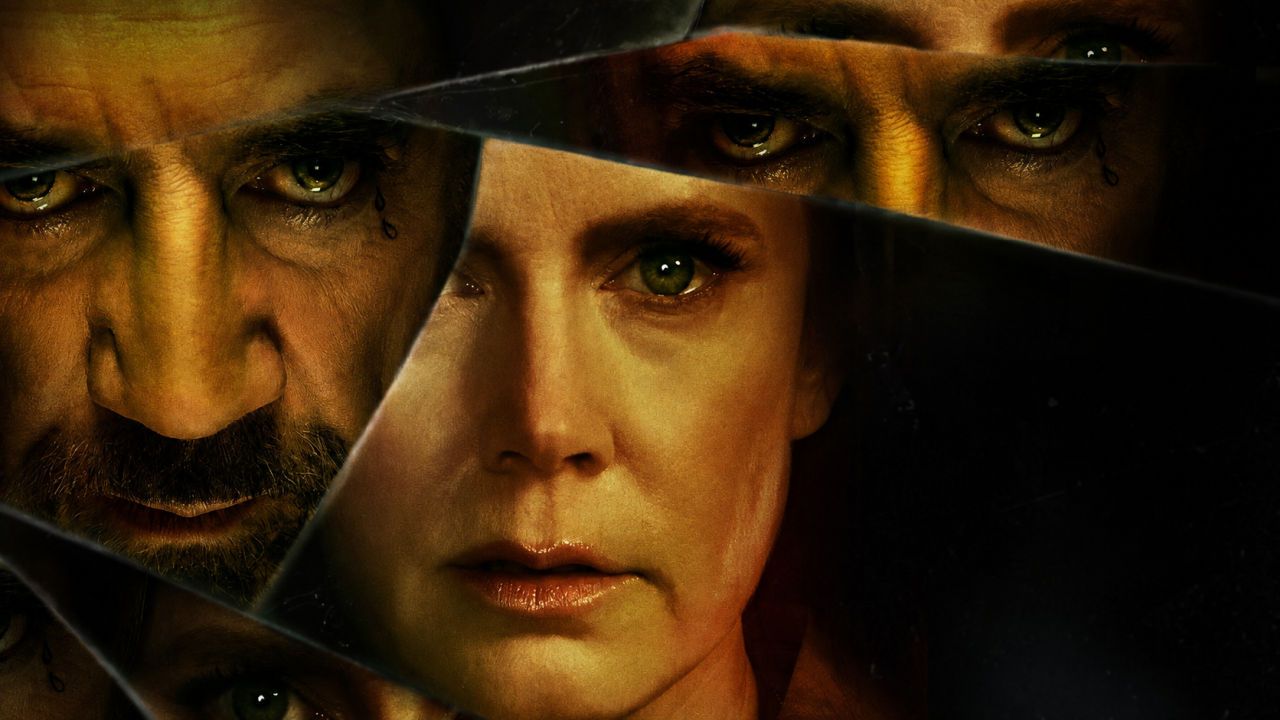
SERIES REVIEW – Max Cady has returned to the screen for a third major incarnation, and judging by Javier Bardem’s smile, the passing decades have done absolutely nothing for his temperament. Apple TV Plus’ ten-episode Cape Fear drags John D. MacDonald’s classic nightmare into an age of deepfakes, true crime, social media and modern family dysfunction, while Amy Adams and Patrick Wilson play a married couple whose home was hardly structurally sound before Cady came knocking. The new adaptation has tension, style and an outstanding cast to spare; what it does not always have is ten episodes’ worth of story. We watched the complete series on Apple TV Plus.
There is something uniquely unpleasant about Max Cady. You would not want to share an elevator with the man even if you had never testified against him, prosecuted him, defended him badly or otherwise contributed to a lengthy prison sentence. Robert Mitchum achieved that effect in 1962 while barely appearing to move. Robert De Niro arrived in 1991 with biblical fury, tattoos and an alarming quantity of visible teeth. Javier Bardem finds his own Cady somewhere between them. He can be charming, funny and surprisingly easy company, then something changes behind his eyes and you suddenly remember that Bardem once made silence itself dangerous as Anton Chigurh.
That is a considerable advantage for Cape Fear, because the ten-episode story occasionally loses momentum while Bardem almost never does. Even during chapters clearly buying time before the next major revelation, he remains worth watching. Amy Adams is similarly strong as Anna Bowden, while Patrick Wilson gives Tom the convincing self-assurance of a man who believes he is holding his family together despite mounting evidence that he may be one of the cracks. Nick Antosca’s most important early decision is to abandon the idea of Cady attacking an immaculate household. The Bowdens have electrical fires burning long before he arrives.

From Mitchum’s Shadow to Bardem’s Smile
The story began with John D. MacDonald’s 1957 novel The Executioners, a lean, nasty family-under-siege thriller. Sam Bowden’s testimony helps send Max Cady to prison, and when Cady is released, he begins methodically terrorizing not only Sam but his entire family. MacDonald does not bury the premise beneath unnecessary mythology. Cady is dangerous, Bowden knows he is dangerous, and the law can only do so much about a man who has not yet committed the crime everyone knows is coming. Much of the fear comes from that wait.
J. Lee Thompson’s 1962 Cape Fear preserved much of that simplicity. Gregory Peck’s Sam Bowden is the respectable American lawyer and family man, while Robert Mitchum plays Cady with an unnerving absence of effort. He does not need speeches or constant explosions of rage; the slow confidence with which he walks into Bowden’s workplace or simply watches someone for too long is enough. Bernard Herrmann’s score adds menace to otherwise ordinary spaces until even a quiet street begins to feel compromised.
Peck deserves a fair amount of credit for Mitchum being there at all. After acquiring the film rights to MacDonald’s novel, he pushed hard for Mitchum to play Cady, even though the actor initially had little interest in taking the part. Peck and Thompson eventually turned up at Mitchum’s home with a case of bourbon. Mitchum drank the peace offering and, according to the story that has followed the film ever since, essentially informed them that the bourbon had done its job and he would make the movie. Considering what Mitchum subsequently did with Max Cady, that may rank among the more productive cases of bourbon in Hollywood history.
Martin Scorsese’s 1991 Cape Fear dirtied the moral landscape considerably. Nick Nolte’s Sam Bowden is no Gregory Peck figure: as Cady’s former defense attorney, he deliberately suppressed evidence that might have helped his client, giving the revenge a genuine moral debt beneath the madness. Robert De Niro’s Cady belongs to an entirely different species from Mitchum’s. He is loud, theatrical, scripture-spouting and physically transformed by his obsession. Scorsese also pushed the Bowden family’s internal tensions much further, especially through Juliette Lewis’ Danielle.
The 2026 Cape Fear series borrows from every previous version while rearranging the roles again. Anna Bowden was Max’s defense attorney; her husband Tom was the prosecutor who secured the conviction. Seventeen years later, another person’s confession helps free Cady, and the series initially refuses to make his guilt quite as simple as it was in the earlier films. That immediately creates a more interesting moral problem than merely releasing a proven monster and waiting for him to behave monstrously.
Bardem’s Cady also becomes a public figure. The media loves the story of a potentially wrongfully convicted man, activists and opportunists want access to him, and he understands very quickly how useful attention can be. The Cadys of J. Lee Thompson’s 1962 Cape Fear and Scorsese’s 1991 Cape Fear approached the Bowdens through streets, bars and parking lots. This version can begin invading their lives through a screen.

The Bowden Family Was Cracking Before Cady Arrived
The strongest change in the new Cape Fear is that Anna and Tom’s marriage is not presented as an American dream waiting for an outside evil to destroy it. Anna is a recovering alcoholic with fifteen years of sobriety behind her. Tom is wrestling with anxiety, temptation and his own flexible moral standards. Their children already have serious problems before Max Cady re-enters the family orbit. Natalie, played by Lily Collias, looks like the accomplished teenage daughter expected to make her parents proud, but resentment is building because so much of the household’s energy goes toward her troubled younger brother Zack. Joe Anders gives Zack a darker instability built from guilt, anxiety and dangerous impulses that Cady notices faster than the boy’s parents do.
That fractured setup gives a ten-hour adaptation more room to work than either film had. Max does not always need to threaten anyone directly. A sentence placed at the right moment, a carefully arranged encounter or one piece of private information can do more damage than physical violence. Bardem is terrific in those scenes. His obvious menace works, of course, but his friendliness is more interesting. There are moments when he seems genuinely likable, and that is exactly why he is dangerous.
Amy Adams refuses to turn Anna into a conventional victim. She is intelligent, forceful and capable of manipulation herself, having spent years working cases involving failures of the justice system while keeping several uncomfortable details of her own history securely locked away. Adams is excellent at showing Anna trying to remain lawyer, mother, wife and sober alcoholic while Cady attacks every certainty holding those identities together. Patrick Wilson receives the quieter role, although Tom’s moral evasions and increasingly desperate behavior as a father become more important as the season goes on.
The children are both the series’ greatest expansion and one of its occasional excesses. Natalie and Zack generate several strong turns and make the central idea much richer: Cady may be the man introducing chaos, but he is entering a family already failing to understand itself. The trouble comes when almost everyone eventually acquires another secret, another hidden relationship or another piece of history designed for an episode-ending revelation. Most of these developments work. A few smell rather strongly of the writers’ room needing one more cliffhanger.
The perpetually unfinished Bowden house is a much cleaner idea. Missing walls, blocked rooms and increasingly uncomfortable corridors turn the family home into a visual extension of the marriage and the people living inside it. Nobody needs to stop and explain the metaphor. The house required renovation before Max Cady joined the project.

Ten Episodes Is Almost a Sentence of Its Own
This is where the new adaptation runs into its clearest problem. The Executioners was not a thousand-page family saga, and J. Lee Thompson’s 1962 Cape Fear and Martin Scorsese’s 1991 Cape Fear told the essential story in roughly two hours. Apple’s version asks for ten episodes, and there are stretches when it cannot fill that space naturally. The opening episodes are excellent at establishing Cady’s return, the tension inside the family and uncertainty surrounding the old case. The middle begins collecting additional mysteries, supporting plots and detours. Some deepen the characters. Others mainly postpone a confrontation we already know must eventually happen.
Antosca also updates Cady’s arsenal for 2026. Deepfakes, artificial intelligence, catfishing, online humiliation, true-crime celebrity and media manipulation join the old methods of physical stalking and intimidation. Several of these additions are genuinely effective because contemporary life offers terrifyingly efficient ways to invade a person’s reputation and private world without ever standing outside their house. Other moments feel as though the series is trying to complete a checklist of current anxieties before the finale.
The twists follow a similar pattern. Once the first few secrets have landed, it becomes clear that almost every major character is carrying another concealed relationship, old crime, hidden motive or family revelation. For a while this is enormously watchable because our loyalties keep shifting. Eventually the existence of another twist becomes less surprising than the possibility that somebody might simply tell the truth the first time.
The finale thankfully restores the physical danger and confinement that have always served this story best, giving the last episodes more urgency. Not every idea accumulated along the way receives an equally elegant payoff, and the melodrama occasionally pushes close to the point where credibility begins protesting. The season still reaches the finish line with its central threat intact. Once the story strips itself back to a family, a predator and a shrinking number of exits, Cape Fear remembers exactly why this premise has survived for nearly seventy years.
In the Shadow of Scorsese and Spielberg
Martin Scorsese and Steven Spielberg are executive producers here, and the series makes no attempt to hide the cinematic inheritance. Bernard Herrmann’s famous musical language returns, Cady’s prison years are presented in black and white, and the Bowden house is photographed from increasingly uncomfortable angles as the situation deteriorates. Georgia’s humid landscape, enormous homes and trees draped in Spanish moss often provide enough unease without anybody needing to pull a weapon.
The direction occasionally overplays its hand, but at least it has a hand to play. Far too many expensive streaming thrillers now share the same polished lighting, tasteful grading and anonymous camera placement, leaving almost no individual image behind once the credits roll. Cape Fear has the opposite problem. Some shots insist on their importance too strongly, but others remain in the memory days later.
Of the three major Max Cady performances, Bardem may be the hardest to classify. Mitchum remains the quietest and perhaps the most naturally dangerous in J. Lee Thompson’s 1962 Cape Fear. De Niro is the most intense, theatrical and openly deranged in Scorsese’s 1991 Cape Fear. Bardem wisely refuses to chase either performance and builds his own version around social ease. His Cady can occasionally look like someone whose company a stranger might actually enjoy. The mistake becomes apparent shortly afterward.
The new Cape Fear ultimately falls into a familiar streaming trap: because it has more time, it assumes every element deserves more time. Yet compression was always one of the story’s strengths. A man gets out of prison. A family knows he is coming. The law cannot do enough. The available space keeps shrinking. Antosca adds a more complicated family, technology, media culture, social anxieties and a warehouse of new secrets. Some of those additions genuinely improve the material. Several could have remained in the writers’ room without anyone filing a missing-person report.
Bardem nevertheless makes the ten hours difficult to regret. Amy Adams and Patrick Wilson are strong opponents, the younger cast holds its own, and whenever the series stops preparing the next revelation and simply allows Max Cady to occupy a room, it can summon the same primitive discomfort that MacDonald built the entire story around almost seventy years ago. It could simply have reached those moments a little faster.
-Gergely Herpai „BadSector”-
Cape Fear
Direction - 7.4
Actors - 8.3
Story - 6.2
Visuals/Music/Sounds/ - 7.2
Hangulat - 6.9
7.2
GOOD
Cape Fear does not squeeze as relentlessly as J. Lee Thompson’s 1962 Cape Fear or go as gloriously mad as Scorsese’s 1991 Cape Fear, but Javier Bardem’s Max Cady gives this version ample reason to exist. Amy Adams, Patrick Wilson and the fractured Bowden family provide enough material to justify a broader reinterpretation, even if Nick Antosca often uses too many twists and side stories to justify the running time. It is a good, tense and occasionally vicious thriller that could comfortably have served a couple of episodes less.



![Jason Statham Turns His Car Into a Weapon in Mutiny's Explosive New Clip [VIDEO]](https://thegeek.games/wp-content/uploads/2026/08/theGeek-Zendules-Mutiny-Jason-Statham-302x180.jpg)





![Brad Pitt and His Combat Dog Battle the Wild in New Heart of the Beast Footage [VIDEO]](https://thegeek.games/wp-content/uploads/2026/08/theGeek-Heart-of-the-Beast-Brad-Pitt-302x180.jpg)