
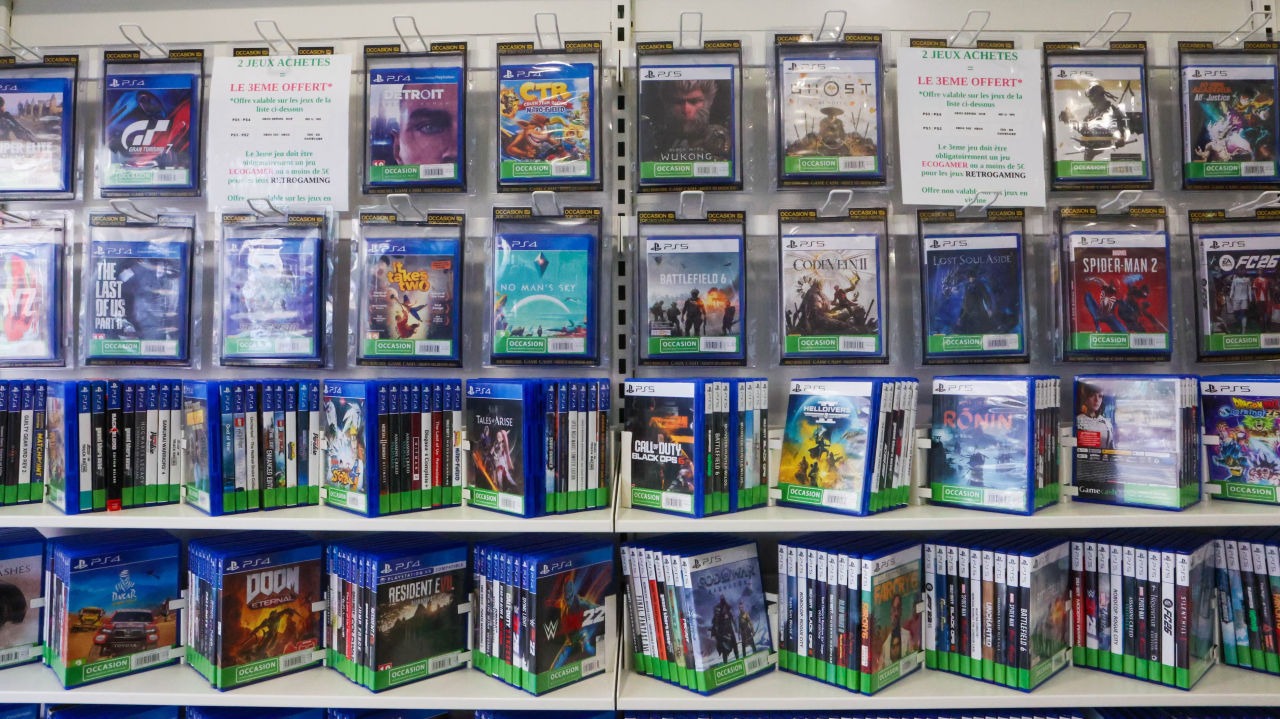
The head of a game preservation group was critical of Sony.
PC gamers have been using digital downloads for years, but in the world of consoles, the battle over physical game discs is still raging and could become even more intense over time. With Sony set to end support for physical discs in the near future and Ubisoft and Take-Two executives seemingly unconcerned about the issue, the end of the era of physical game discs appears imminent. At the same time, however, a growing movement is emerging to resist this trend. PC Gamer spoke to Clemens Istel, owner of the game preservation website Does It Play, about this movement.
Does It Play is, on the one hand, a community dedicated to physical game media and, on the other, a database designed to document which games can be played without downloading or in offline mode. Last month, based on a report from Does It Play, we wrote that 34% of physical PlayStation 5 games and 50% of Xbox Series X games tested do not function fully without first being downloaded. There are a few key reasons why it might be worth advocating for the continued use of physical discs. Since games undergo numerous updates after release, the disc offers a straightforward way to preserve the original version for future players. This also means that store owners cannot establish a monopoly over prices. If we were to buy a PlayStation 5 game, for example, we could purchase it directly from Sony or from any marketplace selling new or used physical games. In the long term, this reduces companies’ direct control over pricing.
Istel points out that the last two generations of Xbox consoles cannot be set to offline mode without a Microsoft account. He also notes that, although some games are available entirely on disc, they still contain built-in online checks that must be completed before the games can be played. He argues that game developers keep players on a tight leash, which is precisely what gave rise to the ‘Does It Play‘ initiative and movements such as ‘Stop Killing Games‘. He believes that Sony knew exactly what consumers wanted when it mocked Microsoft’s introduction of DRM in 2013, but now it no longer understands its customers at all. All that remains is an extremely arrogant ‘take it or leave it’ attitude. According to Istel, however, this situation doesn’t just affect console gamers.
Although he believes that attitudes towards game ownership have deteriorated over the years, there is a glimmer of hope in PC gaming with the emergence of DRM-free stores (e.g. GOG). PC games switched to digital formats long ago and, even before that, many PC games had physical restrictions in the form of CD keys. However, according to Istel, digital DRM is not the same thing. Nevertheless, even if Sony officially discontinues support for discs with the PlayStation 6, Istel doesn’t think physical media will disappear entirely.
“Customer rights are almost non-existent in the gaming industry, and companies have repeatedly shown that they are not good at communicating honestly. Having fewer options is always a bad thing. It’s especially bad if the only option is a future in which your purchased goods can simply be taken away or altered at someone else’s whim. For the most part, over all these years, it has felt as though there has been an unwritten agreement between companies and players. They provide cool experiences; we buy them. But in recent years, this symbiosis has increasingly turned into a one-sided form of exploitation. Lobby groups and lawyers have attacked preservation efforts; a growing number of games are being released unfinished; and even hardware now has online dependencies.
The next step is eliminating physical media, the last thing you had any ownership over. This sets another precedent and pushes distribution further towards streaming, as Take-Two CEO Strauss Zelnick recently suggested. Once we reach that point, all hope of customers ever having control over a product will be gone. Digital DRM that requires you to go online makes you dependent on a third party, whereas a CD key puts you in complete control of accessing the game. The former will eventually lead to the game becoming inaccessible. At the very least, there needs to be an end-of-life plan to ensure the game continues to work after official support ends. I firmly believe that physical media will endure, but it will probably never be mainstream again,” said Istel.
Since consoles are unlikely to introduce third-party stores, physical game discs are the last line of defence when it comes to actually owning games, creating a situation that is completely different from that of PCs.
Source: PCGamer



![Ghost of Yotei: Sucker Punch’s Game Is Getting New Content Updates! [VIDEO]](https://thegeek.games/wp-content/uploads/2025/10/theGeek-Ghost-of-Yotei-teszt-review-302x180.jpg)

![Warhammer 40K: Dawn of War IV Will Be Delayed! [VIDEO]](https://thegeek.games/wp-content/uploads/2025/08/thegeek-Warhammer-40000-Dawn-of-War-IV-nagy-1-302x180.jpg)





Leave a Reply