
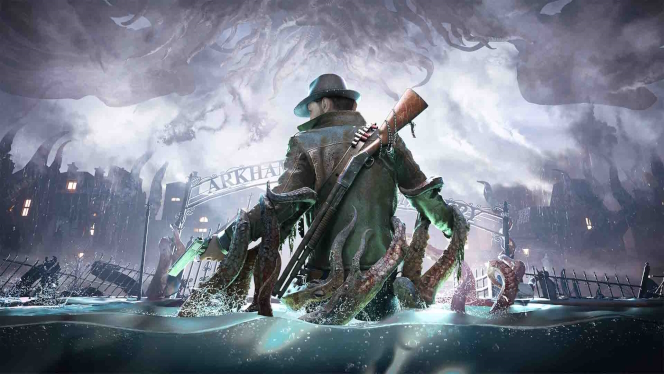
REVIEW – The Sinking City 2 pushes aside much of the open-world detective structure of its predecessor and dives headfirst into survival horror, a change that works surprisingly often. Flooded Arkham is oppressive, the Lovecraftian creatures are appropriately revolting, several puzzles are genuinely clever, and firearms no longer feel like an unfortunate obligation attached to a detective game. Unfortunately, Calvin and Faye can be more irritating than half the Mythos, the level design rarely rises above decent, the controls still feel awkward in crucial moments, and melee combat is astonishingly weak. Making matters worse, apparently not one resident of Arkham remembered to leave a knife, pipe, axe, crowbar or any other actual melee weapon behind before civilization collapsed.
The original The Sinking City was an endearingly rough game: excellent ideas, terrific Lovecraftian atmosphere, genuinely interesting detective work and enough mechanical friction to make Charles Reed consider filing a complaint against reality itself. Frogwares clearly learned from the experience, but instead of simply polishing the old design it has dramatically changed the formula. The investigation-heavy RPG structure has been reduced and a more focused survival horror, clearly influenced by modern Resident Evil and Silent Hill, has taken its place. That is a bold decision for a series whose detective systems were previously one of its defining features.
This time the setting is Arkham rather than Oakmont, a name that hardly requires introduction for anyone with even a passing interest in Lovecraft. The city is collapsing beneath supernatural flooding, much of the population is dead, insane or considerably less human than it used to be, and Calvin Rafferty arrives at precisely the point when every sensible person would be rowing in the opposite direction. A Dreamlands ritual performed with his longtime girlfriend Faye Bennett went catastrophically wrong, leaving Faye comatose and Calvin without much of his memory. Around the same time, Arkham began to drown. Pure coincidence is technically an option, although the surviving residents might disagree.
The Slither, an otherworldly parasite capable of reanimating the dead, has made the situation even less inviting. Whispers travel through abandoned buildings, malformed creatures occupy the flooded streets and something far larger seems to be working behind events that Calvin barely understands. His objective is straightforward enough: save Faye. Discovering what has taken an interest in the couple, what happened to Arkham and how much of the disaster stems from their own reckless curiosity is far more interesting.

Arkham, Where the Flood Is the Smaller Problem
The best character in The Sinking City 2 is Arkham itself. Frogwares understands this kind of decaying, waterlogged 1920s American nightmare exceptionally well, where the remains of ordinary life have been transformed into evidence of a society that collapsed almost overnight. Notes scattered through apartments, hospital rooms, hotel corridors and flooded streets are not merely lore filler. Together they show how ordinary people reacted as the impossible became normal, and once again prove that humanity rarely needs cosmic entities to invent particularly ugly forms of cruelty.
The hospital is an excellent example. A surgeon used people seeking shelter from the flood as material for his experiments, while another story inside the Devil’s Reef Hotel involves a beautiful woman, psychedelics, poison and an end-of-the-world celebration that becomes considerably more literal than its guests expected. These smaller human tragedies frequently interested me more than Calvin and Faye’s central romance. Discoverable radio broadcasts are equally effective, delivering strange little stories that occasionally feel like Welcome to Night Vale has somehow found a frequency in Lovecraft’s Arkham.
The surviving side characters strengthen the city as well. Help is rarely offered without conditions, everyone has an angle, and civilization’s polite surface has been scrubbed away rather efficiently by the apocalypse. I was usually more interested in what might be behind the next locked door or what happened to the owner of another abandoned apartment than in hearing Calvin and Faye explain once again how much they are prepared to sacrifice for each other.

A Love Story at the Edge of Madness
The central premise itself is not the problem. Calvin and Faye interfered with forces they did not understand, leaving one trapped in a coma, the other with damaged memories and an entire city facing consequences that may be connected to their experiment. Beneath the occult mystery is a simple love story: Calvin is prepared to do almost anything to recover Faye, while the game steadily raises doubts about whether recovering what they once had is even possible.
The problem is the couple themselves. Both become irritating surprisingly quickly, and more importantly, neither spends enough time seriously considering how much responsibility they may carry for the catastrophe surrounding them. Calvin regularly reacts with disgust toward Arkham’s selfish, violent or obsessive survivors, and often with good reason. It is simply difficult to forget that he and Faye, driven by their own curiosity, poked something that probably had excellent reasons for remaining on the other side of reality.
Faye later accompanies Calvin in a spectral form and develops a supernatural ability far more dangerous than anything mentioned in the Necronomicon: she never stops talking. During boss fights this becomes especially aggravating. She announces attacks we have already been hit by, points toward obvious environmental mechanisms, and repeatedly explains that Calvin is injured as though the blood covering the screen had left the matter open to interpretation. During the final encounters, I was occasionally less concerned about the boss than the possibility that Faye might remind me once again that Calvin was hurt. Yes, Faye. I noticed.
That weakness is frustrating because the world around them contains much stronger material. The narrative burns slowly, introduces several effective twists and eventually reaches some suitably unpleasant Lovecraftian territory. Calvin and Faye simply lack enough personality to carry every emotional scene. Frogwares remains better at writing monsters than lovers.

The Detective Is Not Completely Dead
Fans of the first game should be relieved to know that investigation has not disappeared, it simply no longer dictates the entire structure. Calvin gathers evidence, reads documents, connects information and uses what he learns to solve puzzles and optional mysteries. Important information can be highlighted inside documents, although the assistance can be disabled for players who would rather perform the reading themselves than let the game attack every clue with a virtual yellow marker.
Some of the puzzles are genuinely clever. A few forced me to return to collected information, inspect the environment again and work out which detail Frogwares had been quietly placing in front of me. Optional investigations are particularly worthwhile because they provide more than background fiction. Weapon upgrades, survival resources and talent points can all come from exploring beyond the critical route.
The talent system is useful without becoming mandatory. Crafting can be improved, incoming damage reduced and various offensive options strengthened. You can even improve melee damage, which is a curious feature considering the actual state of melee combat. It feels a little like selling performance tires for a car after removing the engine.
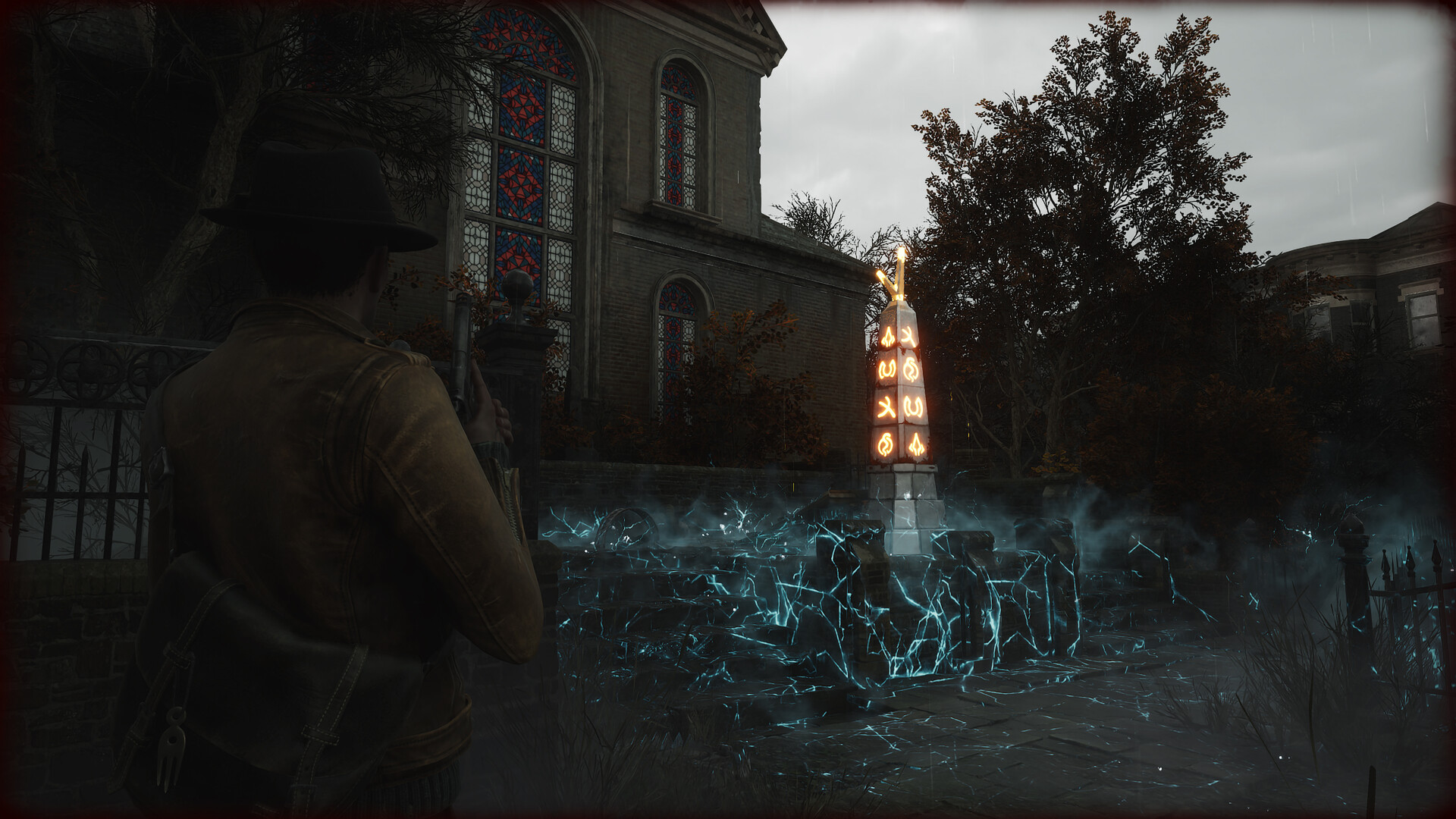
Level design is less exciting. The campaign moves through roughly four or five major areas, including a hospital, hotel, ruined city districts and the fish market. Individual locations have strong atmosphere, useful shortcuts and optional rooms worth investigating, but the actual layouts rarely become memorable. They are fine. In a genre where Resident Evil has spent decades demonstrating how brilliantly a building can unfold around the player, The Sinking City 2 too often reveals the familiar key-door-corridor-next-room skeleton beneath the decoration.
The Guns Work, the Fists Merely Exist
Frogwares has placed far greater emphasis on combat, and the improvement is immediately obvious with firearms. The pistol has respectable impact, the shotgun makes a convincing argument at close range, and later additions include an SMG, bolt-action rifle and grenade launcher. The grenade launcher is somewhat awkward, but the rest of the arsenal is satisfying, particularly after finding useful upgrades.
Ammunition remains scarce because this is survival horror rather than an Arkham firearms exhibition. Searching every room matters, because a handful of additional rounds can determine whether the next monster is carefully dispatched or whether Calvin spends thirty seconds sprinting around furniture while desperately crafting something useful. Inventory space stays valuable for much of the game, constantly forcing choices between ammunition, healing items, crafting materials and key objects. That pressure is exactly what the genre needs.
Enemies are aggressive, frequently fast and particularly fond of landing attacks when Calvin is already one bad decision away from death. Weak points matter, especially the bright red growths visible on many creatures. The armored fish-like humanoids introduced later are significantly less entertaining. Their vulnerable gills are small, they absorb a ridiculous amount of ammunition and often provide too little feedback about whether your shots are achieving anything. They feel less like difficult enemies than expensive ones. Expensive in bullets.
The game warns early that running is frequently wiser than fighting. Listen to it. In later areas I regularly avoided enemies simply because spending another magazine on them made no sense when the next room could contain something far worse. Resource conservation becomes part of navigation, which suits the game extremely well.
Then there is melee combat, which feels like somebody left work early before finishing it. There is no knife, pipe, axe, crowbar, machete, bat or any proper melee weapon at all, an astonishing omission in a survival horror built around making every bullet valuable. Calvin can punch and stomp downed enemies, but both options are weak, inaccurate and awkward even as emergency measures. Punches lack impact, judging range is unreliable and smaller monsters can make Calvin look as though he strongly disagrees with their existence but does not want physical contact with them.
The controls do not entirely escape criticism either. They are functional, but during situations requiring quick transitions between aiming, dodging, reloading, healing and repositioning, the game can feel clumsy at exactly the wrong moment. Survival horror works beautifully when panic makes the player commit a mistake. It works less beautifully when Calvin and the controller briefly disagree about the plan.

Bosses That Are Almost Too Helpful
Strangely, several major bosses are easier than ordinary encounters leading up to them. Their arenas provide generous ammunition and healing crates, so the careful resource management that defines much of the campaign temporarily stops mattering. Run low, circle the arena, collect another supply and continue. The best survival horror bosses force players to carry the consequences of earlier mistakes into the fight. Here, the game occasionally cleans up those consequences for us.
The bosses themselves are not particularly demanding either. Several are visually effective and there are tense scenarios surrounding them, but mechanically they rarely create as much stress as ordinary enemy groups. Faye’s constant commentary during later fights adds an entirely separate difficulty setting. Not because her advice is useful, but because resisting the urge to mute her becomes a test of endurance.
That makes these problems more frustrating, because when The Sinking City 2 commits fully to cosmic horror, it can be excellent. Dark corridors, movement beneath flooded rooms, malformed bodies, bizarre radio stories, journals from doomed citizens and the constant suggestion that something underneath Arkham is far beyond Calvin’s understanding create terrific atmosphere. Frogwares still understands the most important lesson of Lovecraftian horror: it is not about placing the maximum possible number of tentacles on screen. It is about slowly understanding how insignificant humanity is compared with what lies beyond it.
The Sinking City 2 therefore feels like a good game with the outline of a much better one constantly visible beneath it. Worldbuilding is excellent, several puzzles are strong, firearm combat has improved considerably and resource management creates genuine pressure. The protagonists are weaker than the world surrounding them, the level design is merely competent, the controls occasionally fight back, and I genuinely cannot understand why the melee system was released in this state. Wandering through a survival horror without an actual melee weapon is not cosmic terror. It is simply annoying.
Players who enjoy slower resource-driven horror, detailed exploration, documents, puzzles and the occasional entirely sensible retreat from a monster will still find plenty to enjoy. Frogwares’ genre shift is imperfect, but it works, and Arkham remains compelling even during the weaker stretches. Faye could simply spend a little more time in another dimension.
-Gergely Herpai „BadSector”-
Pros:
+ Excellent Lovecraftian atmosphere and worldbuilding
+ Gunplay is dramatically better than in the first game
+ Clever investigations, puzzles and rewarding exploration
+ Effective resource and inventory management
Cons:
– Controls can feel clumsy and uncomfortable in critical situations
– No proper melee weapon, while unarmed combat is weak and unreliable
– Level design rarely rises above competent
– Calvin and especially the relentlessly talkative Faye can become irritating
Publisher: Frogwares
Developer: Frogwares
Genre: Lovecraftian survival horror
Release: August 18, 2026 – PC, PlayStation 5, Xbox Series X|S
| Gameplay | 62/100 |
| Graphics | 77/100 |
| Story | 66/100 |
| Music/Sound | 73/100 |
| Atmosphere | 82/100 |
| Overall | 72/100 |
| Rating | GOOD |
The Sinking City 2
Gameplay - 6.2
Graphics - 7.7
Story - 6.6
Music/Audio - 7.3
Ambiance - 8.2
7.2
GOOD
The Sinking City 2 is strongest when it stops worrying about Calvin and Faye’s relationship and lets Arkham, its monsters, investigations and resource scarcity take control. Gunplay is substantially better, the worldbuilding is excellent and several puzzles are genuinely satisfying, but awkward controls, poor melee combat, the complete absence of a proper melee weapon and merely adequate level design drag the experience down. It remains a good survival horror despite those flaws, although sometimes the game itself contributes more to your descent into madness than Cthulhu ever could.







Leave a Reply