
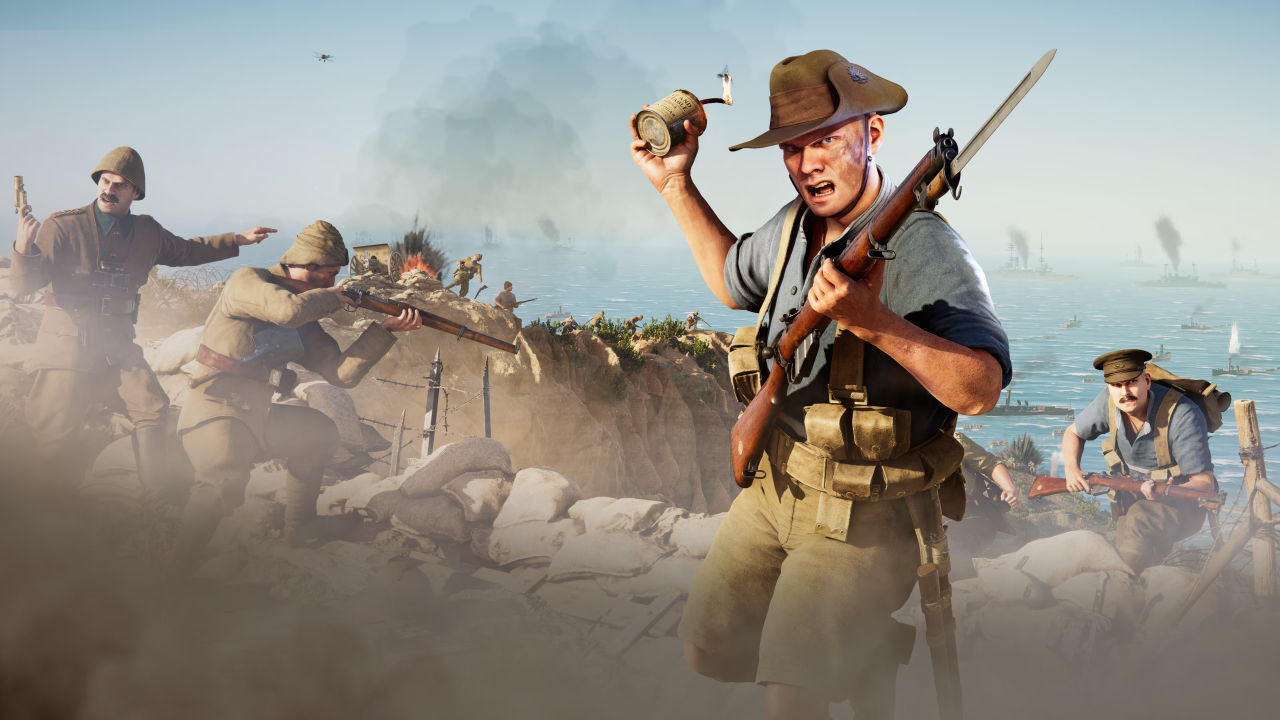
REVIEW – BlackMill Games is now on its fourth game in its World War I series. It’s relentless and slow-paced, yet it aims to be as historically accurate as possible. This time around, we won’t see anything like what Battlefield previously offered. Instead, it strives to present something different — and perhaps even unique — in comparison. Here, there’s a real cost to running out of ammo or failing to aim accurately.
From our experience, it takes ten seconds to reload a rifle. In that amount of time, an opponent can quickly take us down.

Realism above all else
If we aren’t hit in a vital spot, we have to stop the bleeding and regain our full strength, which takes another quarter of a minute. Do we run somewhere? We’ll run out of breath, and it will take just as long to catch our breath again. These details alone suggest that the game is not heading in the direction of the attention-deficient, ADHD-style gameplay of Call of Duty or Battlefield, because here, not even interrupting the reload animation helps; it simply has to run its course. It also seems natural to waste ammunition, since we have to remember that we’re in the mid-1910s. Where were laser sights back then? There are lots of animations, and if our weapon moves even slightly, our aim goes haywire. When standing around corners, we won’t have a clue where we’re shooting. But it’s not just firearms; we also have knives and bayonets at our disposal. And yes, things can get chaotic — very chaotic, in fact — even then. In the background, a grenade whizzes by, and the heavy artillery fires a round over there. There’s a certain atmosphere as we lie in the trench tending to our wounds and hoping that we’ll have just enough time to do so before someone pops up and shoots us in the face.
Don’t be surprised if we run out of ammunition. Back then, even the Allies made “projectiles” for their catapults out of nails and scrap metal. Many people died from diseases rather than enemy fire, but this hasn’t been incorporated into the game, where success doesn’t depend solely on shooting. There are other ways to lead the team to victory.
Let’s observe the other team through the binoculars. Set up the machine gun nests. Create the spawn points. After all, this is a team-based game, and proper coordination is essential. It’s brilliant that this can be achieved without speaking, though our ranking system doesn’t always reflect this, which might not be entirely fair, as players in support roles are somewhat overlooked. There are 125 points in the game, representing the total number of attacks that all characters on the attacking team can perform. Capturing an objective restores 25 points, while killing a defender restores 10 points. Gallipoli features a single game mode and five maps, two of which are named after the locations that inspired the game’s name: V Beach and Anzac Cove. In Mesopotamia, there are Ctesiphon and Kut, while Suez is naturally in Egypt. Are the locations varied? In short: yes.

Fighting across the sectors
Each sector has two objectives: first, to capture the hub; and second, to create a spawn point and gain access to resources. You have to place explosives or structures around the hub to defend it, which certainly complicates things because you will lose the point more than once, and it will go back and forth a few times between the two teams. Here, you have to choose not only character classes, but also units.
The British have light machine guns, but the Ottomans are missing one of the ten character classes. However, they have two slots for heavy machine guns. Since they built their strategy around the Maxim, they get the M1909, while the British are left with the Vickers. Weapons and classes can be upgraded to level 20 (separately for each faction), after which prestige levels follow. Each class must also complete a role-specific challenge. For example, an officer must kill fifty enemies using secondary weapons.
But how many of those 150 count as a weapon? The rifle’s aiming reticle treats each weapon as distinct, whereas the bayonet or rifle grenade is treated as the same weapon when used with the primary weapon. Class perks have been divided into three tiers, and the difference between them is significant. It’s almost impossible to control rifle spread using a controller, but you can use aim stabilisation — though aim assist doesn’t solve the spread or recoil issues.

Recommended… but only on PC?
Although the PlayStation 5 Pro supports 4K, 60 FPS isn’t always guaranteed. This is somewhat surprising, as it doesn’t seem to have been an issue in previous instalments of the series. Even at 50 FPS, players can clash on large maps, but screen tearing is still evident.
Playing with a controller also doesn’t quite feel right for Gallipoli (it feels like you have to move the analogue sticks a bit too much for anything to happen). That’s why we’d give this game a 7.5/10 on PC and a 7/10 on console. The performance isn’t perfect, and we don’t even want to think about what it’s like on the standard PlayStation 5.
-V-
Developer: BlackMill Games
Publisher: BlackMill Games
Release date: 20 August 2026
Genre: World War I FPS
Pros
- Authentic design
- Relentless close-quarters combat
- Slower pace, making it unique in several ways in the market
Cons
- Slightly problematic on console
- Content is a bit lacking at launch
- Animations can’t be interrupted; they will go all the way
Gallipoli
Gameplay - 75%
Graphics - 75%
Story - 58%
Music/sound - 72%
Ambience - 68%
70%
GOOD
This battle has never been portrayed in a game like this before. How long will the audience stick with it?


![The Wolf Among Us Remastered: Bigby Goes Noir! [VIDEO]](https://thegeek.games/wp-content/uploads/2026/08/theGeek-08-wolf-among-us-remastered-1280x720-1-302x180.jpg)

![Alien Deathstorm: A Look at the Reactor Mission [VIDEO]](https://thegeek.games/wp-content/uploads/2026/08/theGeek-06-alien-deathstorm-1280x720-1-302x180.jpg)

![Shadow of the Road: You Can Now Try Out This Japanese Adventure [VIDEO]](https://thegeek.games/wp-content/uploads/2026/08/theGeek-05-shadow-of-the-road-1280x720-1-302x180.jpg)
![Etre: A Metroidvania with a sci-fi twist [VIDEO]](https://thegeek.games/wp-content/uploads/2026/08/theGeek-04-etre-1280x720-1-302x180.jpg)
![Greak 2: Alliance of the Storms: A Hand-Drawn Metroidvania Set in Synoraz [VIDEO]](https://thegeek.games/wp-content/uploads/2026/08/theGeek-02-greak-2-1280x720-1-302x180.jpg)
![The Wolf Among Us Remastered: Bigby Goes Noir! [VIDEO]](https://thegeek.games/wp-content/uploads/2026/08/theGeek-08-wolf-among-us-remastered-1280x720-1-300x365.jpg)
Leave a Reply