![The System Requirements for Fable Are In! [VIDEO]](https://thegeek.games/wp-content/uploads/2026/08/vnews-05-fable-1280x720-1.png)
Playground Games originally planned to generate a large portion of Fable‘s NPC population procedurally, but one especially strange combination forced the studio to reconsider that approach. During testing, the system produced a vegetarian butcher, and that odd little accident ultimately convinced Ralph Fulton’s team to start building Albion’s inhabitants by hand.
In an open-world RPG, believable NPCs depend on far more than facial detail or animation quality. Their routines, reactions, personal histories, dialogue, occupations and place within the wider community all contribute to whether a fictional world feels convincing. Playground Games understood that problem early in the development of Fable, although its first solution relied heavily on automation.
Game director Ralph Fulton told GamesRadar that the initial idea involved tools capable of generating non-player characters by combining different traits at random. Appearance, interests, personality characteristics and professions could all be assigned automatically, potentially saving the team a significant amount of development time and resources. It is not an unusual concept, particularly for background characters that many players may never meaningfully interact with. CD Projekt has also discussed plans to use its own AI-driven systems to create more elaborate networks of NPC interactions, histories and visual identities in future projects.
The problem for Playground Games was that random combinations do not necessarily produce coherent people. During internal testing, the system eventually generated a butcher who happened to be a vegetarian. There is nothing inherently impossible about that combination, and a writer could easily turn it into an interesting contradiction with a believable explanation, but that was precisely the issue: the game had produced the contradiction without any deliberate narrative reason behind it.
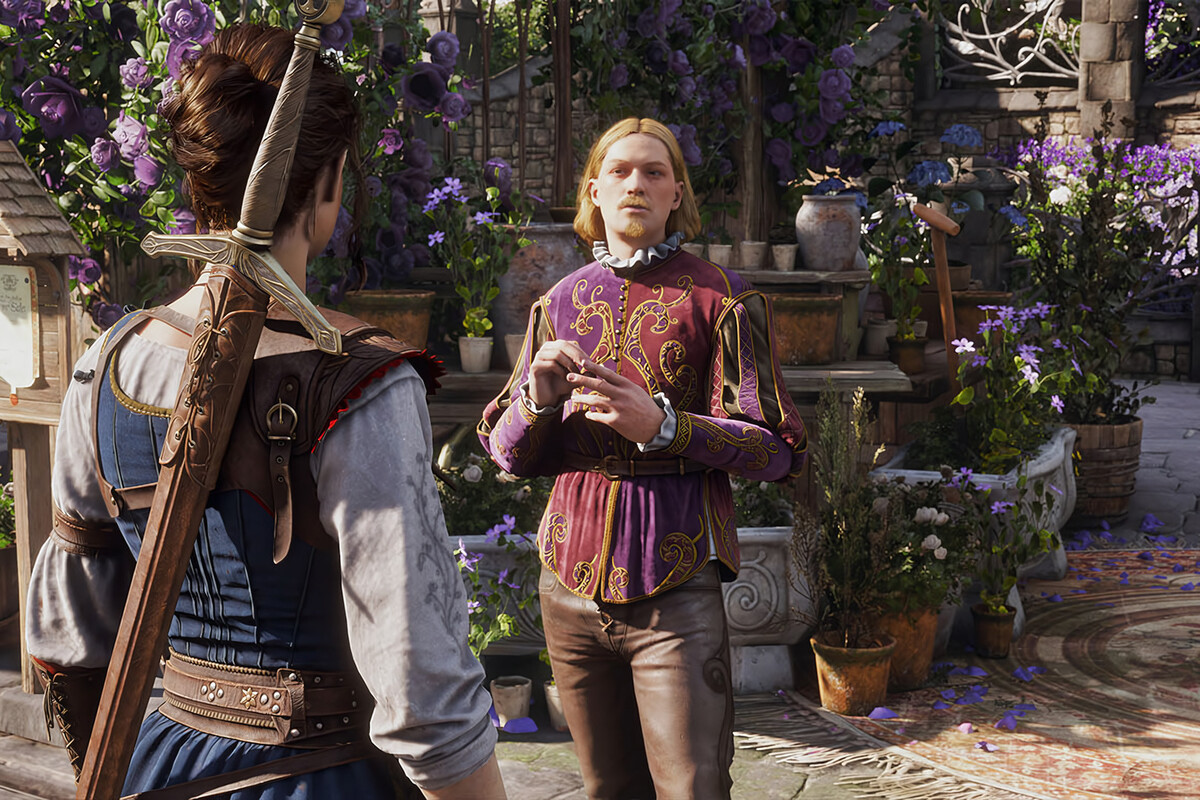
That example helped convince the team to abandon automatic NPC creation and move toward individually authored characters instead. Fulton explained that the developers now select the relevant pieces of every NPC by hand so each person remains readable and internally consistent from one end of their characterization to the other. Their appearance, occupation, personality, history and broader relevance to Albion are all considered together rather than assembled through an uncontrolled collection of random traits.
The aim is to make Albion’s settlements feel like communities rather than containers filled with interchangeable background figures. That matters because Fable still places considerable emphasis on the player’s relationship with ordinary citizens. NPCs can form opinions of the protagonist, react differently to the same behavior and become part of longer-term relationships, which means inconsistencies are far more visible than they would be in a world where most townspeople exist purely as scenery.
This Handcrafted Philosophy Extends to Fable’s Economy and Karma
The same attention to deliberate design is also shaping the game’s economic systems. Players will be able to purchase and improve a variety of businesses in Fable, ranging from bakeries and bookstores to tailors, barbershops and farms. Ownership will involve more than simply collecting passive income, however, because players will also be able to influence how those businesses are managed.
Employee wages are one example. Paying workers more can improve their mood, strengthen their relationship with the protagonist and potentially increase productivity, although doing so naturally cuts into the owner’s profits. Reducing salaries may push revenue in the opposite direction and damage employee relationships, but Fulton noted that it will not automatically cause productivity to collapse in every situation. The intention is to create a system in which players experiment rather than discover a single universally optimal setting.
That distinction is important because Playground Games is not rejecting systemic design itself. The studio still wants the player to have multiple tools, combine them in different ways and discover the consequences through experimentation. The difference is that those systems are being designed, tested and constrained by people before they reach the player, rather than being left entirely to combinations that may produce results nobody actually intended.
Fable is taking a similar approach to morality. Instead of returning to the traditional karma meter that places the protagonist somewhere on a single line between good and evil, the new game will use a more layered reputation system. Townspeople may therefore hold apparently contradictory views of the protagonist depending on what they have personally witnessed, what they have heard and which actions have affected their lives.
Fulton described this approach as a more accurate representation of what the player actually does and what other people know about those actions than simply moving a marker up and down one universal scale. In practical terms, the new Fable seems determined to make Albion feel less like a collection of isolated game systems and more like a network of people, businesses and reputations that respond to one another. Strangely enough, a randomly generated vegetarian butcher appears to have helped push the project in that direction.
Source: 3DJuegos









![The System Requirements for Fable Are In! [VIDEO]](https://thegeek.games/wp-content/uploads/2026/08/vnews-05-fable-1280x720-1-300x365.png)