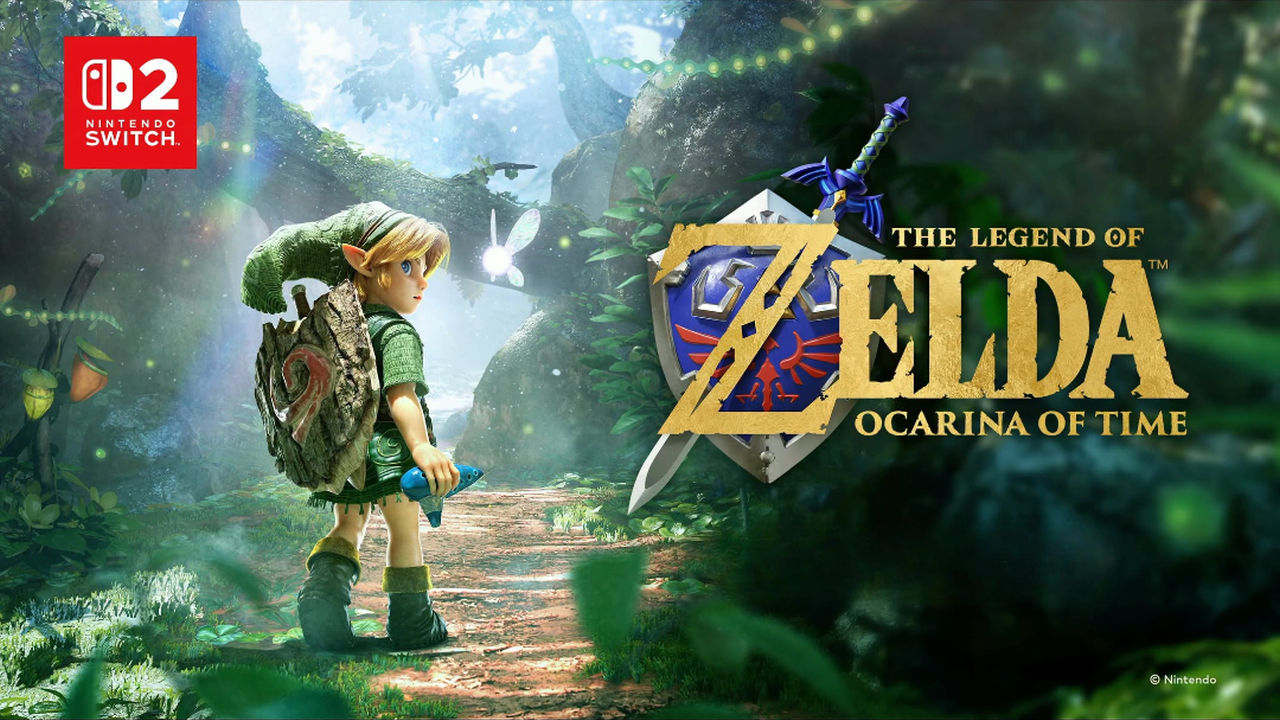
PREVIEW – Twenty-eight years have passed since we first stepped out of Kokiri Forest and onto Hyrule Field in 1998, when an entire generation of players suddenly discovered what a truly three-dimensional adventure world could feel like. The Legend of Zelda: Ocarina of Time is now returning as a full remake for Nintendo Switch 2, and Nintendo’s extended showcase has finally revealed just how far the company is willing to go in altering one of the most influential video games ever made. The answer is far more conservative than the current remake craze might have led us to expect: rather than a Final Fantasy VII Remake-style reinterpretation, this is a version that almost stubbornly preserves the foundations of the 1998 original while thoroughly modernizing its technology, controls, and overall usability. Nintendo is not trying to make a new Ocarina of Time; it is trying to make the old one finally look and respond in 2026 the way twenty-eight years of nostalgia have polished it in our memories.
When Nintendo announced the remake in June with a teaser lasting only a few seconds, the brief footage left practically every important question unanswered. After Breath of the Wild and Tears of the Kingdom, it was perfectly reasonable to wonder whether Hyrule would be rebuilt as one enormous open world, whether the Nintendo 64 locations would be substantially expanded, whether the dungeon order would become more flexible, or whether Nintendo might build an entirely new combat system around the original story. Following the September 8 Nintendo Direct celebrating the Zelda series’ 40th anniversary, the picture is much clearer, and remarkably few of the changes qualify as radical. Eiji Aonuma described the project as a “faithful interpretation made with modern technology,” and the first extended gameplay footage reflects exactly that: the game’s fundamental rhythm, world structure, and mechanical logic remain unmistakably rooted in 1998, while Nintendo has intervened wherever old technical limitations would simply get in the player’s way today.
That approach is reassuring and dangerous in equal measure, because the original Ocarina of Time is one of those rare games where the question is not merely whether it was good, but how much of the entire genre eventually learned from it. Z-targeting effectively established a standard for three-dimensional melee combat, context-sensitive controls elegantly worked around the limited button layout of the Nintendo 64 controller, while Hyrule Field served as a central space connecting dungeons and smaller regions in a way that countless action-adventure games would later imitate. The seven-year gap between Link’s childhood and adulthood was more than a time-travel gimmick, too, allowing us to explore the same world in two radically different states with consequences that affected both the narrative and the gameplay. Over twenty-eight years, however, many of those once-revolutionary ideas have become basic expectations, making one of the remake’s most fascinating questions whether Ocarina of Time’s own systems can still stand as strongly now that an entire genre has grown up around them.

Hyrule has been reborn, but thankfully it has not become Breath of the Wild 3
The visuals are naturally where the difference requires no magnifying glass. Compared with Kokiri Forest’s dense vegetation, the richly detailed bark of the Great Deku Tree, the distant horizon of Hyrule Field, or the far livelier streets of Castle Town, the Nintendo 64 original now looks almost like an abstract geometric sketch. Nintendo has wisely avoided mechanically grafting the painterly, near-cel-shaded aesthetic of Breath of the Wild and Tears of the Kingdom onto the 1998 game, instead choosing a slightly more grounded fantasy style with dramatically richer lighting, materials, and environments while preserving the stylized, storybook proportions of the characters. Link still looks unmistakably like Link, while Hyrule feels far more tangible without suddenly resembling a photorealistic Unreal Engine tech demo. Based on the first footage, that compromise is a far more interesting direction than simply wrapping a twenty-eight-year-old classic in the visual language of the latest Zelda.
Structural faithfulness is an even more important decision. Hyrule Field still serves as a central space connecting the different regions, and transitions remain between major locations, meaning the remake does not stitch the entire game into one huge seamless open world. That may initially sound old-fashioned in an era when even the instruction manual for a coffee machine seems one pitch meeting away from becoming an open-world RPG, but Ocarina of Time’s dungeons and time-travel puzzles depend on the story handing the player specific items, abilities, and information in a carefully controlled order. The game was never designed around charging Ganondorf twenty minutes after the opening with a stick and three apples; Hyrule is supposed to unfold gradually, with each new tool changing the way we understand places we have already visited. If Nintendo dismantled that structure simply in the name of modern freedom, it could easily destroy the meticulously constructed rhythm that made the original so memorable.
The same restraint is visible in the dungeons and smaller locations. Residents of Kokiri Village have more dialogue, Hyrule’s town areas promise more interaction, and the environments function far less like static backdrops, yet the first rooms shown inside the Great Deku Tree are instantly recognizable to anyone who played the original. The classic chest-opening animation, the familiar jingle, and the puzzle structure all suggest that Nintendo is making old locations richer and more natural rather than turning them into completely different spaces. There has been no announcement of new dungeons, entirely rebuilt temples, or radically expanded regions, so those ideas are better left on wish lists and message boards for now. As things stand, the Water Temple appears destined to remain the Water Temple; at least this time we will be able to get lost in it more beautifully.
The identity of the studio developing the remake also remains strangely murky. An earlier retailer listing named Monolith Soft, which would hardly be surprising given that the Xenoblade Chronicles developer has served as a support studio on several major Nintendo projects and contributed to both Breath of the Wild and Tears of the Kingdom. That still does not make Monolith Soft’s involvement an established fact, however, because Nintendo has yet to provide a definitive developer credit. Until that happens, it is worth keeping highly plausible information separate from confirmed information, even if the internet tends to blur those categories into one another within a few hours.

Link finally jumps when we want him to
Perhaps the most ridiculous-sounding mechanical change also says the most about Nintendo’s approach to modernization: Link finally has a dedicated jump button. In the original, he automatically threw himself from appropriate ledges, which was an elegant solution in 1998 on a console where developers were still fighting for every available button and workable camera angle. In 2026, however, it would feel more like an unnecessary restriction if the hero of a modern third-person adventure could only leave the ground when the software granted permission. The remake therefore preserves the basic character of Link’s movement while giving the player more direct control, and it is precisely these seemingly small adjustments that can keep the game from feeling like a twenty-eight-year-old design wearing new graphics.
The freer camera follows the same philosophy. The original game’s camera was a technical and design achievement in its time, but today it clearly reveals that it was created in an era when the entire industry was still trying to figure out how players should even be followed through three-dimensional space. The remake’s modern camera offers far more natural control, yet the combat system has not been replaced with some fashionable soulslike interpretation. Classic lock-on remains, Link can still strafe, circle enemies, evade with a backflip, and strike at the right moment, so Nintendo has not tried to “fix” the essence of Z-targeting simply because twenty-eight years have passed. It is genuinely refreshing to see Nintendo resist the urge to put a stamina bar over Link’s head merely because by 2026 even a mailbox seems expected to have an endurance system.

There are plenty of subtler modernizations as well. When using the bow, we can aim with Joy-Con 2 motion controls, the interface and menus have moved closer to the clean design language of the modern Zelda games, and a new journal continuously records Link’s journey. More interesting is the Threads of Time system, which helps us keep track of where we are in the story, which era contains the next important objective, and where we should head after returning from a three-week break with only a vague memory that someone somewhere in Kakariko wanted something from us. To players who know the original by heart, this may seem like unnecessary hand-holding, but one of the remake’s most important jobs is to work just as naturally for people who do not remember Ocarina of Time from childhood and will experience it as an entirely new game.
Story progression is also represented by a tapestry that gradually fills in, while Zelda Notes support returns after being established in the Switch 2 editions of Breath of the Wild and Tears of the Kingdom. These companion features can track certain activities, offer visual clues for secrets, provide a virtual ocarina, and keep additional information within reach without turning the main game screen into an airplane cockpit. None of these additions are likely to inspire game-design textbooks ten years from now, but in a remake, this kind of quality-of-life work is precisely what separates a restoration from a genuinely modern release.

If it is Ocarina of Time, the ocarina should not be stuck in 1998 either
The remake’s most unmistakably Nintendo idea naturally concerns the very instrument in the title. The ocarina can still be played using the Joy-Con 2 buttons, so anyone who somehow remembers the combinations for Zelda’s Lullaby, Epona’s Song, or Song of Storms by muscle memory twenty-eight years later can perform them exactly as before. Nintendo has also built in melody recognition that can identify the correct song simply when we hum it. So if the music is permanently burned into some corner of our brain while the old button sequence disappeared long ago, there is no need to dig out a notebook from 1998 or consult a twenty-year-old GameFAQs page; we can simply try to sing it.
From there it was only one perfectly Nintendo step to allowing the game’s melodies to be performed on a real ocarina. The system can recognize the sound of the instrument itself, and Nintendo plans to offer its own ocarina as well. Obviously this is not the kind of feature that will single-handedly send anyone sprinting out to buy a Switch 2, but the idea fits the world of Ocarina of Time so precisely that it is difficult not to appreciate it. In the original game, the ocarina was never a decorative prop or a one-off gimmick, but an integral part of how Hyrule worked: melodies changed the time of day, summoned Epona, opened paths, triggered events, and teleported Link across the world. In a remake, this is exactly the kind of mechanic worth expanding because it adds something new without taking anything away from the logic of the original.

The audio experience is changing significantly in other areas as well. Based on what Nintendo has shown, the remake features richer, newly arranged music and voiced dialogue while preserving Link’s traditional silence. Voice tracks are being prepared for several European languages, with German specifically mentioned, though there is currently no official confirmation of a Hungarian dub. That is hardly a problem in itself; the more interesting challenge will be preserving the extraordinary musical identity of the original within a much richer, more contemporary soundscape.
Saria’s melody, the choir of the Temple of Time, the Lost Woods theme, and Hyrule Field’s dynamically shifting score did not become unforgettable through technical muscle, but through a handful of exceptionally precise motifs. A modern remake could easily fall into the trap of making everything bigger, louder, and more symphonic, only to lose the very simplicity that has kept those melodies instantly recognizable after all this time. So far, the footage suggests Nintendo understands that danger, but this is one area where only the complete game will reveal whether the original musical character has truly survived intact.
In November, it is not the graphics but the twenty-eight-year-old foundations that face the real test
The Legend of Zelda: Ocarina of Time launches exclusively for Nintendo Switch 2 on November 5, giving it an interesting place in the history of the series as the first Zelda designed from the ground up as an exclusive for Nintendo’s new console. The Switch 2 editions of Breath of the Wild and Tears of the Kingdom came from a different starting point, having originally been designed for earlier Nintendo hardware, whereas this remake could be built around the new system’s capabilities from the outset. That still has not turned it into some kind of Switch 2 technical showcase, because Nintendo clearly considers preserving the identity of the original more important than turning every new hardware feature into a fireworks display.
Pricing remains somewhat murkier. An Australian Nintendo Store listing and earlier retailer information suggest that the digital version could land around the $59.99/€59.99 range, while Nintendo’s US page had not listed a final dollar price at the time this article was written. Sixty euros therefore looks highly likely, but until Nintendo confirms regional pricing, it is better not to treat the figure as though Miyamoto personally carved it into a stone tablet. Information has also surfaced about special textured packaging for the physical edition, suggesting Nintendo is very much counting on collectors taking notice.
The pricing itself is interesting because it helps show how Nintendo appears to be positioning the entire project. The remake is not trying to become a gigantic new Zelda padded out with three continents, seventy new systems, and a twenty-hour Ganondorf side campaign simply to justify its existence. There has been no official word about completely new dungeons, an alternate story, continent-sized new regions, or any Final Fantasy VII Rebirth-style expansion that multiplies the scale of the original adventure. What Nintendo has shown so far is a technically rebuilt Ocarina of Time with modernized controls, camera, interface, and presentation, while remaining remarkably willing to leave intact many of the things that were already working twenty-eight years ago.

And this is exactly where the November review becomes genuinely fascinating. There is little point in proving the original game’s historical importance yet again; by now, more essays, analyses, and retrospectives may have been written about it than about the complete history of several small countries. A remake, however, is not a museum display we are expected to admire simply because everyone handed out perfect scores in 1998. It is a video game being released again in 2026, and it still has to work as one. The Forest Temple has to be good because it remains brilliant today, not because it was brilliant twenty-eight years ago; Z-targeting cannot survive solely on the fact that it was once revolutionary, and Hyrule Field is not automatically entitled to awe just because it once seemed impossibly enormous on a Nintendo 64.
Since Breath of the Wild, the Zelda audience itself has also fundamentally changed the way it thinks about Hyrule. For an entire generation of players, seeing a mountain means climbing it, spotting the outline of a ruin on the horizon means simply walking toward it, and being told to go left often feels like an invitation to head right just to see what happens. Ocarina of Time is far more structured, linear, and carefully choreographed by comparison, with freedom emerging from a sequence of discoveries rather than from exploring the entire world in whatever order we please. Based on the first substantial gameplay footage, Nintendo is not pretending that this is some embarrassing relic of the 1990s.
The remake retains its dungeon structure, does not make every rock face climbable, and does not rebuild combat simply because modern action games increasingly seem obliged to contain a stamina meter, a parry system, and three separate progression trees. That stubborn faithfulness could become the project’s greatest strength because it gives a new generation the opportunity to understand what Ocarina of Time’s design actually was rather than receiving its story transplanted into modern Zelda systems. At the same time, that exact philosophy is also its greatest risk, because pacing or structural limitations may reappear that our memories have quietly edited out of their own internal remaster over the past three decades.
If Nintendo has found the right balance, the The Legend of Zelda: Ocarina of Time remake could become far more than a nostalgia project. Instead of merely showing new players what a classic looked like in 1998, it could explain why it once felt so impossibly modern, vast, and free despite being far more tightly controlled than what we now call an open world. If excessive faithfulness carries the original limitations into the remake just as precisely as it preserves its dungeons and melodies, however, the beautiful graphics may ultimately conceal little more than a very expensive restoration. Based on the first extended presentation, Nintendo at least seems acutely aware of the tightrope it is walking, and it is returning to Ocarina of Time not to rewrite it, but to discover whether, twenty-eight years later, so little of it still needs rewriting.
Source: 3DJuegos, Nintendo, The Verge, JPGames.de
-Gergely Herpai „BadSector”-