
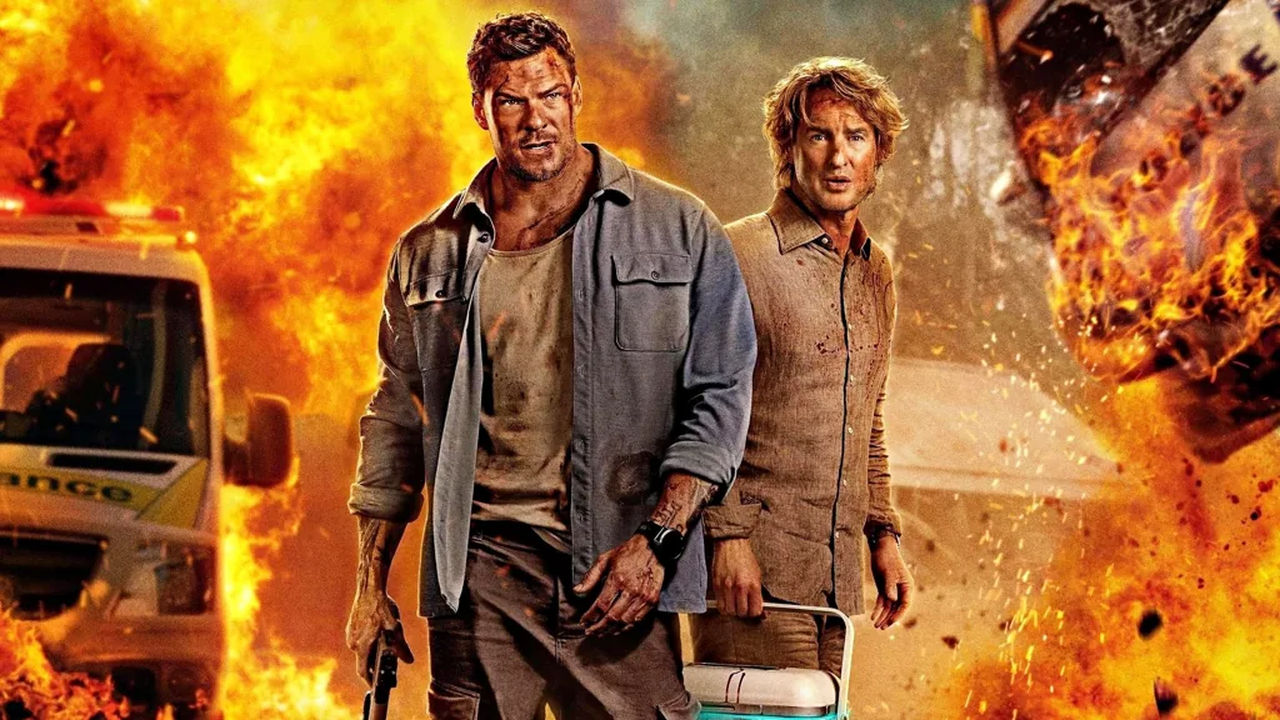
MOVIE REVIEW – There is something refreshingly old-school about an action movie that has no interest in launching a cinematic universe, squeezing a grand social statement into every car crash, or setting up three sequels before the credits roll. Runner simply puts two well-matched stars in a car, hands them a desperately needed donor liver, and sends an armed criminal organization after them. Alan Ritchson supplies the moving concrete wall, Owen Wilson plays the man who could probably begin a five-minute anecdote in the middle of automatic gunfire, and Scott Waugh keeps the whole thing moving for a lean 98 minutes. The movie never comes close to reinventing the buddy-action thriller, but at least it understands that this particular story does not require two and a half hours, five flashbacks, and a post-credits scene. The pity is that while its stars and action occasionally suggest a slicker theatrical crowd-pleaser, the production values keep dragging it back toward mid-tier streaming territory.
Hank Malone is supposed to be having a straightforward day. Played by Ritchson, the former American soldier now works as a courier in Brisbane, is celebrating a year of sobriety, and is teaching himself French in memory of his late daughter, which already gives him more personal history than most action heroes receive between their first two car crashes. His latest assignment sounds simple enough: collect a donor liver arriving from the United States and deliver it to a hospital on the Gold Coast, where it could save the life of a seven-year-old girl. The package arrives with Ben Bishop, however, meaning Owen Wilson climbs into the vehicle as well, and Hank suddenly finds himself responsible for both a vital human organ and a man seemingly incapable of leaving silence undisturbed.
The drive quickly becomes more complicated because another family desperately wants the same liver. Damian Zaldívar, the ruthless son of a powerful cartel boss, intends to obtain the organ for his own dying mother, and his interpretation of transplant procedure involves considerably more gunfire than paperwork. Black SUVs, armed men, and increasingly violent obstacles begin appearing behind Hank and Ben while the medical clock keeps ticking. The entire screenplay can essentially be summarized in one breath, but simplicity is hardly a fatal flaw in an action movie if the machinery built around it works.

One liver, two families, and far too much ammunition
One of Runner‘s smartest choices is refusing to pretend that its premise is more complicated than it really is. The movie does not stop every twenty minutes to explain that the liver symbolizes the enduring hope of mankind, nor does Damian receive a lengthy speech explaining the childhood trauma that persuaded him automatic weapons were an acceptable solution to organ allocation. A liver has to reach a sick child, another party intends to take it by force, and two men have to survive long enough to complete the delivery. Entire city blocks have been destroyed in action movies for substantially dumber reasons.
Scott Waugh is most comfortable when he simply allows that engine to run. A former stuntman, he still seems much more confident arranging two vehicles trying to remove each other from the road than handling delicate emotional material, but the action is generally clean, readable, and pleasingly physical. The camera does not need eighteen cuts to disguise every punch, and Ritchson’s sheer mass works especially well whenever some unfortunate thug has to discover why attacking him was a poor career decision. After the synthetic look of Waugh’s previous major action outing, it is refreshing that collisions and fistfights here usually have a genuine sense of weight.
The 98-minute runtime is almost a feature in itself. By the time many modern blockbusters would finish introducing their mythology and preparing the villain’s proper entrance, Runner has already delivered several chases, multiple shootouts, and at least one stretch during which Owen Wilson has apparently forgotten breathing is supposed to interrupt speech. Waugh rarely stretches a set piece into a ten-minute showcase, so the movie tends to change location or tempo just before a scene begins exhausting itself. This plot has enough fuel for roughly an hour and a half, and the movie has the uncommon good sense not to install a larger tank.

Lock Reacher in a car with Owen Wilson and somehow it works
The whole construction depends heavily on Ritchson, who also serves as a producer and remains Hollywood’s ongoing experiment in turning the success of Reacher into a full-fledged movie-star career. Physically, he requires very little introduction: Hank looks dangerous simply by getting out of a vehicle, and when he starts walking toward someone, dialogue is rarely necessary to clarify which participant is about to regret the encounter. Yet Ritchson finds more in the role than brute force. Hank’s alcoholism and the loss of his daughter are underlined with a fairly thick dramatic marker, but Ritchson plays the quieter moments with enough restraint and dry humor to stop them becoming completely manipulative.
Wilson arrives with essentially the same comic equipment audiences have known for three decades, which turns out to be exactly what the movie needs. Ben talks, comments, digresses, and continues communicating during situations in which most reasonable people would consider silence a useful survival strategy. Wilson nevertheless understands the remarkably narrow line between entertainingly annoying and simply unbearable. With a less experienced comic actor in the role, Ben could have destroyed the movie before the first major chase.
The contrast is the ancient tough-guy-and-motormouth formula, but ancient formulas survive because they occasionally still work. Ritchson responds to Wilson’s increasingly elaborate sentences with increasingly fewer words, while Wilson behaves as though being pursued by armed cartel killers is merely another opportunity to learn why Hank is so emotionally unavailable. Not every joke lands, but the chemistry does, and eventually the movie becomes as much about waiting to see whether Hank will finally throw Ben out of the car as it is about the medical delivery. Strangely, by the end I wanted another Ritchson-Wilson movie much more than I wanted Runner 2.

The action rides up front, the screenplay is in the trunk
Almost nothing beneath the movie’s surface feels unfamiliar. Hank’s tragic history mirrors the present assignment with almost comic precision: he could not save his own daughter, and now fate has provided another little girl whose survival depends on him. It is the dramatic equivalent of writing “SYMBOLISM” on the side of an ambulance and driving it through the frame. Ritchson lends those scenes enough sincerity to keep them from collapsing completely, but subtlety is not among the screenplay’s major ambitions.
Rodrigo Santoro’s Damian is serviceable rather than memorable. His motivation is at least slightly more interesting than the standard money-power-revenge package because he too is trying to save a dying member of his family; his main distinction is having radically different ideas about how waiting lists should work. There is a genuinely compelling moral conflict buried inside that setup, with two families depending on the same life-saving organ and only one capable of receiving it. Waugh glances at that idea, then notices another black SUV entering the intersection and understandably gets distracted.
That pattern essentially defines Runner. Whenever the film could dig deeper, it hits the accelerator instead, making it dramatically shallow but surprisingly efficient as disposable entertainment. It rarely becomes boring because every time we begin noticing how little story exists underneath the action, Ritchson is already folding another attacker over a piece of automotive bodywork. The downside is that almost nothing develops enough emotional or thematic weight to remain once the credits roll.

Brisbane is probably beautiful; the movie barely proves it
The film’s visual presentation is where its mid-tier status becomes most obvious. Runner is not ugly, and portions of the action look perfectly convincing, but there are repeated moments when the budget becomes visible in ways budgets are generally not supposed to. Several moving backgrounds outside vehicle windows look conspicuously artificial, while some composite shots could clearly have used another serious visual-effects pass. There are scenes in which Ritchson and Wilson appear to be performing in a more expensive movie than the one being rendered around them.
Brisbane itself is surprisingly anonymous. A good chase movie can transform geography into another character, but Australia frequently functions here as scenery that could be swapped for another location without meaningfully altering the story. At times it is difficult not to suspect that Brisbane’s most decisive contribution to the production may have appeared on a tax-incentive spreadsheet. That is a missed opportunity for a film built almost entirely around movement through a city and its surroundings.
The soundtrack shows signs of economizing as well. Familiar songs are sometimes represented by covers or suspiciously similar substitutes, which would be a minor detail on its own but reinforces the same impression created by the cheaper VFX. The strongest elements of Runner feel theatrical, while several technical details remain closer to a respectable streaming production. None of this ruins the movie, but it repeatedly prevents it from transcending the B-movie foundations it otherwise embraces rather effectively.

It will not break records, but at least it never stops to catch its breath
Runner ultimately belongs to the category of movies that are easy to watch, fairly easy to enjoy, and probably just as easy to partially forget. There is little originality, the villain is functional, the drama is simple, and the technical execution occasionally looks cheaper than the stars standing in front of it. Yet it never becomes genuinely bad because Ritchson and Wilson are fun together, Waugh can stage action, and the movie refuses to mistake a simple premise for an epic.
For Ritchson, this probably is not the theatrical vehicle that instantly turns him into the next Schwarzenegger or Stallone, but it once again proves there is more to him than an intimidating physique. Wilson, meanwhile, needs to prove nothing and can still pull enough casual charm from familiar material to improve almost every scene he enters. Runner‘s strangest success is therefore that the movie itself may not demand a sequel, but its two stars absolutely deserve another project together. Preferably one where they are not also responsible for holding the production values together through sheer personality.
-Gergely Herpai „BadSector”-
Pros:
+ Alan Ritchson and Owen Wilson make an unexpectedly effective team
+ Fast, readable, pleasingly physical action
+ A lean 98-minute runtime perfectly matched to the simplicity of the premise
Cons:
– Paper-thin plotting and a forgettable antagonist
– Distractingly cheap VFX and several obvious production compromises
– Brisbane and the potentially interesting moral dilemma are both underused
Runner
Direction - 6.6
Actors - 7.5
Story - 5.9
Visuals/Music/Sounds - 6
Ambiance - 6.8
6.6
FAIR
Runner is a simple, occasionally cheap-looking action thriller elevated well beyond its screenplay and production values by the chemistry between Alan Ritchson and Owen Wilson. Scott Waugh handles the fights and chases with confidence, while the 98-minute runtime wisely prevents the slender story from running completely out of gas. Almost nothing here has not been done better elsewhere, but with Ritchson, Wilson, and a donor liver along for the ride, this particular delivery remains entertaining enough to reach its destination.








![An ex-Bethesda Dev Says Including More than 1,000 Planets in Starfield Was a Bad Decision! [VIDEO]](https://thegeek.games/wp-content/uploads/2025/09/thegeek-starfield-nagy-1-300x365.png)