
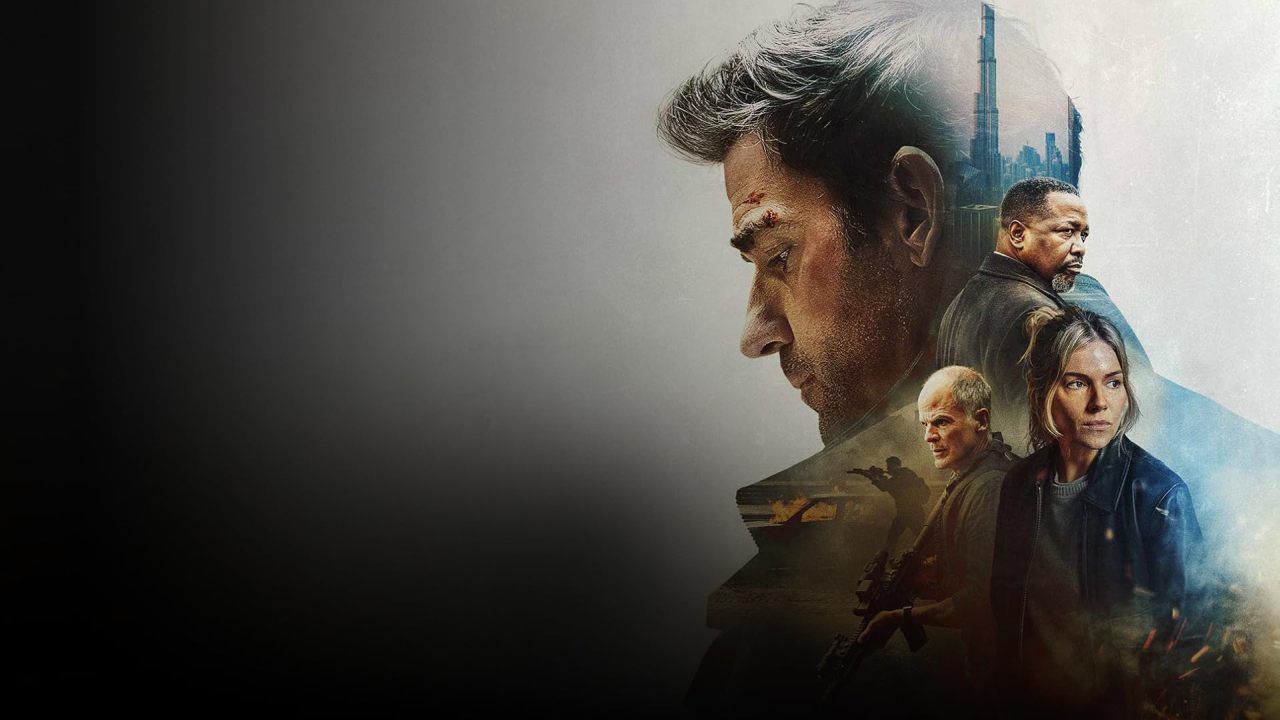
MOVIE REVIEW – Tom Clancy’s Jack Ryan: Ghost War tries to become a tense, globe-trotting political spy thriller as if someone at Prime Video had pulled an old Jack Ryan dossier from storage, dusted it off, and forgotten to fill in the field marked: excitement. John Krasinski returns as the CIA analyst turned action hero, but the film drags him through the usual circles of betrayal, conspiracy, Dubai, London, rogue agents, and saving the world with such indifference that Ryan sometimes really does feel like a ghost in his own story. The result is not a disaster in any spectacular sense, but something almost worse: a bland, bloodless, tired spy movie where even the patriotic posture slides down like lukewarm champagne on an ad-flavored Emirates flight.
Jack Ryan could be an interesting figure precisely because he is not supposed to radiate the sleek killer romance of the classic action spy. He is not James Bond, not Jason Bourne, not Ethan Hunt, but the intelligent, analytical, supposedly sober American institutional man who can function as the system’s conscience even when the system has already started eating itself. Alec Baldwin, Harrison Ford, Ben Affleck, Chris Pine, and John Krasinski have all pulled the character in different directions, but after Tom Clancy’s Jack Ryan: Ghost War, it is hard not to feel that the franchise’s own hero is standing in a corridor, staring at the signs, unsure which meeting room he is supposed to enter.
The film picks up after four seasons of the Prime Video series. Ryan has supposedly left the spy world behind and wants some civilian calm, maybe even a life where a person does not have to fly to Dubai or London after every second phone call while former superiors whisper ominously in half-lit offices. James Greer appears, however, with Wendell Pierce bringing some weight to the room as usual, and pulls Ryan back into another case that first looks like a missing contact and a routine intelligence headache, then naturally swells into a global conspiracy. In this world, a missing contact is never just a missing contact, but at least another secret network that everyone knew something about, while the viewer receives far too little reason to care.
The story is simple enough: Ryan has to work with Greer, Mike November, and MI6 officer Emma Marlow to unravel a dangerous operation tied to an old war shadow, a rogue black-ops circle, and a dose of information warfare. Written down like that, it could work. The problem is not that Tom Clancy’s Jack Ryan: Ghost War is too complicated, but that it wants to suggest a lot while making almost nothing truly tense. The film is full of people saying serious-sounding things with serious faces, while the scenes lack the paranoid pressure that should make every handshake, half-sentence, and opening door feel suspicious in a spy movie.
That is especially frustrating because the middle seasons of the series at least sometimes engaged with politics and state-level games, even if not always gracefully. The film instead retreats to meat-and-potatoes spy business: an old colleague has gone rogue, a hidden group wants to destabilize order through terror and misinformation, and Ryan has to save the day again. But the whole thing feels like safe franchise exercise. It is as if someone wrote on a board: “Jack Ryan returns, Greer must be saved, Sienna Miller needs a few scenes, and the ending should include a moral sentence about the CIA”, then simply went out and shot exactly that.

The Spy Movie Without Spy-Movie Nerves
Andrew Bernstein’s direction dutifully places the scenes on the table, but the film never starts breathing. Tom Clancy’s Jack Ryan: Ghost War looks like something one could switch on in the middle of a weekend afternoon binge of the series and only realize half an hour later that this is technically a feature film. There is Dubai, London, polished interiors, planes, office briefings, armed raids, and running through buildings, but there is no visual nervous system of its own. It is not dirty, not elegant, not brutal, not paranoid. It merely proceeds.
That would not be fatal if the film compensated with action or rhythm, but it never really finds a character there either. In the Mission: Impossible films, the stunt work can become drama by itself; in the better moments of the Bourne series, even the camera behaves as if it is having a panic attack; James Bond, even in weaker entries, can still do something with iconography. Jack Ryan joins none of them here. The fights, shootouts, and chases are competent industrial blocks, but there is not a single moment in them that anyone is likely to remember two days later.
The film’s biggest issue is not that it is poorly assembled, but that it contains no real decision. It does not dare to treat itself as a dry, realistic intelligence thriller, because it is too loud and too often reaches for action templates. It does not dare to become a grand blockbuster either, because it is too flat, too televisual, and too short on visual ideas. So it remains stuck in between, where every scene whispers: you have seen this before, only with different actors, better editing, and more blood pressure.
It is particularly striking how little the film does with its own “Ghost War” title. A ghost war could mean information warfare, shadow operations, invisible conflict, a spy game where nobody is what they seem. Instead, the film mostly states that the situation is complicated, then pushes Ryan into another straightforward action situation. Hiddenness never becomes tension, misinformation never becomes paranoia, and the secret war never becomes anything more than a moderately gray workday at the streaming action office.

John Krasinski Does Not Return as a Hero, He Clocks In
John Krasinski was always an interesting choice for Jack Ryan because his version of the character was built not on classic macho force, but on office intelligence, stubbornness, and a very American kind of good-guy faith. That often worked in the series, even as the character gradually became more of an action hero. In the film, however, Krasinski seems to be playing at a safe minimum. Ryan is tired, restrained, reluctant, but not in the compelling sense of a man genuinely wrestling with his past. More as if the actor himself knows this is one more franchise assignment to be checked off.
The screenplay tries to give him emotional emptiness: Ryan has no real civilian life, his previous relationship did not work out, the spy world keeps pulling him back, and even his friendships are basically operational relationships. On the level of premise, this could work, but the film never digs deep enough. Ryan is not truly lonely, not truly broken, not truly cynical, not truly angry. It is as if a strict corporate policy forbids the protagonist from becoming too interesting.
Sienna Miller, as Emma Marlow, gets a role that could have sparked something: an MI6 agent, professional, sharp, a potential counterweight and maybe a semi-romantic dynamic beside Ryan. The film handles that too flatly. Krasinski and Miller get a few scenes meant as flirtation, a few glances, some professional banter, but almost none of it registers. The problem is not that there is no grand romance, but that even the absence of one does not become character drama. Emma’s presence feels more like another box ticked on the international spy-film checklist.
Wendell Pierce and Michael Kelly at least bring familiar energy back. Greer has weight, Mike November has some dry humor, and at times one would rather watch their tired, sideways remarks than another of Ryan’s grim stares. But the film uses them as functions too: mentor, endangered friend, old comrade, mission-launching figure. The characters do not develop; they move through the plot like little icons dragged across a map.

The Patriotic Pose Comes With a Travel Brochure
One of the old defining traits of the Jack Ryan universe has always been its belief in American institutions. Ryan is the good guy even when something inside the CIA or Washington is rotting, because at the end of these stories there is supposedly still some moral America that can be cleaned up and reclaimed. Tom Clancy’s Jack Ryan: Ghost War tries to play with that too: near the end, Greer writes grand words about institutions, lies, decay, and infiltration. By then, however, the film has thrown so many empty location cards and ad-flavored luxury shots at us that the big moral idea feels more like a late-arriving corporate training sentence.
The first-class admiration aboard an Emirates flight, the shine of Dubai, and the self-congratulatory talk about security technology sit especially strangely in a franchise supposedly built around American intelligence ethos. This does not mean a spy movie cannot use spectacular cities or luxury settings. James Bond has been doing that for half a century. The problem is that here the locations do not provide character; they smell like brochures. At times, the film seems to pause between two action scenes just to politely remind us that these cities are beautiful, safe, and technologically advanced, so please consider booking.
That national-brand gloss is especially awkward because the story is supposedly about shadow espionage, hidden operations, and institutional lies. The two elements do not create productive tension; they cancel each other out. One moment, the film wants us to fear invisible networks, and the next it lights its locations as if we were flipping through a special issue of an airline magazine. The paranoia never gets enough darkness to function.
Greer’s final moral message therefore rings hollow. The idea that institutions crumble when the ideals they claim to defend are built on lies is not bad in itself. The film simply has not earned it. In a story that had truly dissected the self-deception of intelligence work, it might have landed. Here, it feels as if the script suddenly remembered at the last minute that a Jack Ryan movie should probably say something about America, then quickly pasted in a paragraph before the credits.
The Ghost War Is Missing Its Ghost
The greatest problem with Tom Clancy’s Jack Ryan: Ghost War is ultimately not one bad scene, one clumsy twist, or even Krasinski’s muted performance. The problem is that the film has no internal temperature. The plot moves, the characters travel, people disappear, others betray someone, guns go off, but all of it happens inside a surprisingly flat emotional and visual space. This is a spy movie where everyone behaves as if the stakes are enormous, while the film never makes us feel them for a second.
Ryan does not receive a strong new direction as a hero either. After the series, he could have become a tired institutional survivor, a disillusioned former spy, a civilian dragged back in, or even someone finally forced to confront how sick the system he served has become. Instead, he remains a decent but slightly empty figure who moves through the level, solves what needs solving, then steps back in front of the bigger moral lesson. This is not a character arc. It is administration.
The film is watchable, and that may be the most irritating thing about it. It is not bad enough to become entertaining through anger, and not inept enough to remain memorably ridiculous. It simply drains away. Tom Clancy’s Jack Ryan: Ghost War is a streaming action film that disguises lack of inspiration as competent craftsmanship, while by the end even its title character seems to slip out of it. Ryan has returned, in theory, but the film never explains why that should make anyone happy.
In a world where real wars, secret-deal accusations, intelligence scandals, and authoritarian displays of force keep dominating the news, a Jack Ryan film has room to say something about power, institutions, lies, and violence. This film instead delivers a safe, sterile, more-tired-than-average piece of spy-industry product. The 38% final score is not this low because every single element is offensively awful. It is this low because presenting so little life with so many serious faces is, by itself, a crime against the genre.
-Gergely Herpai “BadSector”-
Tom Clancy's Jack Ryan: Ghost War
Direction - 3.4
Actors - 4.3
Story - 3.1
Visuals/Music/Sounds/ - 3.9
Ambience - 4.3
3.8
BAD
Tom Clancy's Jack Ryan: Ghost War is not a spectacular collapse, but something perhaps worse: a sterile, bored, anonymous spy movie missing tension, political bite, and real character drama. John Krasinski stands through the scenes competently enough, but Jack Ryan this time feels more like a function than a person, while the supporting characters and locations mostly operate as templates. The 38% final score goes to a tired franchise exercise that talks about ghost war while having no ghost of its own.







![Power, Intrigue and Execution: How the Tudors Lost Their Heads Comes to National Geographic [VIDEO]](https://thegeek.games/wp-content/uploads/2026/08/noguchi-tudorok-official-1280x720-1-302x180.jpg)



![The JRPG Made by Final Fantasy and Dragon Ball Creators Got an unofficial PC port! [VIDEO]](https://thegeek.games/wp-content/uploads/2026/08/vnews-blue-dragon-reblue-300x365.jpg)
Leave a Reply