
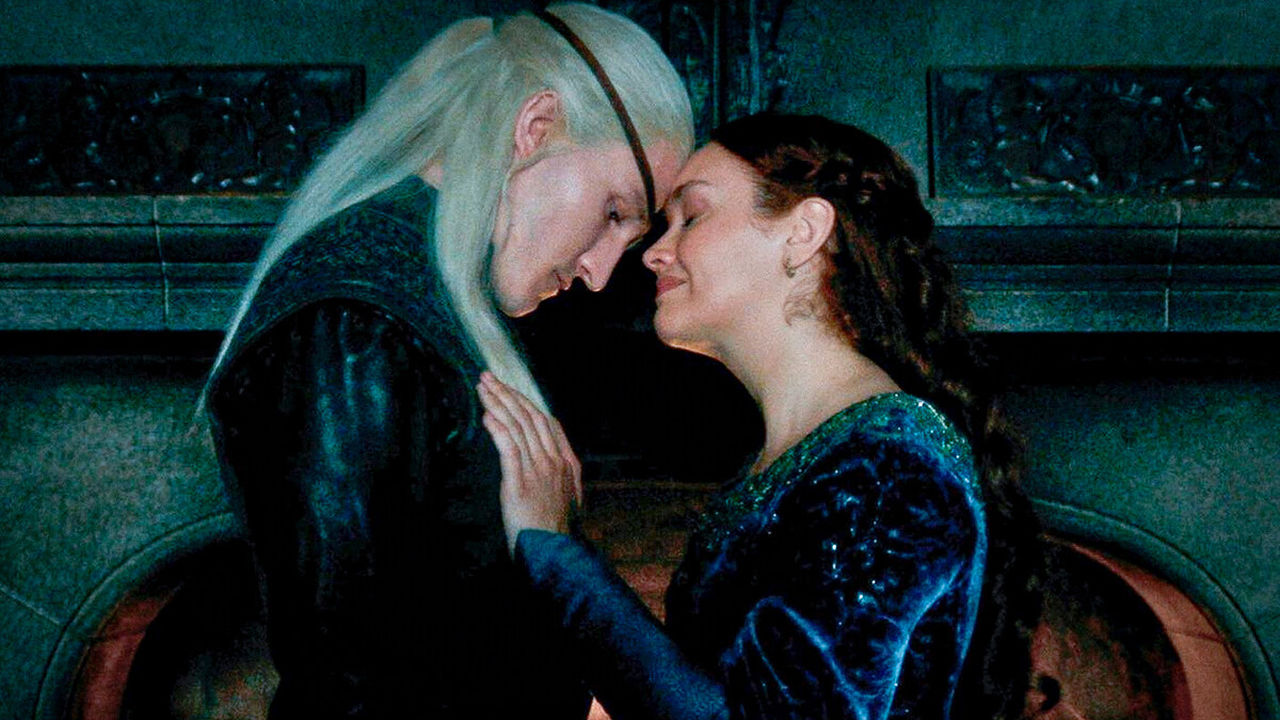
MOVIE NEWS – House of the Dragon did not open its third season with a spectacular battle, but with a disturbing and intensely uncomfortable family moment that immediately split the audience. Warning: the following article contains major spoilers for the new season’s first episode.
House of the Dragon has returned to HBO, and the Season 3 premiere has already created the kind of controversy that did not require dragons burning fleets or bloody betrayals inside King’s Landing. The episode’s biggest reaction did not come from the war tearing Westeros apart, but from an intimate, unsettling, and emotionally warped scene between Aemond Targaryen and Alicent Hightower.
The moment landed so heavily because the series crossed a line that feels different even within the Game of Thrones universe. Incest has never been unfamiliar territory for the Targaryens, but this time the scene involved a mother and her son. The shock was not simply that another boundary had been violated in this family. It was that the violation was framed as something painful, ugly, and psychologically broken rather than lurid or romantic.
A Kiss That Is Not Just a Kiss
The scene is built around a conversation between Aemond and Alicent. Alicent tries to convince her son to leave King’s Landing, appealing to his duty, his safety, and the possibility that doing so could prevent further destruction. Aemond, however, is not truly moved by the political argument. What hits him much more deeply is the emotional recognition he has spent his entire life seeking from his mother. When Alicent tells him that he should have been king, something inside him finally breaks through.
According to the actors and the creative team, the moment does not come from conventional romantic logic. It emerges from the way Aemond’s trauma and emotional deprivation have distorted his understanding of affection. He grew up with inconsistent maternal attention, while Alicent’s presence was shaped by political pressure, emotional distance, and constant conditions. As a result, Aemond cannot separate recognition, power, desire, and love in any healthy way. He experiences them as one tangled and deeply warped need.
Ewan Mitchell said the moment is also about Aemond trying to seize control of the family at last. “In Aemond’s head, it’s like he’s taking control of the family.” The actor admitted that the scene felt extreme when he first encountered it, but he also understood how Aemond and Alicent’s history could lead the character there. Alicent, meanwhile, does not reciprocate anything. Olivia Cooke described her reaction as shock and horror, because she understands that her son is no longer simply the wounded, rejected child she once tried to manage.
Fans React With Disgust, Shock, and Uncomfortable Fascination
Reactions on social media appeared almost immediately after the premiere. Many viewers called the moment between Aemond and Alicent one of the most uncomfortable scenes in the entire Game of Thrones franchise. Incest has always existed in this world – Rhaenyra married her uncle Daemon, while Aegon and Helaena are siblings who married each other – but a mother-son dynamic breaks a very different emotional and moral boundary.
The discomfort is not only rooted in what happens, but in how the series constructs it. Alicent is not part of a mutual secret affair. She is a mother in a politically and physically dangerous position, trying to reach an increasingly unpredictable son. Aemond, meanwhile, reads even the smallest sign of affection as permission, ownership, and emotional validation. The scene offers no safe distance for the audience. There is no liberating scandal in it, only suffocating confusion.
That is why viewers are both rejecting the choice and trying to understand it. Some see the scene as unnecessary excess, added only to make the series shocking again. Others see it as a logical, if profoundly disturbing, extension of Aemond’s emotional collapse. Instead of explaining his mental state through another monologue, the show presents a gesture so wrong that it immediately reveals how broken his inner world has become.
“The Child Who Is Not Embraced by His Village Will Burn It Down to Feel Its Warmth” – The Difference From the Book
One of the most significant aspects of the scene is that it does not exist in George R. R. Martin’s Fire & Blood. The relationship between Aemond and Alicent is complicated in the book, filled with political pressure, fear, and family tension, but it never reaches this kind of explicit emotional and physical extreme. The kiss is therefore one of the adaptation’s riskiest creative decisions, because it does not simply expand an existing thread. It moves both characters into new psychological territory.
The television version is clearly choosing to prioritize the story’s emotional side. The book functions as a historical chronicle, keeps its distance, leaves room for competing interpretations, and does not step into every character’s mind. The series, by contrast, wants to show what a toxic family environment, emotional neglect, political pressure, and an absence of unconditional love can actually do to people.
Aemond is no longer presented only as a cold and calculating warrior. He becomes someone endlessly desperate for his mother’s validation while being unable to receive or understand it in any normal way. Alicent, meanwhile, increasingly feels less like a straightforward queen mother playing political games and more like a woman whose own upbringing, fear, ambition, and forced role in life have made her incapable of giving her children genuine emotional security.
A Season Premiere That Proves Westeros Can Still Start a Fight
The opening of House of the Dragon Season 3 is a reminder of why this franchise can still generate such intense debate. It does not necessarily need spectacular battles to do it, although those are obviously coming. Its real engine remains human relationships pushed to extreme limits. The scene between Aemond and Alicent is not simply a controversial moment. It becomes the catalyst for a larger question about what power, trauma, and emotional hunger do to people who were never given anything resembling a normal family.
The scene also shows that the series’ creators are willing to move beyond the source material even when doing so will almost certainly anger part of the audience. Some viewers will see it as needless provocation, while others will see it as the ugly but consistent evolution of Aemond’s character. One thing is certain: House of the Dragon has already made people talk about more than who will win the war. It has made them talk about the emotional price paid by those still trapped inside it.
The first episode of House of the Dragon Season 3 is now available on HBO Max.
Source: 3DJuegos, Entertainment Weekly, People















Leave a Reply