
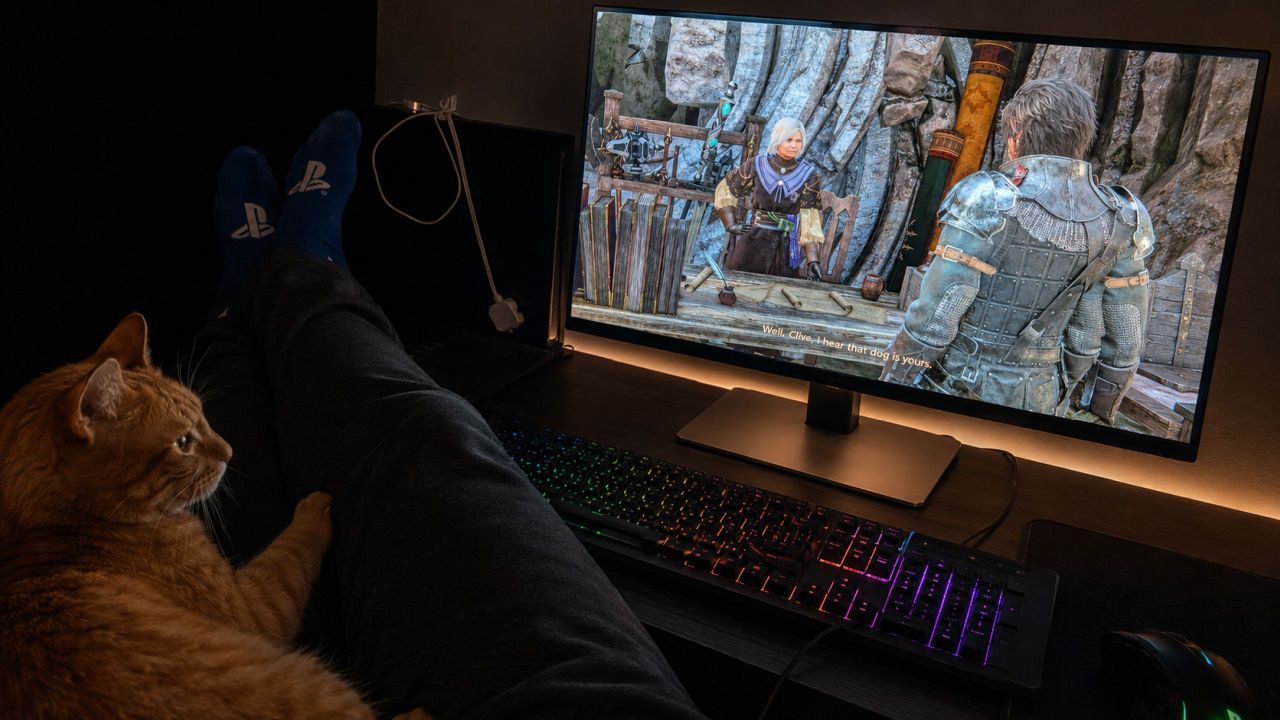
TECH REVIEW – The Samsung Odyssey OLED G8 G80SH does not rely on 4K and 240Hz alone to make its case. Behind its 32-inch QD-OLED panel sit DisplayPort 2.1 UHBR20, a Glare Free coating, HDR10+ Gaming, capable HDR hardware, and USB-C laptop connectivity. This is a premium display that becomes truly convincing with the right PC behind it, but it is designed to do more than simply impress competitive players.
The Samsung Odyssey OLED G8 G80SH looks straightforward at first: 32 inches, 3840 x 2160 resolution, a QD-OLED panel, 240Hz, and a 0.03ms GtG response time. That alone puts it near the top of the premium gaming monitor market, but Samsung has added more to the package. The G80SH offers DisplayHDR True Black 500, HDR10+ Gaming, AMD FreeSync Premium Pro and G-SYNC Compatible support, two HDMI 2.1 ports, DisplayPort 2.1 UHBR20, and USB-C-based laptop connectivity.
The important part of the name is genuinely G80SH. This is Samsung’s newer 32-inch OLED G8 model for the European market, not an older display with a similar name. The difference is not just a few letters on the box. The new monitor brings a stronger HDR certification, a more modern DisplayPort 2.1 connection, high bandwidth support, and a more deliberate approach to reflection handling.
The 32-inch 4K format remains one of the best compromises in premium gaming monitors. It is large enough to make games feel cinematic, but it does not force you to sit at the far end of your desk. With roughly 138 PPI, it also delivers more comfortable text clarity than a 27-inch 1440p OLED, while 4K detail remains valuable for games, movies, and everyday work.

32-Inch 4K Is No Longer a Halfway Solution
A 32-inch 16:9 4K display has become one of the most versatile gaming formats available. It is not as wide or desk-hungry as a 49-inch super ultrawide, but it offers a more cinematic and spacious experience than a 27-inch panel. The Samsung Odyssey OLED G8 G80SH feels especially well suited to this format because QD-OLED contrast and 4K detail reinforce one another rather than compete for attention.
In a dark, detail-heavy scene, the panel immediately shows why an average IPS or VA monitor cannot match OLED in the same way. Black pixels really switch off, while neon lights, lamps, explosions, and reflections rise from the background without bright halos around darker areas. That is especially effective in games such as Cyberpunk 2077, Alan Wake 2, Diablo IV, and Dead Space.
The panel does not only work for spectacular HDR titles. 4K resolution also improves distant scenery, small environmental details, and fine textures in open-world games. In a fast racing game or action title, that is not merely visual decoration. It becomes easier to read the environment, preserve detail, and keep the image from breaking apart during rapid movement.
QD-OLED and Glare Free: Strong Beyond a Dark Room
QD-OLED’s biggest advantage is its vivid, high-volume color. Reds, greens, and blues can look more saturated than on a typical WOLED display, while OLED’s classic strengths, deep blacks and near-infinite contrast, remain in place. Samsung pushes this further with DisplayHDR True Black 500 certification and high peak brightness capability.
The Glare Free coating matters here. Glossy OLED panels can look spectacular in a dark room but can become mirrors during the day. Samsung’s solution significantly reduces reflections from direct light sources and windows, making the G80SH more practical in brighter rooms. The more matte surface does not provide the same glass-like depth as a fully glossy OLED, but it is easier to live with in real conditions.
QD-OLED still is not magic. Strong ambient light can reduce perceived black depth, and dark areas may gain a faint purple character under difficult lighting. The newer coating improves that situation, but anyone placing the monitor directly opposite a sunlit window should still think about blinds, lighting control, and sensible desk placement.

240Hz: Your Hardware Decides How Much It Matters
A 240Hz refresh rate and OLED’s extremely fast pixel response form a serious combination. Motion stays clean, fast camera turns blur less, and mouse movement feels more direct. The 0.03ms GtG figure is a marketing-friendly number, but OLED’s real advantage is the lack of classic LCD smearing, overshoot, and overdrive tuning across different refresh rates.
4K at 240Hz is not a setting every game and every graphics card can realistically sustain. Even with an NVIDIA GeForce RTX 5090 or a flagship AMD GPU, modern AAA games may require DLSS, FSR, frame generation, or reduced settings to approach 240 frames per second. Competitive titles, older games, and well-optimized multiplayer releases are where the G80SH can clearly show why 240Hz is not wasted.
High refresh is not exclusively an esports benefit. Forza Horizon 5, DOOM: The Dark Ages, and fast-paced action games all feel smoother and more immediate. The jump from 120Hz to 240Hz is smaller than the leap from 60Hz to 120Hz, but on a panel this quick, it remains visible whenever the PC can deliver the required frame rate.
HDR and Color: Strong, but Not Without Trade-Offs
DisplayHDR True Black 500 suggests that the G80SH aims to provide a brighter, more impactful HDR image than earlier OLED monitors. QD-OLED is particularly strong in darker scenes: star fields, flashlight beams, metallic reflections, explosions, and bright interface elements can all look powerful without losing shadow detail.
Real HDR is not only about the highest nit figure. What matters more is how the monitor handles deep black, small bright highlights, midtones, and color at the same time. In that respect, the G80SH should sit among the best current 32-inch QD-OLED displays, particularly in games built with proper HDR mastering and carefully designed lighting.
The usual OLED compromise remains. A completely bright snowy landscape or sunlit desert will not feel as blindingly intense as it can on a powerful mini-LED display. Samsung wins back ground through black levels, contrast, and color intensity, areas where zone-based LCDs still cannot deliver the same clean separation.

DisplayPort 2.1, USB-C, and Console Use
One of the G80SH’s most important advantages is its DisplayPort 2.1 UHBR20 connection. The standard offers up to 80Gbps of bandwidth, meaning the right graphics card can drive 4K, 240Hz, 10-bit color, and variable refresh without the more serious compromises associated with earlier generations. Not every current PC can fully exploit that capability, but it makes the monitor more future-facing.
Two HDMI 2.1 ports also matter for console owners. A PlayStation 5 or Xbox Series X will not target 4K at 240Hz, of course, but 4K at 120Hz, VRR, and HDR are much better matches for a premium panel like this than an older DisplayPort-focused monitor. The 32-inch size is large enough for couch use while remaining comfortable on a desk.
USB-C connectivity and close to 100 watts of laptop charging broaden the display’s usefulness further. A powerful notebook can be connected with a single cable for work, and the same monitor can remain the center of a PC or console gaming setup in the evening. The G80SH does not become an office monitor because of that, but it is much more versatile than a display built only for esports.
Good for Work Too, but OLED Comes With Conditions
A 32-inch 4K panel is genuinely comfortable for work. Two large windows fit side by side, text looks clean, photos remain detailed, and video timelines or editing interfaces are easy to manage. The 240Hz refresh rate also makes standard desktop use feel smoother, especially while scrolling, moving windows, or using the mouse.
OLED does not love static images for extended periods. Fixed menus, spreadsheets, browser panels, and application windows left on screen all day can increase the risk of burn-in over the long term. Samsung’s pixel protection routines, screen movement, and refresh processes help, but they do not erase the technology’s natural limitation.
That makes the G80SH excellent for hybrid use, creative work, evening gaming, and media, but a strong IPS or mini-LED monitor remains the calmer option for ten-hour static office days. Anyone who genuinely games alongside work and does not leave the panel on the same static image for hours can manage the compromise well enough.
Price and European Market Position
Across continental Europe, the Samsung Odyssey OLED G8 G80SH is positioned as a premium display. The announced launch level is €1,199, although national availability and final pricing vary by country. That is a serious amount of money, but the combination of DisplayPort 2.1 UHBR20, higher HDR certification, Glare Free coating, 4K at 240Hz, and USB-C connectivity makes the package more future-facing than an ordinary high-refresh OLED.
At around €1,199, the G80SH does not look cheap, but it does not feel wildly overpriced either. It competes directly with other 32-inch 4K QD-OLED monitors, where a lower cost can mean weaker connectivity, lower HDR capability, or fewer practical extras. If regional pricing climbs much higher, value becomes harder to defend, especially against OLED rivals that are already heavily discounted.
This is a monitor for people who are not only looking for a beautiful screen today, but for a central display that can remain relevant for several years across a powerful PC, consoles, and occasionally a laptop. 4K at 240Hz remains demanding today, but the display itself should stay relevant longer than the first graphics card connected to it.
Verdict: 4K 240Hz Is Not Just a Number on the Box
The Samsung Odyssey OLED G8 G80SH is one of the most exciting new entries in the 32-inch 4K OLED gaming monitor category. Not because it invented QD-OLED or 240Hz, but because it combines them with strong connectivity, capable HDR, reflection control, and console-friendly features in a package that makes sense together.
The display’s biggest attraction is image quality. Deep blacks, strong color, rapid motion, and 4K detail combine into an experience that can make an average LCD monitor feel compromised very quickly. Glare Free is not magic, OLED burn-in risk does not disappear, and 4K at 240Hz requires a seriously powerful PC, but none of those points make the overall package less compelling.
As long as regional pricing stays close to its European launch position, the G80SH can become one of the best choices for anyone who wants 4K image quality, esports-level speed, HDR impact, console flexibility, and modern connectivity from a single display. This is not simply a fast OLED. It is a monitor your PC has to grow into.
-Herpai Gergely „BadSector”-
Pros:
+ Excellent 4K QD-OLED image with strong HDR and deep blacks
+ 240Hz, 0.03ms GtG, and DisplayPort 2.1 UHBR20 in a genuinely future-facing package
+ Glare Free coating, HDMI 2.1, and USB-C make it useful beyond PC gaming
Cons:
– Making full use of 4K at 240Hz requires an extremely powerful graphics card
– OLED burn-in remains a real factor during prolonged static work
– Its premium European launch price still puts it in an expensive category
Manufacturer: Samsung
Model: Odyssey OLED G8 G80SH
Category: 32-inch 4K QD-OLED gaming monitor
Release: 2026
Samsung Odyssey OLED G8 G80SH
Design - 9
Display - 9.6
For Gamers - 9.7
For Productivity - 8.4
Price/value - 8.5
9
EXCELLENT
The Samsung Odyssey OLED G8 G80SH has the potential to be one of the strongest premium 32-inch gaming monitors available. Its 4K QD-OLED panel, 240Hz refresh rate, rapid pixel response, DisplayHDR True Black 500 support, Glare Free coating, and DisplayPort 2.1 UHBR20 are not simply an attractive specification list, but a serious long-term gaming package. High pricing, OLED’s own limitations, and the enormous PC requirements of 4K at 240Hz prevent it from being a universal choice, but for players who can actually use it properly, few 16:9 displays will look this convincing.





![DLSS 5’s Neural Rendering Barely Works on a GeForce RTX 3080! [VIDEO]](https://thegeek.games/wp-content/uploads/2026/08/vnews-02-rtx3080-1280x720-1-302x180.png)






Leave a Reply