
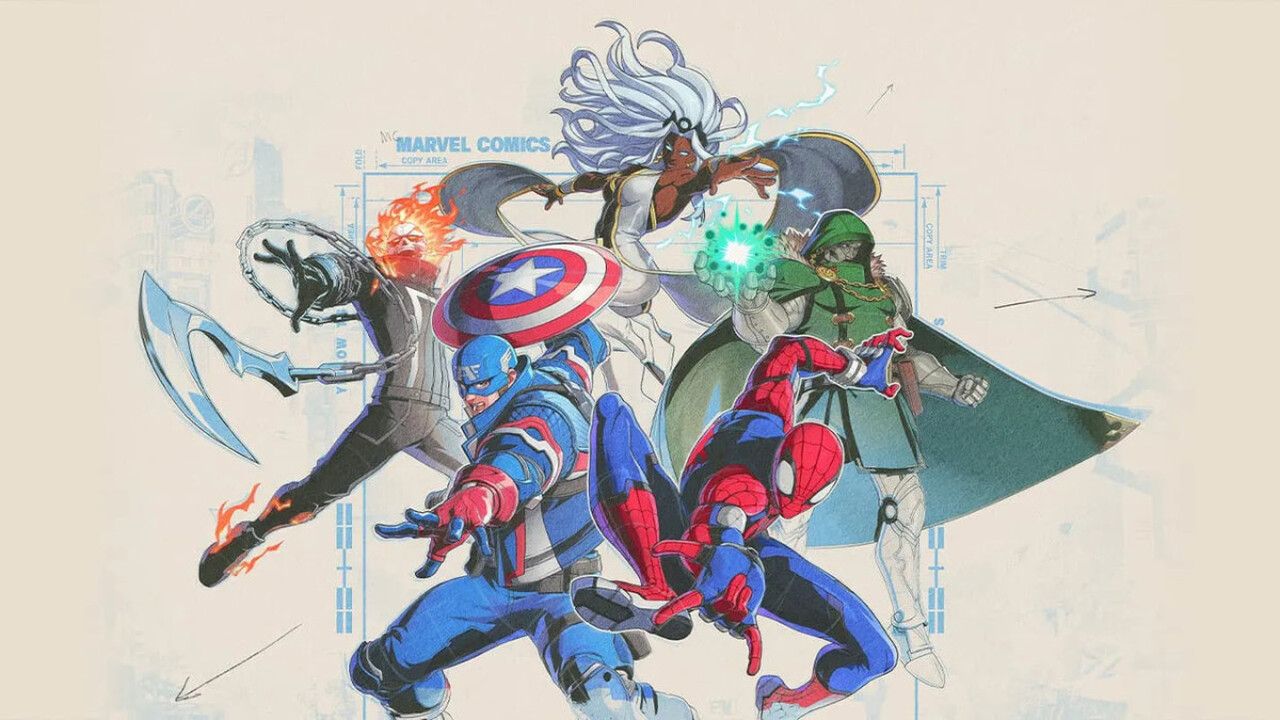
REVIEW – Marvel heroes and villains have spent decades beating each other senseless in video games, but Arc System Works has done much more than dress an old formula in expensive new costumes. MARVEL Tōkon: Fighting Souls combines four-character teams, outrageous anime-inspired presentation and a combat system that welcomes newcomers during the opening hour before quietly encouraging them to obsess over frame data, assist order and wall breaks. On PS5, it is an exceptionally complete fighting game that even remembers solo players exist; the troubled PC launch is the one substantial bruise on an otherwise outstanding package.
Marvel and fighting games have been together for a very long time. Even players who would mistake a quarter-circle-forward input for pizza instructions know the name Marvel vs. Capcom, while Arc System Works has already demonstrated through Dragon Ball FighterZ and Guilty Gear that it knows how to turn exaggerated comic and anime personalities into functional fighting-game characters. MARVEL Tōkon: Fighting Souls respects both histories without becoming another attempt to rebuild them.
Teams consist of four characters, but the entire squad is not immediately available at the start of every round. Additional members become accessible as the fight develops through specific actions and stage interactions, so a match genuinely changes as it progresses. This affects team construction far more than the number “4v4” might suggest. You are not simply selecting four favorite Marvel characters; you are considering assist properties, position, tagging opportunities and which fighter can naturally continue the pressure created by another.
The twenty-character launch roster also avoids the trap of producing twenty variations on the same basic toolset. Spider-Man’s mobility, Doctor Doom’s control, Carnage’s aggressive symbiote mechanics and Captain America’s more direct approach demand very different decisions. This is precisely where Arc System Works proves why it was chosen for the project: the characters are not merely recognizable, they possess playable personalities.

Four Fighters, One Health Bar
A 4v4 fighting game sounds dangerously close to visual noise: eight superheroes, several lasers and a collapsing city all competing for the same screen. In practice, the structure is much more disciplined. One fighter remains under direct control while teammates function through assists and tags, and the game carefully controls how much information players must process at once. Matches can become spectacularly chaotic, but they rarely become impossible to follow.
Light, medium and heavy attacks, special skills, Crossovers and cinematic supers make the first matches approachable without reducing the game to automatic combos. The deeper systems begin revealing themselves quickly. Assist positioning, team order, combo extensions, wall breaks and character-exclusive mechanics create a huge number of decisions beneath the colorful surface.
Carnage, for example, can apply Necrosis before using Parasite Bomb to create additional pressure, while other characters establish offense through completely different tools. Team building therefore becomes more interesting than simply opening a tier list and selecting the four names at the top. A supposedly weaker fighter may fit perfectly into a particular team because the assist or tag opportunity fills exactly the gap another character leaves open.
The greatest success is that four-character teams never feel like a marketing number. Every member can matter, and after several hours you stop learning four separate characters and begin learning one functioning team.

From Comic Panel to Knuckle Sandwich
Arc System Works’ visual language is almost impossible to mistake for anybody else’s. The studio continues using 3D models to create movement that frequently resembles hand-drawn animation, and Marvel characters benefit enormously from that approach. Iron Man’s Japanese-influenced armor, Doctor Doom’s theatrical presence, Spider-Man’s elasticity and Carnage’s constantly shifting body do more than look attractive. Their movement communicates how the developers understand each character.
Super moves give the artists permission to lose any remaining restraint. The camera dives in, backgrounds collapse and an unfortunate opponent spends several seconds trapped inside an extremely expensive Marvel anime before normal play resumes. It could easily have overwhelmed the actual fighting, but the game generally understands when presentation should take control and when it needs to return the match to the player.
Episode mode pushes the comic-book aesthetic even further. Five established teams receive their own stories after being invited by the Champion, an Elder of the Universe threatening Earth through a tournament that will determine the planet’s survival. Nobody should expect Shakespeare from the setup, but Kieron Gillen’s writing receives far more care than the usual fighting-game plot in which everybody misunderstands everybody else until violence conveniently solves the problem.
Fully voiced comic panels are illustrated by different comic and manga artists. Spider-Man sounds like Spider-Man, Doom retains exactly the amount of humility one expects from Doctor Doom, and the Champion is an actual deep-cut Marvel character rather than a generic game-exclusive villain invented to provide a final boss. Arc System Works did not merely receive access to the license. Somebody clearly read it.

A Training Room for Beginners and Maniacs
Fighting games have spent years advertising themselves as beginner-friendly before introducing terms such as frame advantage and input buffering halfway through the tutorial as though every player learned them in elementary school. MARVEL Tōkon makes a much more convincing attempt to teach the genre properly.
Training includes frame data, Replay Takeover, a detailed glossary and visual examples. Individual Action Checks explain each fighter, Combo Challenges extend that knowledge and Level-Up Missions go further by giving players restrictions and asking them to invent their own solutions. That final feature is particularly valuable because it teaches players to understand the system instead of simply reproducing a predetermined sequence of buttons.
The controls are not flawless. A large number of functions compete for a relatively limited input layout, and the buffer system can occasionally become too generous. Ironically, that can make strict combinations less reliable because the game accepts a command earlier than the player intended. Newcomers may benefit from the forgiveness; more precise players may find it irritating.
Even so, few fighting games provide this many built-in tools for learning without requiring players to spend their evening jumping between YouTube tutorials, Discord servers and community spreadsheets. A beginner can genuinely learn inside the game. A veteran can still find new things to study long after the basics have become automatic.

Rollback Works, PC Hits Back
The online foundations are strong. Rollback netcode provides the right technical base, Ranked and Casual playlists are available, and the stylized lobby is more usable than several of Arc System Works’ previous attempts. Avatars move through shared spaces, players can find matches and cosmetic rewards offer a little additional motivation. When two healthy systems meet, online matches are quick and stable.
The qualification matters because the PC launch has been rough. Players reported micro-stutters, unexpected frame drops, crashes and poor hardware utilization during the opening days. Those problems are especially serious in a fighting game. A small performance interruption that might be irritating in an action RPG can directly damage timing and online synchronization here.
The problem can also affect crossplay. If a PC player cannot maintain the locked 60 fps required during combat, rollback behavior and latency can become unpleasant for the PS5 opponent as well. Steam feedback turned Mixed quickly, and Arc System Works had already acknowledged PC performance problems during the beta. Patches and maintenance have since improved the experience for some configurations, but the launch remains part of the review.
The mandatory PlayStation Network account on PC adds another unnecessary obstacle, particularly in regions without official PSN availability. It is not a flaw in Doctor Doom’s moveset, but that distinction means very little to someone who cannot launch the game because of account policy.
There Is Life Beyond Ranked Matches
Players with little interest in being dismantled by strangers online have an unusual amount of content available. All-Star Arena is effectively a survival mode built around teams, checkpoints and bosses, providing a useful environment for becoming comfortable with a new lineup without somebody with ten thousand matches explaining the concept of humility.
Arcadia Rumble is stranger. Avatars move through a shared space, attack one another, gain levels, collect items and score points across three rounds through direct encounters and traditional matches. It is part party mode and part arcade experiment. It probably will not become the reason the community is still playing Tōkon five years from now, but it provides welcome variation.
The Gallery is also unusually worthwhile because the game has so much visual work worth preserving. Character concepts, illustrations and animation material demonstrate how extensively Marvel’s familiar designs were reinterpreted. The soundtrack is somewhat less consistent than the art direction, but impact sounds, supers and character effects deliver the weight the animation demands.
The most impressive achievement of MARVEL Tōkon: Fighting Souls is therefore not simply increasing the traditional tag-team number to four. Arc System Works has created a Marvel fighter that does not attempt to imitate Marvel vs. Capcom. It has its own mechanics, its own visual identity and its own pace. It remains approachable without becoming shallow, spectacular without hiding an empty system underneath, and surprisingly complete for solo players even though competitive multiplayer will obviously determine its long-term health.
On PS5, this is one of the strongest fighting games of the year. The PC version’s launch condition prevents the same recommendation from being completely unconditional across every platform. If Arc System Works continues improving the port, very little will remain to seriously criticize. Until then, PC players should check current patch feedback before allowing Doctor Doom and an expensive deluxe edition to seize control of their hardware.
-Gergely Herpai „BadSector”-
Developer: Arc System Works
Publisher: Sony Interactive Entertainment / PlayStation Publishing
Genre: 4v4 tag-team fighting game
Release: August 6, 2026 (PlayStation 5, PC)
Pros:
+ Spectacular, deep and unusually approachable 4v4 combat.
+ Outstanding anime-comic presentation and character animation.
+ Exceptional training tools and far more solo content than the genre usually offers.
Cons:
– The PC version launched with serious performance problems.
– Input buffering and button layout can occasionally become unnecessarily messy.
– Not every secondary mode has the same lasting appeal.
MARVEL Tōkon: Fighting Souls
Gameplay - 8.6
Graphics - 8.8
Story - 7.6
Music/audio - 8
Ambience - 8.3
8.3
EXCELLENT
MARVEL Tōkon: Fighting Souls is finally a Marvel game whose license is not the main reason to care about it. Its four-character teams, superb training tools, Episode stories and Arc System Works’ extraordinary visual design create an excellent fighting game beneath the superhero spectacle. It is an easy recommendation on PS5; on PC, the same enthusiasm should wait until the technical fixes fully catch up with the quality of everything else.




![Stranded Deep 2: After Two Years, We Finally Get to See More of It! [VIDEO]](https://thegeek.games/wp-content/uploads/2026/09/Stranded-Deep-2-1280x720-1-302x180.jpg)
![Sony Is Following the Same Path Xbox Took in 2013! [VIDEO]](https://thegeek.games/wp-content/uploads/2026/09/Live-TV-on-PS5-1280x720-exact-302x180.png)






Leave a Reply