
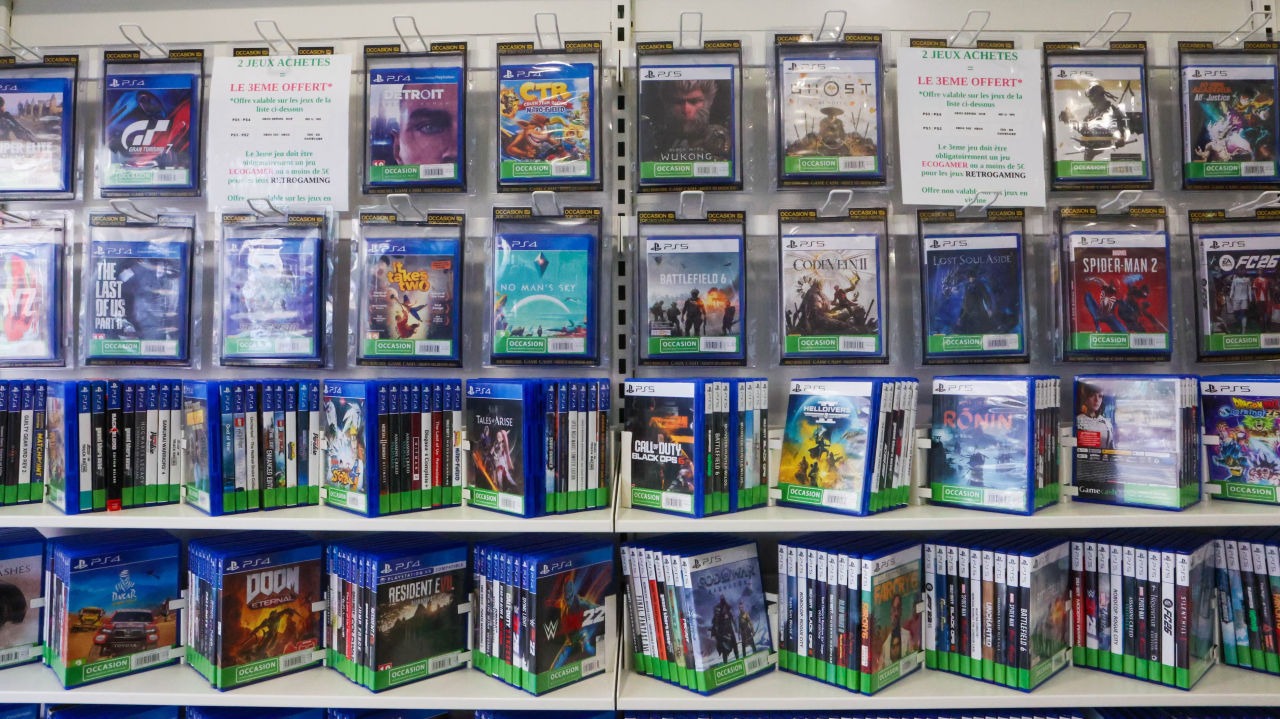
Sony’s push toward an all-digital future would affect far more than collectors and players who prefer boxed releases. Industry analysts warn that it could dismantle a used-game economy currently valued at $7.2 billion while leaving PlayStation customers with fewer ways to buy, sell and retain control over their games.
The consequences of removing discs from the PlayStation ecosystem extend well beyond the design of Sony’s next console. Physical games support an entire chain of activity involving independent retailers, trade-in programmes, private sales and buyers who rely on second-hand copies to keep the hobby affordable. Once every purchase is tied to a digital account, most of that economy can no longer function in its current form.
Research firm Dataintelo valued the worldwide pre-owned video game market at $7.2 billion in 2025. Its figures also suggested that used products were involved in more than 38 percent of gaming-related transactions in the United States. That level of activity points to a deeply established consumer habit rather than a declining niche kept alive only by collectors.
Before Sony’s digital strategy cast doubt on the sector’s future, Dataintelo expected the market to expand to approximately $13.8 billion by 2034. Demand for less expensive games was one of the projected drivers, alongside growing interest in reuse and sustainability among millennial and Generation Z consumers. A console ecosystem without transferable physical products would remove the foundation on which much of that expected growth depended.
The Pre-Owned Market May Shrink Until Nothing Is Left
CNBC highlighted the Dataintelo findings while examining what the transition could mean for retailers and consumers. Morningstar analyst Kazunori Ito described Sony’s position as deeply ironic. In 2013, PlayStation famously mocked Microsoft’s original Xbox One policies with a video demonstrating how simple it was to share a game: one person handed a disc to another. The freedom celebrated in that campaign is now precisely what a digital-only strategy would eliminate.
Michael Futter, co-founder of consultancy F-Squared, offered an even harsher assessment, calling the move “an extremely anti-consumer decision.” He also rejected attempts to present the change as the console equivalent of the PC market’s gradual embrace of digital distribution. PC players can choose between Steam, GOG, the Epic Games Store and several other sellers, all of which must compete through pricing, promotions and customer service.
PlayStation owners would not have the same protection. Without physical retailers or used copies, the PS Store would become the only authorised marketplace for the platform. Sony could determine the available prices and discounts without competition from second-hand sellers, while customers would lose the ability to recover part of a game’s cost by selling it after completion.
Brick-and-mortar stores would absorb much of the immediate damage. Trade-ins and pre-owned sales remain valuable because the same copy can generate revenue several times as it moves between customers. Ito expects that business to contract steadily and eventually disappear if PlayStation fully abandons discs. Sony receives no share of those resale transactions, whereas a digital-only system directs every new purchase through its own storefront.
The dispute is therefore not simply about nostalgia for cases, shelves and physical collections. It concerns a multibillion-dollar market, the survival of specialist retailers and whether players retain any practical control over products they have paid for. Sony may be able to push its audience toward the PS Store, but the success of that strategy will ultimately depend on whether customers accept the loss of choice or respond by taking their money elsewhere.
Source: 3DJuegos



![Monster Hunter Wilds: Ascendance’s Daily Boosted Action Overviews Have Begun [VIDEO]](https://thegeek.games/wp-content/uploads/2026/09/bca47e7d475d4cc4-302x180.jpg)
![Lost Museum: Echoes of the Chromageists: Adventures in the Lost Museum [VIDEO]](https://thegeek.games/wp-content/uploads/2026/09/1c2bd0af3f56a59c-1-302x180.jpg)







![Monster Hunter Wilds: Ascendance’s Daily Boosted Action Overviews Have Begun [VIDEO]](https://thegeek.games/wp-content/uploads/2026/09/bca47e7d475d4cc4-300x365.jpg)
![Lost Museum: Echoes of the Chromageists: Adventures in the Lost Museum [VIDEO]](https://thegeek.games/wp-content/uploads/2026/09/1c2bd0af3f56a59c-1-300x365.jpg)
Leave a Reply