
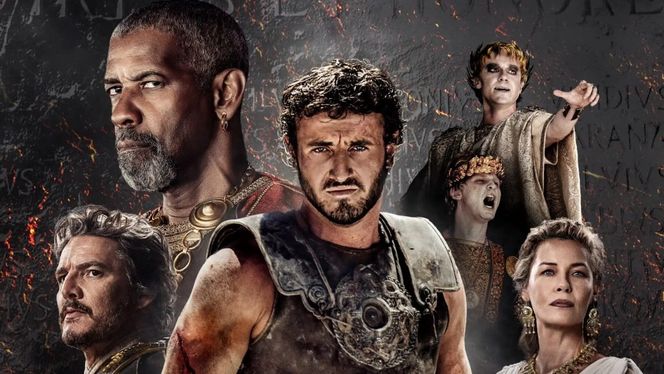
MOVIE NEWS – Ridley Scott’s ambitious sequel is set in the world of the ancient Roman Empire, yet the crew was unable to shoot in the Italian capital. Rome’s available filming locations had already been secured by Roland Emmerich’s Anthony Hopkins-led series, Those About to Die.
Ridley Scott’s Gladiator II is entirely centred on Rome. The film first introduces General Acacius, one of the empire’s most celebrated military commanders, as he sets out to conquer Numidia. As expected, he emerges victorious from the campaign. His men return with several slaves, including Lucius, the long-lost son of Maximus.
Lucius begins his new life as a fighter working for Macrinus, an arms dealer who also owns a gladiator school, and it is only a matter of time before the two men turn against each other. The scheming Macrinus wants the throne for himself, while Lucius intends to reclaim his rightful place in the empire. Which of them will ultimately emerge victorious?
Given the film’s detailed focus on ancient Rome, fans could reasonably assume that it was shot there, but that was not the case at all. It was not for lack of trying. Paul Mescal, Denzel Washington and Pedro Pascal might have worked on the same ground once walked by the Romans had it not been for a television series starring Anthony Hopkins. Peacock’s sword-and-sandal production, Those About to Die, disrupted Ridley Scott’s plans for Gladiator II.
Anthony Hopkins Plays the Founder of the Flavian Dynasty in Those About to Die
Peacock premiered Those About to Die in July 2024, with the series based on Daniel P. Mannix’s book of the same name. The book also influenced the story of the first Gladiator. Its title refers to the Latin salute traditionally attributed to gladiators addressing the emperor during the games: “Ave Caesar, morituri te salutant,” meaning, “Hail, Caesar, those who are about to die salute you.”
Anthony Hopkins portrays the ageing Emperor Vespasian, who rose to power as the final and most capable ruler of the chaotic Year of the Four Emperors. As in the historical record, he governs Rome alongside his sons, Titus and Domitian. The story is set in 79 AD, when Vespasian decides that the best way to secure his legacy is to build the Flavian Amphitheatre, later known as the Colosseum, and orders its construction.
Historians regard the real Vespasian as one of Rome’s most significant emperors. He founded the Flavian dynasty after the Julio-Claudian dynasty, creating the second imperial house to rule the Roman Empire, which remained in power for 27 years. At a time when the throne frequently changed hands, Vespasian ruled for a decade. His financial reforms and political measures created stability while launching a major wave of construction.
In another strand of the series, the gambler Tenax attempts to climb the empire’s social hierarchy by building a formidable Circus Maximus racing team with the help of Scorpus, a gifted charioteer. Meanwhile, Cala travels to Rome to free her enslaved daughters, Aura and Jula, while also trying to prevent her son Kwame from entering the gladiatorial games because she fears he will be killed.
Roland Emmerich Took the Opportunity to Film in Rome Away From Ridley Scott
Behind the production of Gladiator II and Those About to Die, a confrontation resembling a gladiatorial contest was also taking place. The two similarly themed productions were filmed during the same period, but Peacock’s series secured the opportunity to shoot in Rome before Scott could do so. How did it manage that? The show was directed by an equally prominent filmmaker, Roland Emmerich, widely known as the “master of disaster movies.”
Emmerich built his reputation during the 1990s with large-scale science-fiction films such as Independence Day, Godzilla, Stargate and Universal Soldier. The director commands considerable authority in Hollywood, allowing him to compete with Ridley Scott for access to Rome’s filming resources.
Empire asked both Emmerich and the series’ lead writer, Robert Rodat, about the matter, and both confirmed the reports. Although Emmerich won the battle for the locations, he stressed that he held Scott in extremely high regard, particularly because Scott had managed to continue a story that had appeared completely finished. “I’m honestly fascinated by how he managed to continue that story. Maximus was dead!”
Rodat also revealed that Scott had been disappointed at losing the opportunity to film in Rome. The writer was nevertheless polite enough to apologise. “There is only a limited amount of suitable filmmaking infrastructure available in Rome, and I understand he was disappointed that he could not shoot there. So I apologise!”
It was an elegant gesture, although it did not change Scott’s situation. After missing out on Rome, he selected Morocco, Malta and the United Kingdom as the film’s shooting locations. Fortunately, all three proved to be excellent alternatives.
Gladiator II Still Delivered Excellent Entertainment for Fans
Rome has changed considerably over the centuries, but it still would have been wonderful to see the city’s authentic landmarks in the film. The forced change did not diminish the quality of the production. Gladiator II remains excellent, and in some respects its cast is even stronger than that of the first film.
Denzel Washington is superb as the calculating gladiator owner who relies primarily on his intelligence rather than a sword. The actor, who was 69 at the time, brings his distinctive personality to the role perfectly. He delivers one of the finest villainous performances of his career, once again evoking the magic of Training Day.
Paul Mescal is equally impressive as Lucius, the gladiator who evolves from Macrinus’ employee into his rival. He radiates confidence despite never previously having appeared in a film of this scale or budget. Viewers inevitably sympathise with Lucius and wonder whether he will ever discover the freedom and self-expression taken for granted in the modern world. Pedro Pascal gives General Acacius a distinctive personality, successfully separating him from the many other characters the actor has portrayed in recent years.
Ridley Scott’s multicamera filming technique, combined with computer-generated effects, makes the action feel breathtakingly real. Together, these elements create a substantial and emotionally affecting Roman story that casts a harsh light on the greed and betrayal of the era.
Unfortunately, the same cannot be said of Those About to Die. The series often appears to use its spectacular setting as an excuse to introduce far more scenes and ideas than it can shape into a coherent story. Although the production received the perfect playground it needed, it failed to use it effectively.
The series received mixed reviews from audiences and critics alike. It holds a user rating above six on IMDb, while 46 per cent of Rotten Tomatoes critics gave it a positive review. Most criticism focused on the production’s overcrowded narrative, which left insufficient room to develop the individual characters properly, as well as its excessive emphasis on bloody scenes.
Two years later, the verdict can be regarded as final: although Robert Rodat and Emmerich originally envisioned the story as a trilogy, the series was not renewed. Executive producer Stuart Ford acknowledged in 2026 that a second season would “probably not” happen. In the end, Ridley Scott proved to be the worthier emperor after all.
Source: MovieWeb





![The System Requirements for Fable Are In! [VIDEO]](https://thegeek.games/wp-content/uploads/2026/08/vnews-05-fable-1280x720-1-302x180.png)


Leave a Reply