
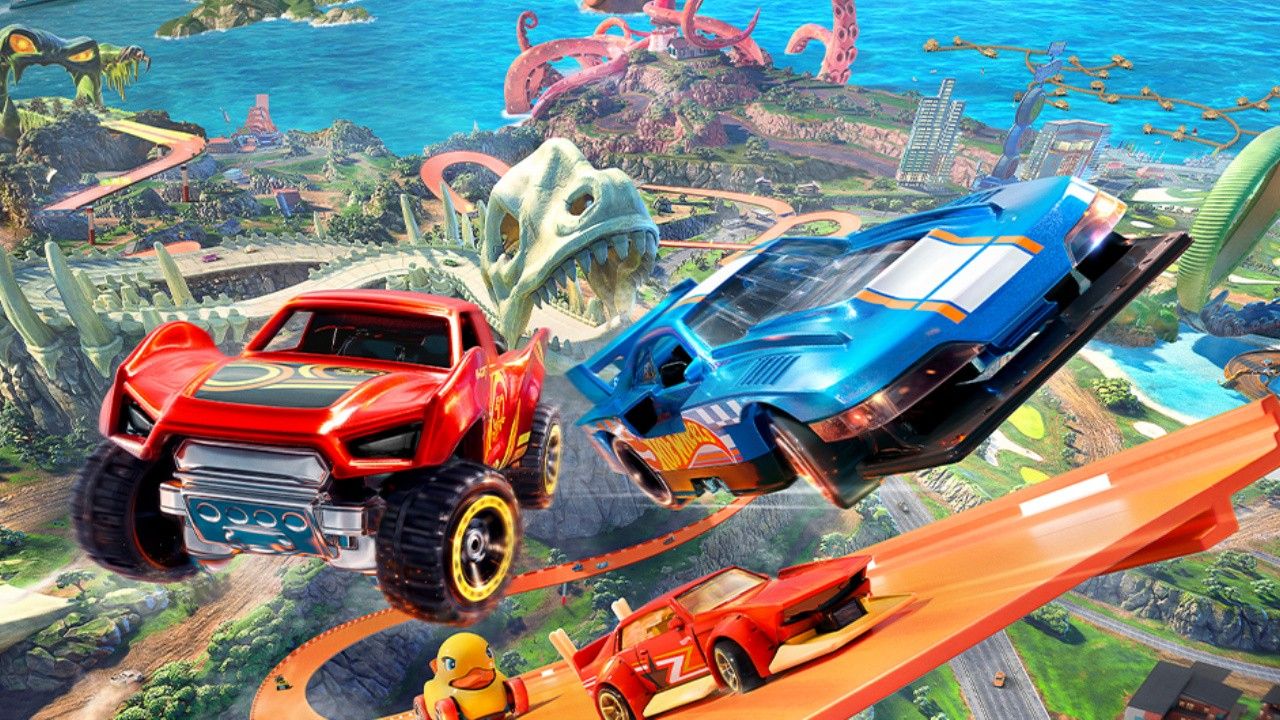
REVIEW – The two Hot Wheels Unleashed games already proved that Mattel’s little die-cast cars can fuel an arcade racer that does not require you to be ten years old to still be grinning after a couple of races. Hot Wheels Infinite Rush is no longer satisfied with orange tracks, loops, and oversized living rooms, however: this time Milestone unleashes its miniature monsters across four free-roaming areas, while making little effort to hide the homework it has done on Forza Horizon and Burnout Paradise. The result is colorful, fast, ridiculously easy to enjoy, and occasionally dangerous in the classic “just one more race” sense. Greater freedom comes at a price, though, because Infinite Rush occasionally dilutes the concentrated toy-car insanity that made Unleashed so immediately lovable.
Hot Wheels has a long videogame history filled with titles where the license itself was considerably more exciting than what actually happened on screen, but Milestone finally understood the assignment in 2021. There was no need to turn tiny plastic cars into serious driving simulators, and there was equally little reason to pretend the audience consisted exclusively of elementary-school kids. The Unleashed games were fast, spectacular, and technically demanding enough to give adult arcade racing fans something to sink their teeth into. Infinite Rush does not throw that foundation away; it simply removes the walls of the living room.
The first area, Wheelswood, immediately makes it clear that Milestone wants a much bigger playground this time. Instead of selecting one track after another from a menu, you drive, explore, stumble across photo opportunities, speed challenges, destruction tasks, events, and naturally enough collectibles to keep anyone with completionist tendencies permanently distracted. Progress is not completely unrestricted: completing enough events unlocks the local Rush Master showdown, and defeating that rival opens access to the next island. The four worlds do not form one seamless continental map, but each has enough visual identity for unlocking the next one to feel like moving into a new chapter rather than merely loading a different backdrop.

From the Living Room to Four Islands
There is little point pretending the Forza Horizon influence is subtle. Infinite Rush fills its maps with events and bite-sized activities, throws spontaneous challenges at you while you are driving, constantly dangles new cars in front of you, and repeatedly causes you to abandon the event you originally marked because something shinier has appeared off to the side. Thankfully, Milestone has not simply pasted Hot Wheels branding onto a more realistic festival racer. Giant objects, ludicrous track pieces, and toy-car logic still dominate the presentation, allowing the game to retain its own identity even when its structure is borrowing heavily from genre giants.
The event selection has enough variety as well. Traditional races sit alongside time attacks, drift challenges, elimination events, waypoint races, and destruction-based competitions, while Daredevil encounters fit the Hot Wheels fantasy particularly well. These have you chasing a rival already speeding through the open world, challenging them to an impromptu race, and adding their vehicle to your collection if you win. It is the sort of mechanic that sounds minor in a feature list but works beautifully in practice because it always provides one more reason not to turn the game off just yet.
Less elegant is the fact that failing one of those Daredevil encounters does not offer an immediate restart. You simply have to wait for another opportunity, an oddly rigid decision in a game otherwise built around relaxed free-roaming freedom. Navigation can also become unnecessarily vague during certain events, occasionally failing to communicate the intended direction as clearly or as quickly as it should. These are minor problems in isolation, but in a game built around uninterrupted momentum, every moment where the interface effectively reaches for the handbrake becomes especially noticeable.

Unleashed Handling, Finally Let Off the Leash
The most important good news is that driving still feels excellent. Veterans of Unleashed will be at home almost immediately: high speed, aggressive drifting, constant boost management, and the same approachable arcade physics remain intact. The handling is predictable enough to learn properly without becoming so sterile that every vehicle feels like a plastic brick running on invisible rails. The more open environments do meaningfully change the experience, though. You are no longer trapped on a narrow track at all times, which grants greater freedom while simultaneously creating many more opportunities to make extremely stupid decisions at extremely high speed.
Drifting remains crucial, and the game quickly teaches you that maintaining momentum through a corner often matters more than using the brake like a responsible driver. Boost is not merely a visual effect either; it is fundamental to keeping the rhythm alive, so the best races develop a satisfying cycle of sliding, accelerating, jumping, correcting, and accelerating again. This is not simulation racing, and thankfully it has no interest in pretending otherwise. Hot Wheels works best when its relationship with the laws of physics can politely be described as “advisory.”
The four vehicle classes – Speeders, Drifters, Versatiles, and Titans – are designed to offer different handling personalities, and you can quickly switch between four selected vehicles while exploring. The differences are noticeable, although not every class feels equally essential. Titans, for example, are positioned as heavy demolition specialists, yet when most other vehicles can already smash through a surprising amount of scenery, their special advantage loses some of its impact. Upgrade slots and stat modifications provide a degree of fine-tuning, but fortunately Infinite Rush never tries to transform a toy-car collection into an RPG spreadsheet.

More Than 150 Cars, and Somehow You Still Need One More
Collecting is obviously one of the strongest engines driving the entire game. More than 150 vehicles are available, ranging from Hot Wheels versions of recognizable real-world favorites to the brand’s most absurd fantasy designs, meaning a Mitsubishi Lancer can comfortably share garage space with something shaped like a lucky cat without anyone questioning it. That visual nonsense is exactly what this license needs. The cars also continue to look superb, with convincing plastic, painted metal, and miniature detailing that occasionally make you expect an enormous child’s hand to descend from the corner of the screen and pick one up.
They are earned in enough different ways to keep the garage from turning into a sterile shopping catalogue. Events, exploration, challenges, and roaming rivals all feed back into the collection, so acquiring new cars remains connected to actually playing rather than simply purchasing icons from a list. The game also understands the psychology of “one more thing” with alarming efficiency. A nearby activity, another vehicle, or one missing collectible routinely provides enough justification to turn an intended twenty-minute session into something considerably longer.
The Track Builder returns too, and in the long term it may prove more important than the campaign itself. Community-created tracks inevitably depend on how active the player base remains, but building your own ridiculous layout in a Hot Wheels game is hardly some disposable side feature; it is practically one of the core fantasies of the brand. Offline and online racing options round out the package alongside local split-screen play. Full crossplay is available across most supported platforms, although Nintendo Switch 2 is excluded from the cross-platform pool.

The Blessing and Curse of the Open World
The central question is whether Hot Wheels is genuinely better for moving into an open world. In the short term, the answer is clearly yes. It is enjoyable to simply pick a direction, head down a side road, grab a few collectibles, and accidentally fall into another challenge rather than constantly bouncing back through menus. The four maps are large enough to encourage detours, and that freedom suits the childhood logic behind Hot Wheels perfectly: of course the car does not stop when the orange track ends, because in your imagination it keeps going across the table, the sofa, the garden, and preferably halfway down the street.
Over longer sessions, however, the familiar open-world disease begins to appear: more content does not automatically mean more variety. By the time all four islands have been explored thoroughly, photography tasks, drifting, destruction events, collectibles, and smaller challenges begin repeating familiar ideas rather than consistently introducing new ones. This is where the concentrated structure of Unleashed reveals one of its old strengths. Every track there could function like a carefully constructed toy-car attraction; a larger open world inevitably requires more connective tissue and more activities designed to fill space.
That repetition is also the third meaningful weakness worth placing beside the two more obvious mechanical irritations. Infinite Rush is certainly not empty – there is plenty to do – but the activities are not always as distinct from one another as the sheer number of map icons might suggest. Players accustomed to the almost absurd quantity of content in Forza Horizon will inevitably find this a smaller and simpler experience. Anyone who merely wanted the Unleashed handling model transplanted into a freer Hot Wheels playground is far less likely to care.
It Is Not Forza Horizon, and It Does Not Need to Be
The greatest strength of Hot Wheels Infinite Rush is that despite its obvious inspirations, it never settles for becoming a discount Forza Horizon. It is smaller, sillier, more immediate, and considerably less interested in the engine under the hood than in how spectacularly a car can boost through a giant loop while upside down. That is exactly the right priority. Milestone understands that the power of this license does not come from the number of realistic cars in the garage, but from a world where a supercar, a fantasy machine, and a completely idiotic object on wheels can share the same starting grid without looking remotely out of place.
Not every change works perfectly. The open world occasionally weakens the tighter track design of the earlier games, side activities begin repeating themselves, the inability to restart Daredevil encounters makes little sense, and navigation sometimes realizes what it should be doing a fraction too late. None of those issues ruins what matters most, though: the cars remain great to control, the sense of speed is strong, collecting is dangerously addictive, and the world almost constantly provides another excuse to keep the controller in your hands.
Infinite Rush therefore feels less like a replacement for Unleashed and more like a relative heading in a different direction. Players who loved the precisely constructed, ridiculous plastic tracks above everything else may miss the more concentrated structure of the earlier games. Those who kept wondering what Hot Wheels might look like if it escaped the living room and received its own miniature Forza Horizon, on the other hand, now essentially have their answer. It is not flawless, but it is fast, colorful, and exactly as unserious as a Hot Wheels game ought to be.
-Gergely Herpai „BadSector”-
Pros:
+ Excellent arcade handling, drifting, and boost mechanics
+ Four sizable areas and more than 150 collectible vehicles
+ Accessible, spectacular, and dangerously addictive racing
Cons:
– Daredevil events cannot be immediately restarted
– Navigation can be vague or slow to react during certain races
– Open-world side activities become repetitive over time
Publisher: Milestone S.r.l.
Developer: Milestone S.r.l.
Genre: Open-world arcade racing
Release: September 10, 2026
Hot Wheels Infinite Rush
Gameplay - 8.2
Graphics - 8.4
Physics - 8.1
Music/audio - 7.5
Ambience - 8
8
EXCELLENT
Hot Wheels Infinite Rush successfully transfers the fast, drift-heavy arcade racing of Unleashed into a freer world built around four large areas. More than 150 cars, varied events, and an addictive collection loop can consume hours, even if some open-world activities eventually begin repeating themselves. This is not a toy-car copy of Forza Horizon, but a lighter and crazier Hot Wheels interpretation of the same basic idea.










Leave a Reply